Monthly Archives: May 2013

Do High Insulin Levels Cause Memory Loss and Dementia?

dementia, memory loss, Mediterranean diet, low-carb diet, glycemic index, dementia memory loss

Don’t wait to take action until it’s too late

Insulin resistance and high blood insulin levels promote age-related degeneration of the brain, leading to memory loss and dementia according to Robert Krikorian, Ph.D. He’s a professor in the Department of Psychiatry and Behavioral Neuroscience, University of Cincinnati Academic Health Center.  He has an article in a recent issue of Current Psychiatry – Online.

Proper insulin signaling in the brain is important for healthy functioning of our brains’ memory centers.  This signaling breaks down in the setting of insulin resistance and the associated high insulin levels.  Dr. Krikorian makes much of the fact that high insulin levels and insulin resistance are closely tied to obesity.  He writes that:

Waist circumference of ≥100 cm (39 inches) is a sensitive, specific, and independent predictor of hyperinsulinemia for men and women and a stronger predictor than body mass index, waist-to-hip ratio, and other measures of body fat.

Take-Home Points

Dr. Krikorian thinks that dietary approaches to the prevention of dementia are effective yet underutilized.  He mentions reduction of insulin levels by restricting calories or a ketogenic diet: they’ve been linked with improved memory in middle-aged and older adults. His theory is also consistent with the commonly seen association of type 2 diabetes with dementia: overweight and obese type 2’s quite often have high insulin levels, at least in the early years.

Dr. K suggests the following measures to prevent dementia and memory loss:

  • eliminate high-glycemic foods like processed carbohydrates and sweets
  • replace high-glycemic foods with fruits and vegetables (the higher polyphenol intake may help by itself)
  • certain polyphenols, such as those found in berries, may be particularly helpful in improving brain metabolic function
  • keep your waist size under 39 inches (99 cm), or aim for that if you’re higher and overweight

Nearly all popular versions of the paleo diet would qualify as being low glycemic index.

I must mention that many dementia experts, probably most, are not as confident  as Dr. Krikorian that these dietary changes are effective.  I think they are, to a degree.

The Mediterranean diet is high in fruits and vegetables and relatively low-glycemic.  It’s usually mentioned by experts as the diet that may prevent dementia and slow its progression.

Read the full article.

I’ve written before about how blood sugars in the upper normal range are linked to brain degeneration.  Dr. Krikorian’s recommendations would tend to keep blood sugar levels in the lower end of the normal range.

Steve Parker, M.D.

PS: Speaking of dementia and ketogenic, have you ever heard of the Ketogenic Mediterranean Diet?  (Free condensed version here.)
“It Is the Soldier”: A U.S. Memorial Day Poem

It is the Soldier, not the minister

Who has given us freedom of religion.

It is the Soldier, not the reporter

Who has given us freedom of the press.

It is the Soldier, not the poet

Who has given us freedom of speech.

It is the Soldier, not the campus organizer

Who has given us freedom to protest.

It is the Soldier, not the lawyer

Who has given us the right to a fair trial.

It is the Soldier, not the politician

Who has given us the right to vote.

It is the Soldier who salutes the flag,

Who serves beneath the flag,

And whose coffin is draped by the flag,

Who allows the protester to burn the flag.

 —Charles M. Province

Some Evidence for Tubers Being Paleolithic Human Food

My impression is that some versions of the paleo diet don’t include tubers.

Here’s part of an abstract at the Proceedings of the National Academy of Sciences:

Three grinding stones from Shizitan Locality 14 (ca. 23,000-19,500 calendar years before present) in the middle Yellow River region [north China] were subjected to usewear and residue analyses to investigate human adaptation during the last glacial maximum (LGM) period, when resources were generally scarce and plant foods may have become increasingly important in the human diet. The results show that these tools were used to process various plants, including Triticeae and Paniceae grasses, Vigna beans, Dioscorea opposita yam, and Trichosanthes kirilowii snakegourd roots. Tubers were important food resources for Paleolithic hunter-gatherers, and Paniceae grasses were exploited about 12,000 y before their domestication.

Did you catch “grasses” and “beans”? Could these be the verboten grains and legumes?

I know the tubers/roots above are not the white and sweet potatoes I include on my paleo diet. The latter are a New World phenomenon, and domesticated to boot.

Steve

“NeanderThin” Now Available As E-Book on Kindle

I just learned that Ray Audette’s NeanderThin is available as a Kindle edition. Ray is one of the godfathers of the modern paleo diet movement. His book was first published in 1995. Here’s the book’s description at Amazon:

In a revolutionary approach to weight loss and improved health, author Ray Audette presents his groundbreaking “caveman” diet–an eating program that stems from the notion that what we ate before agriculture and technology evolved is still what our bodies need to function effectively, stave off disease, and stay lean and healthy.

Read NeaderThin and you’ll discover:

How to become a modern-day Hunter-Gatherer and give up the addictive foods and habits that have kept you unhealthy and overweight
How a high-calorie, high-fat diet can actually make you leaner.
Tips for getting started on the NeanderThin Diet, sticking with it, keeping a food diary, and more.
Becoming Neander-Fit, a five-week exercise plan to complement your new diet.
Dozens of delicious, easy-to-prepare NeanderThin recipes, including Chili, Cold Shrimp-Stuff Avocados, Lemon Thyme Pesto Chicken, and Coconut Ice Cream.

I’ve written about Ray before (here and here). Rather than this being a new edition, I think the Kindle version is simply a digitalization of his original book.

Check it out.

My Grand Canyon Adventure

About 10 days ago, I hiked to the bottom of the Grand Canyon with a Boy Scout troop. That’s 4,800 vertical feet down. Of course, I had to hike back out, too. I wrote a short piece about it at one of my other blogs. Click if interested.

-Steve

Is Human Evolution Happening Faster Than We Realize?

Yes, according to an article at Wired magazine. A sample:

Look out, future, because here we come: scientists say the speed of human evolution increased rapidly during the last 40,000 years — and it’s only going to get faster.

The findings, published today by a team of U.S. anthropologists in the Proceedings of the National Academy of Sciences, overturn the theory that modern life’s relative ease has slowed or even stopped human adaptation. Selective pressures are still at work; they just happen to be different than those faced by our distant ancestors.

“We’re more different from people 5,000 years ago than they were from Neanderthals,” said study co-author and University of Utah anthropologist Henry Harpending.


That Explains a Lot: Our Brains Are Shrinking

…and nobody knows why although there’s no shortage of conjecture. From an article at Discovery magazine:


John Hawks is in the middle of explaining his research on human evolution when he drops a bombshell. Running down a list of changes that have occurred in our skeleton and skull since the Stone Age, the University of Wisconsin anthropologist nonchalantly adds, “And it’s also clear the brain has been shrinking.”


“Shrinking?” I ask. “I thought it was getting larger.” The whole ascent-of-man thing.


“That was true for 2 million years of our evolution,” Hawks says. “But there has been a reversal.”

Read more.


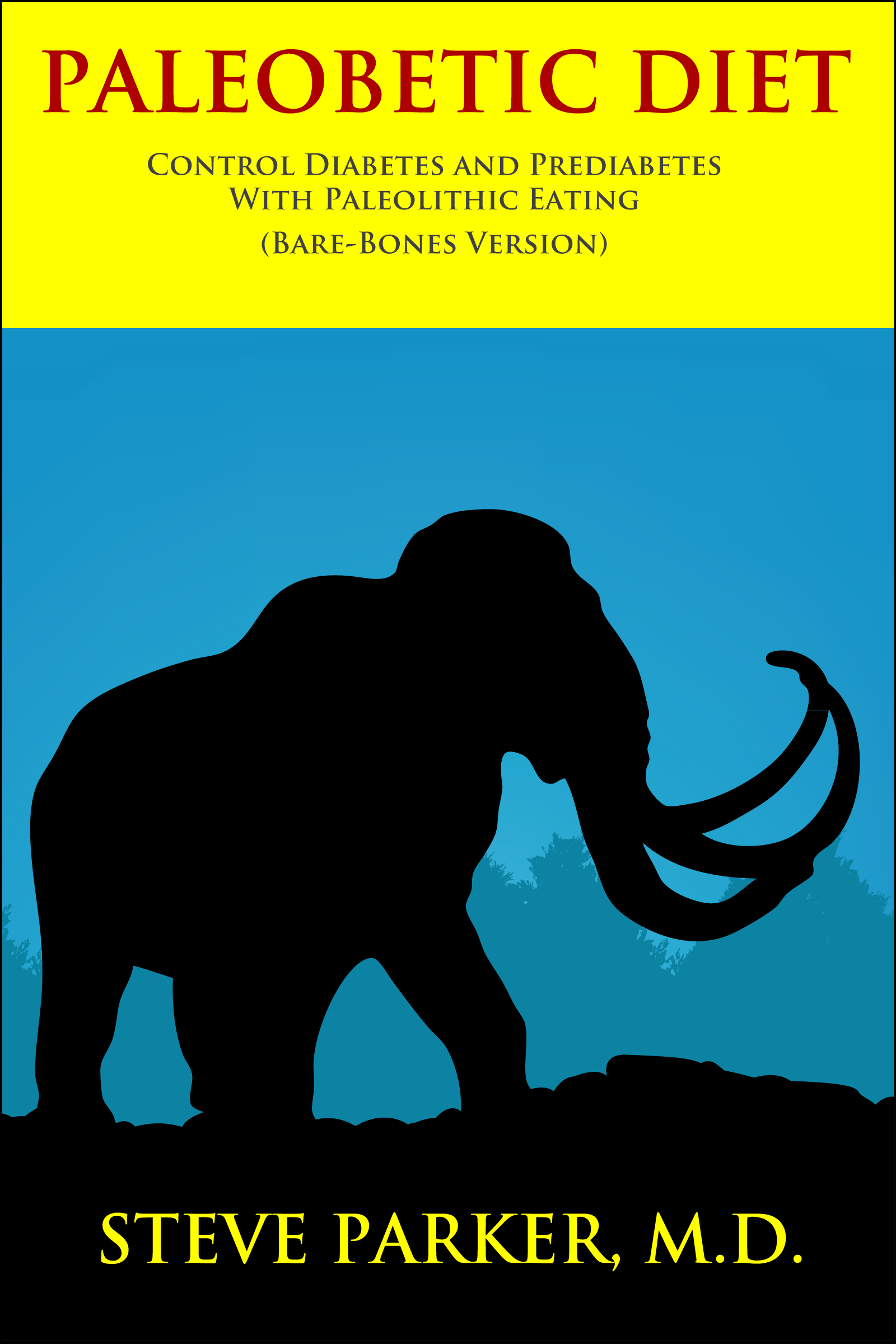
What’s the Paleobetic Diet?

Two years ago, a few of my patients with diabetes asked me whether the paleo diet would help with management of their diabetes. After much deliberation, I can definitely say, “Yeah, maybe.”

We still don’t have much scientific data to back it up, but I’ve seen enough to convince me it would be adequately safe to try a paleo-style diet under medical supervision. The greatest immediate risk is hypoglycemia in those taking certain drugs.

Regardless of diet, diabetics are at risk for hypoglycemia if they use any of the following drug classes. Also listed are a few of the individual drugs in some classes:

  • insulins
  • sulfonylureas: glipizide, glyburide, glimiperide, chlorpropamide, acetohexamide, tolbutamide
  • meglitinides: repaglinide, nateglinide
  • pramlintide plus insulin
  • exenatide plus sulfonylurea
  • possibly thiazolidinediones: pioglitazone, rosiglitazone
  • possibly bromocriptine

I’ve just finished a handout for my patients interested in a paleo diabetic diet. If interested, click for details.

Steve Parker, M.D.

PS: The paleo diet is also referred to as the Paleolithic, Stone Age, Old Stone Age, cavemen, ancestral, and hunter-gatherer diet.

Paleobetic diet, Steve Parker MD,paleo diet, diabetic diet, diabetes

Cover of the fleshed-out ebook at Smashwords

Who Invented Clothes?

Archeologist Suzi Gage suggests the answer in an article at The Guardian:

Quite astonishingly, there is physical evidence that Neanderthals more than 100,000 years ago were tanning animal skins – a stone tool from the site of Neumark-Nord in Germany has preserved scraps of organic material stuck to it that were soaked in tannin, the substance in oak bark used to make leather. It was probably part of the tool handle that got wet while the hides were being worked.

DNA from lice indicate that our ancestors wore clothes as long as 170,000 years ago.

Read the rest.

Meet The Paleo Hygienist

I just discovered Debbie the Paleo Hygienist and thought you might be interested. Debbie had left a comment at Dr. Cate’s blog post on flossing (Dr. Cate’s NOT a flosser). From Debbie’s “About” page:

I created this website, for both dental professionals and patients, to discuss oral health issues from a holistic health/nutrition/Paleo perspective.  After discovering and converting to a Paleo diet, I believe it is the optimal diet for oral and systemic health.  My overall goal is to bring fresh ideas to the table to spur new ways of thinking when it comes to the dental-systemic health connection, which I feel is much needed in our industry.

After obtaining my dental hygiene degree from Clark College in Vancouver, WA I started out in general dentistry, but soon moved to a periodontal practice where I have been a periodontal hygienist since early 2008.  Prior to dental hygiene, I obtained my BS degree in Community Health Education with a minor in Anthropology from Western Washington University.  I have always been passionate about health and nutrition and this site is the perfect opportunity for me to combine my knowledge of oral health with my passion for nutrition in order to help others achieve not only optimal oral health, but overall health as well!

Debbie is one of the most intellectual and science-oriented dental hygienists I’ve ever run across. I hope you benefit from her expertise.

-Steve

PS: I still floss. My wife doesn’t, but uses a water-jet device that may be just as good, assuming flossing’s good. She had a close friend die of endocarditis, and one of the doctors on the case speculated suggested that flossing was the cause.