NASEM is the National Academies of Sciences, Engineering, and Medicine. Dr. Andy Harris writes that:
The nation’s senior scientific body recently released a new report raising serious questions about the “scientific rigor” of the Dietary Guidelines for Americans. This report confirms what many in government have suspected for years and is the reason why Congress mandated this report in the first place: our nation’s top nutrition policy is not based on sound science.
Dr. Harris notes that since 1980, when the guidelines were first published, rates of obesity have doubled and diabetes has quadrupled.
Current recommendations to reduce saturated fat consumption and to eat health whole grains do not, after all, reduce rates of cardiovascular disease. That was my conclusion about saturated fat in 2009.
This new study is out of Sweden. The potential disease-inducing soft drink dose was 400 ml or 13.5 fl oz per day. In the U.S., a typical soda can is 10 fl oz or 355 ml. Surprisingly, artificially-sweetened soft drinks were just as guilty as regular beverages.
From MNT:
“The study included 2,874 Swedish adults, of whom 1,136 had type 2 diabetes, 357 had LADA, and 1,137 were healthy controls.
The team analyzed the self-reported dietary data of each adult, looking specifically at the number of soft drinks consumed up to 1 year before a diabetes diagnosis. Participants’ insulin resistance levels, beta cell function, and autoimmune response were also measured.
The researchers found that adults who reported drinking at least two 200-milliliter servings of soft drinks a day – whether they contained sugar or artificial sweetener – were twice as likely to develop LADA and 2.4 times more likely to develop type 2 diabetes, compared with those who consumed fewer than two soft drinks daily.
What is more, adults who consumed five 200-milliliter servings of soft drinks daily were found to be at 3.5 times greater risk of LADA and 10.5 times greater risk of type 2 diabetes, regardless of whether the drinks were sugary or artificially sweetened.”
Posted onOctober 6, 2016|Comments Off on Professor Tim Noakes: A Nutrition Heretic and His Low-Carb Epiphany
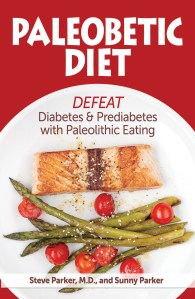
Paleo-compliant low-carb meal. I almost used this for my Paleobetic Diet book cover.
“I argue that the very reason we are facing an uncontrollable global diabetes/obesity pandemic at the moment, is because we have promoted dietary guidelines that are based solely on “evidence” from associational studies without acknowledging that RCTs [randomized controlled trials] have either not supported those conclusions or might have actively disproved them.
The solution in my mind is that we need to give dietary advice to persons with diabetes, T2DM [type 2 diabetes] especially, based on our understanding of the underlying patho-physiology of the condition, not on false information provided by associational epidemiological studies that are unable to prove causation. I suggest that we know a number of features of the abnormal biology of T2DM with absolutely certainty.”
Posted onJuly 26, 2016|Comments Off on Do Statin Drugs Cause Diabetes?
Roni Rabin at the New York Times suggests an answer:
“The Food and Drug Administration updated its advisory about statins in 2012 to include warnings about the slightly increased risk of higher blood sugars and Type 2 diabetes, based in part on two large analyses of earlier studies that controlled for diabetes risk factors like being overweight or being older. One found a 9 percent increase in the risk of diabetes among statin users, and the other a 12 percent increase, with a greater risk for those on intensive rather than moderate doses of the drugs.
The 2012 F.D.A. advisory also warns of other side effects of statins, such as muscle injury, rare cases of liver damage and reports of memory loss and confusion.”
Researchers in Denmark say “no.” French fries, maybe.
“The identified studies do not provide convincing evidence to suggest an association between intake of potatoes and risks of obesity, T2D, or CVD. French fries may be associated with increased risks of obesity and T2D although confounding may be present. In this systematic review, only observational studies were identified. These findings underline the need for long-term randomized controlled trials.”
“Our genes and our environment are kind of on a collision course,” said Dr. Francine Kaufman, the former head of the American Diabetes Assn., who was not involved with the research. “It’s not stopping.”
The problem with prediabetes is that it often evolves into full-blown diabetes. It’s also associated with increased risk for cardiovascular disease such as heart attack and stroke. The Times article says “up to 70% of those with prediabetes develop diabetes in their lifetime.” I’d never heard that vague number before; I say vague because “up to 70%” could be anything between zero and 70. It’s more accurate to note that one in four people with prediabetes develops type 2 diabetes over the course of three to five years.
She has the genes of a cave woman
Prediabetes is defined as:
fasting blood sugar between 100 and 125 mg/dl (5.56–6.94 mmol/l), or
blood sugar level 140–199 mg/dl (7.78–11.06 mmol/l) two hours after drinking 75 grams of glucose
How To Prevent Progression of Prediabetes Into Diabetes
If you’re overweight or obese, lose excess fat weight. How much should you lose? Aim for at least 5% of body weight and see if that cures your prediabetes. For instance, if you weigh 200 lb (91 kg), lose 10 lb (4.5 kg).
If you’re sedentary, start exercising regularly.
Cut back on your consumption of sugar-sweetened beverages, other sugar sources, and other refined carbohydrates like wheat flour.
Posted onJanuary 2, 2016|Comments Off on Does Pollution Cause Type 2 Diabetes?
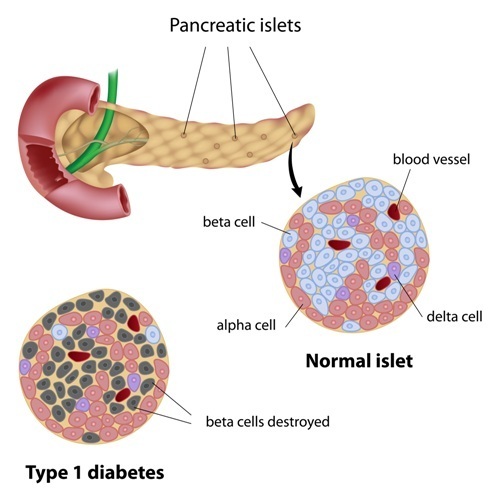
See text for mention of pancreatic alpha and beta cells
A panel of university-based scientists convened by The Endocrine Society recently reviewed the available literature on health effects of endocrine-disrupting chemicals (aka EDCs). The executive summary is available free online. Some excerpts:
The full Scientific Statement represents a comprehensive review of the literature on seven topics for which there is strong mechanistic, experimental, animal, and epidemiological evidence for endocrine disruption, namely: obesity and diabetes, female reproduction, male reproduction, hormone-sensitive cancers in females, prostate cancer, thyroid, and neurodevelopment and neuroendocrine systems. EDCs such as bisphenol A, phthalates, pesticides, persistent organic pollutants such as polychlorinated biphenyls, polybrominated diethyl ethers, and dioxins were emphasized because these chemicals had the greatest depth and breadth of available information.
* * *
Both cellular and animal models demonstrate a role for EDCs in the etiology of obesity and T2D [type 2 diabetes]. For obesity, animal studies show that EDC-induced weight gain depends on the timing of exposure and the age of the animals. Exposures during the perinatal period [the weeks before and after birth] trigger obesity later in life. New results covering a whole range of EDC doses have underscored the importance of nonmonotonic dose-response relationships; some doses induced weight increase, whereas others did not. Furthermore, EDCs elicit obesity by acting directly on white adipose tissue, al- though brain, liver, and even the endocrine pancreas may be direct targets as well.
Regarding T2D, animal studies indicate that some EDCs directly target beta and alpha cells in the pancreas, adipocytes, and liver cells and provoke insulin resistance together with hyperinsulinemia. These changes can also be associated with altered levels of adiponectin and leptin— often in the absence of weight gain. This diabetogenic action is also a risk factor for cardiovascular diseases, and hyperinsulinemia can drive diet-induced obesity. Epide- miological studies in humans also point to an association between EDC exposures and obesity and/or T2D; however, because many epidemiological studies are cross-sectional, with diet as an important confounding factor in humans, it is not yet possible to infer causality.
One possible way that antibiotics could cause diabetes, however, would be through alteration of gut germs (aka microbiome). An antibiotic may do a great job curing your urinary tract infection, while at the same time eliminating millions of certain gut bacteria and allowing other species to have a population explosion. One of the most fascinating fields of medicine now is trying to figure out if and how the billions of bacteria in our intestines might influence health and disease. F’rinstance, gut bacteria may influence whether we are fat or slim.
I bet if you graphed antibiotic use and incidence of type 2 diabetes over the last 50 years, they would trend together pretty well. Any volunteers to do that?
A Pharm.D (Dr of Pharmacology) and a pair of MD’s surveyed much of the available scientific literature—both animal and human studies—and concluded that fructose is a major culprit in the rise of type 2 diabetes and prediabetes. Fructose does its damage by increasing insulin resistance. ScienceDaily has the details.
Be aware that their conclusion is certainly not universally accepted. I read “Pathogenesis of type 2 diabetes mellitus” at UpToDate.com a few months ago and saw no mention of fructose. Under dietary factors, they mainly talked about obesity and how that increases insulin resistance, leading to elevated blood sugars, while the reverse happens with weight loss. I haven’t looked at all the research so I have no definite opinion yet on the fructose-diabetes theory; I’m skeptical.
Fructose is a type of simple sugar. Common dietary sources of fructose are fruits, table sugar (aka sucrose, a 50:50 combination of glucose and fructose molecules), and high-fructose corn syrup (which is usually 42 or 55% fructose).
Damaging effects, if any, of fructose in these fruits may be mitigated by the fiber
A few quotes from ScienceDaily:
“At current levels, added-sugar consumption, and added-fructose consumption in particular, are fueling a worsening epidemic of type 2 diabetes,” said lead author James J. DiNicolantonio, PharmD, a cardiovascular research scientist at Saint Luke’s Mid America Heart Institute, Kansas City, MO. “Approximately 40% of U.S. adults already have some degree of insulin resistance with projections that nearly the same percentage will eventually develop frank diabetes.”
* * *
While fructose is found naturally in some whole foods like fruits and vegetables, consuming these foods poses no problem for human health. Indeed, consuming fruits and vegetables is likely protective against diabetes and broader cardiometabolic dysfunction, explained DiNicolantonio and colleagues. The authors propose that dietary guidelines should be modified to encourage individuals to replace processed foods, laden with added sugars and fructose, with whole foods like fruits and vegetables. “Most existing guidelines fall short of this mark at the potential cost of worsening rates of diabetes and related cardiovascular and other consequences,” they wrote.
Perhaps we’ve been wrong about diabetes all along: the problem isn’t so much with insulin as with glucagon.
At least one diabetes researcher would say that’s the case. Roger Unger, M.D., is a professor at the University of Texas Southwestern Medical Center. That’s one of the best medical schools in the U.S., by the way.
Glucagon is a hormone secreted by the alpha cells of the pancreas; it raises blood sugar. (There are also glucagon-secreting alpha cells in the lining of the stomach, and I believe also in the duodenum.) In the pancreas, the insulin-producing beta cells are adjacent to the glucagon-secreting alpha cells. Released insulin directly suppresses glucagon. So if your blood sugar’s too high, as in diabetes, may be you’ve got too much glucagon action rather than too little insulin action.
Don’t ask me what delta cells do
Dr. Unger says that insulin regulates glucagon. If your sugar’s too high, your insulin isn’t adequately keeping a lid on glucagon. Without glucagon, your blood sugar wouldn’t be high. All known forms of diabetes mellitus have been found to have high glucagon levels (if not in peripheral blood, then in veins draining glucagon-secreting organs).
This is pretty well proven in mice. And maybe hamsters. I don’t know if we have all the pertinent evidence in humans, because it’s harder to do the testing.
Here’s Dr. Unger’s glucagon-centric theory of the pathway to insulin-resistant type 2 diabetes: First we over-eat too many calories, leading to insulin over-secretion, leading to increased fat production (lipogenesis) and storage in pancreatic islet cells as triglycerides, in turn leading to increased ceramide (toxic) in those islet cells, leading to pancreas beta cell death (apoptosis) and insulin resistance in the alpha cell (so glucagon is over-produced), all culminating in type 2 diabetes.
For a diagram of this, click forward minute 40 and 10 seconds in the video below.
If this is all true, so what? It could lead to some new and more effective treatments for diabetes. Dr. Unger says that in type 2 diabetes, we need to suppress glucagon. Potential ways to do that include a chemical called somatostatin, glucagon receptor antibodies, and leptin (the latter mentioned in a 2012 article, I think). The glucagon-centric theory of diabetes also explains why type 1 diabetics rarely have totally normal blood sugars no matter how hard they try: we’re ignoring the glucagon side of the equation. I don’t yet understand his argument, but he also says that giving higher doses of insulin to T2 diabetics may well be harmful. I’m guessing the insulin leads to increased accumulation of lipids (and the associated toxic ceramide) in cells.










 Paleo Diabetic