Category Archives: Paleo Diet

QOTD: Calcium and the Paleo Diet

“Low calcium intake, which is often considered as a potential disadvantage of the Paleolithic diet model, should be weighed against the low content of phytates and the low content of sodium chloride, as well as the high amount of net base yielding vegetables and fruits.”

L.M. Kowalski and J. Bujko

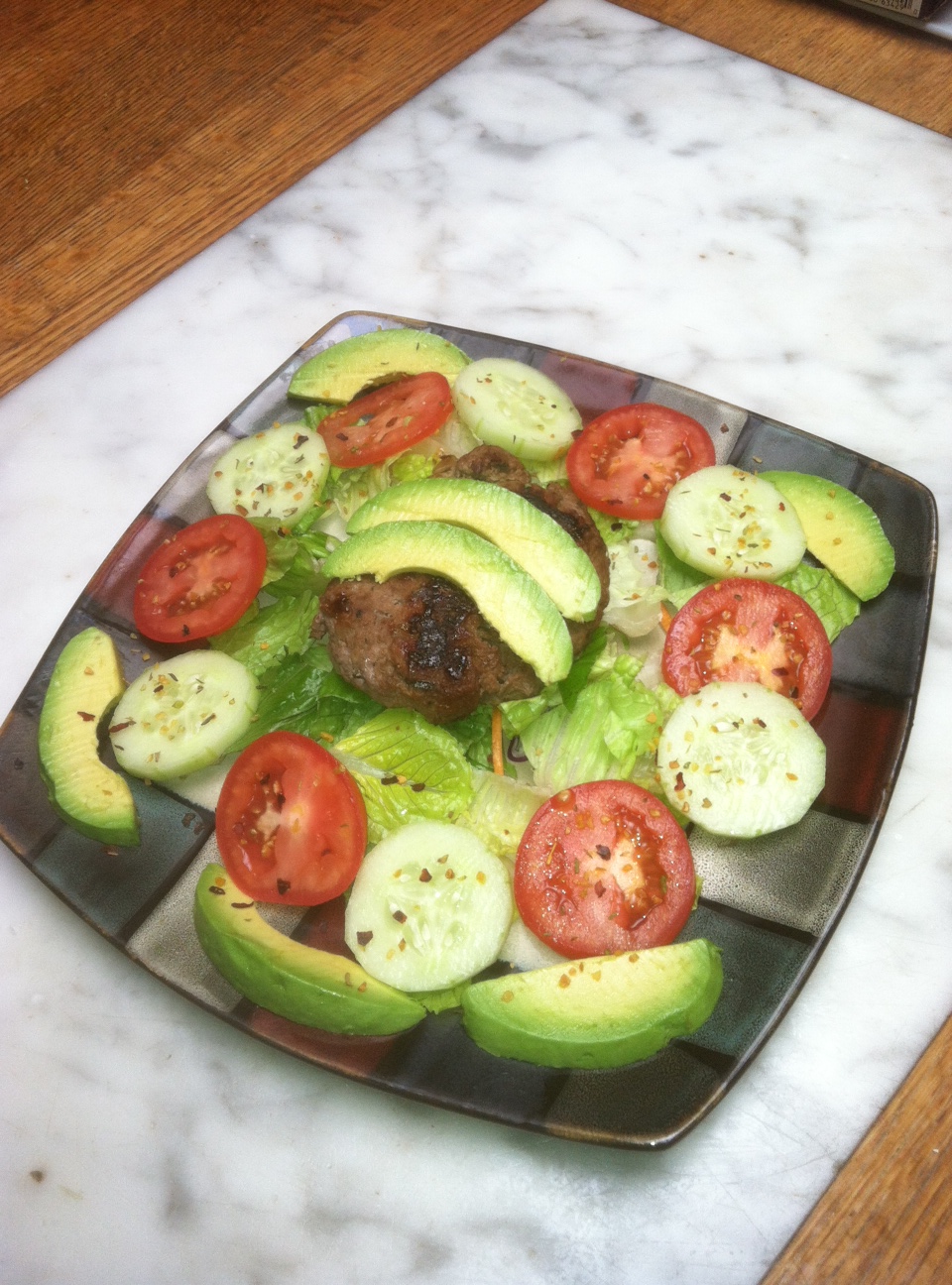
Hamburger-Avocado Salad with tomatoes, cucumbers, lettuce, salt/pepper, and olive oil vinaigrette

Hamburger-Avocado Salad with tomatoes, cucumbers, lettuce, salt/pepper, and olive oil vinaigrette

PS: Low calcium consumption is thought to predispose to osteoporosis, a bone-thinning disease that causes fractures.  It affects women far more than men.  If you don’t live past 50 or 60, it’s not much of a problem.  Kowalski and Bujko imply that low phytate and sodium content, plus alkaline veggies and fruit, counteract any adverse bone effects of low calcium consumption.  I’m not sure because I don’t read Polish.  Loren Cordain’s paleo diet website talks about the diet being healthy for bones, citing the acid-base issue.

h/t Amy Kubal (Twitter: @AmykRd)

Ideas For A Paleo Diabetic Diet

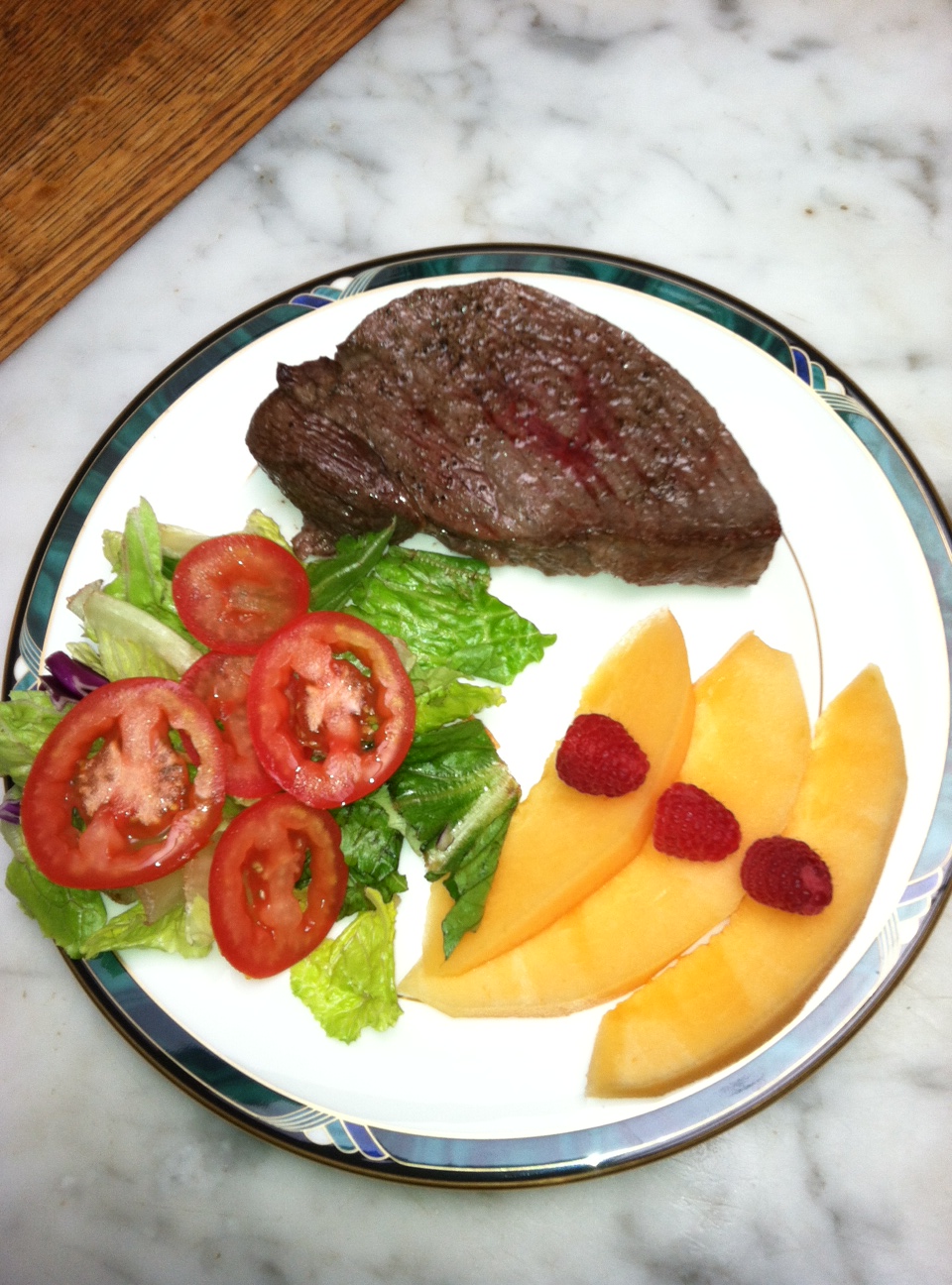
Sirloin steak, salad, cantaloupe, 3 raspberries

Sirloin steak, salad, cantaloupe, 3 raspberries

I’ve been thinking about a paleo-style diabetic diet for over a year.  Here are some miscellaneous ideas for your consideration.

A paleo diabetic diet will have the following major food groups:

  • vegetables
  • fruits
  • nuts and seeds
  • proteins (e.g., meat, fish, eggs)
  • condiments

A paleo diabetic diet could (should?) emphasize salads and low-carb colorful vegetables and only (?) low-carb or low-glycemic-index fruits.

Calories

Total calories?  Probably in the range of 1,800 to 3,000 calories daily with an average of 2,000.  Remember that 85% of type 2 diabetics are overweight or obese. Calorie restriction—regardless of macronutrient ratios (% carb, protein, fat)—tends to improve or normalize blood sugar levels.  Weight loss will likely entail some caloric restriction, whether consciously or not.

Type 1 Versus Type 2 Diabetes

Type 1 and type 2 diabetics have many pathophysiologic differences.  Could a single paleo diabetic diet serve both populations equally well?  That’s the goal.

Carbohydrates

Diabetics have trouble metabolizing carbohydrates, so a paleo diabetic diet should probably be lower-than-average in digestible carbs.  100 g/day?  30 g/day?  I’m leaning toward 60 g ± 25%, so 45–75 g.  Smaller, less active folks could eat 45 g/day; larger, more active guys eat closer to 75 g.

Is there a role for very-low-carb or ketogenic eating patterns?  For most folks, that’s less than 50 g of digestible carbohydrate daily.  Under 30 g for some.  Use that only for those needing to lose weight?  Start everybody at  very low carb levels then increase carbs as tolerated?  On the other hand, there’s a lot to be said for simplicity.  It might be best to avoid very-low-carb (ketogenic) eating entirely.  Anyone not losing the desired amount of fat weight could cut portion sizes, especially carbohydrates.

Fish

I encourage fish consumption twice a week, diabetes or no.  Cold-water fatty fish have more of the healthy omega-3 fatty acids than other fish.

Nuts

I’d encourage 1–2 ounces (28–56 g) of nuts or seeds daily.  Any more than that might crowd out other healthful nutrients.  Nuts are protective of the heart.

Proteins

Protein-rich foods can definitely raise insulin requirements and blood sugar levels, but not in an entirely predictable way, and not to the extent we see with carbohydrates.  Should insulin users dose insulin based on a protein gram sliding scale?  I’m leaning towards simply recommending the same amount of protein at each meal, perhaps 4–8 ounces (113–229 g).

Fruit and Starchy Vegetables

Could a paleo diabetic diet even be “paleo” without fruit?  The problem with classic fruits is that they spike blood sugars too high for many diabetics.  To prevent that, Dr. Richard Bernstein outlaws all classic fruits (and other starchy carbs), even limiting tomatoes and onions to small amounts.  E.g., a wedge of tomato in a salad.  He doesn’t allow carrots either, unless raw (lower glycemic index than when cooked).  A paleo diabetic diet eater may be able to get away with eating lower-carb, lower-GI (glycemic index) fruits such as cantaloupe, honeydew, strawberries and other berries.  Some paleo diabetic dieters will tolerate half an apple twice a day.

Different diabetics will have different blood sugar effects when eating starchy vegetables and higher-carb fruits.  Type 1 diabetics will tend to be more predictable than type 2s.  Both may just need to “eat to the meter”: try a serving and see what happens to blood sugar over the next hour or two.

Starchy vegetables—potatoes and carrots, for example—may well have to be limited.  Again, eat to the meter.

Gluten

This is looking to be gluten-free.  How trendy!  It’s a paleo celiac diet.

Use “natural” stevia as a sweetener?  If you read about how the product on your supermarket shelf  is made, it’s not at all natural.

Omega-6/Omega-3 Fatty Acids

A strict focus on omega-6/omega-3 fatty acid ratio will not appeal to many folks, even if it’s important from a health viewpoint.  Reserve this for advanced dieters who have mastered the basics?  Modern Western diets have an omega-6/omega-3 ratio around 10 or 15:1.  Paleolithic diets were closer to 2 or 3:1.  So we have an over-abundance of omega-6 fatty acid or deficiency of omega-3 that may be unhealthy.

Implementation

To get dieters started, I’d design a week of meals based on 2,000 to 2,200 calories.  If still hungry, eat more protein, fat, and low-carb vegetables (and fruits?).

What do you think?

Steve Parker, M.D.

Disclaimer:  All matters regarding your health require supervision by a personal physician or other appropriate health professional familiar with your current health status.  Always consult your personal physician before making any dietary or exercise changes.  

PS: See Dr. Bernstein’s “no-no” foods on page 151 of his Diabetes Solution book.

PPS: The paleo diet is also known as the Paleolithic diet, Stone Age diet, caveman diet, hunter-gatherer diet, and ancestral diet.

The Traveling Sweet Potato

If you like sweet potatoes, ScienceNOW has an interesting article on the travels and domestication of the humble sweet potato.  An excerpt:

Humans domesticated the sweet potato in the Peruvian highlands about 8000 years ago, and previous generations of scholars believed that Spanish and Portuguese explorers introduced the crop to Southeast Asia and the Pacific beginning in the 16th century. But in recent years, archaeologists and linguists have accumulated evidence supporting another hypothesis: Premodern Polynesian sailors navigated their sophisticated ships all the way to the west coast of South America and brought the sweet potato back home with them. The oldest carbonized sample of the crop found by archaeologists in the Pacific dates to about 1000 C.E.—nearly 500 years before Columbus’s first voyage.

Some versions of the paleo diet don’t include white or sweet potatoes, probably because they originated in the New World (particularly Peru).  They wouldn’t have been eaten by our prehistoric ancestors in Africa.  I haven’t done the research yet, but I bet northeast Africa had a starchy tuber roughly equivalent to potatoes.

Steve Parker, M.D.

h/t Ivor Goodbody

Paleo Pioneer S. Boyd Eaton’s Personal Lifestyle

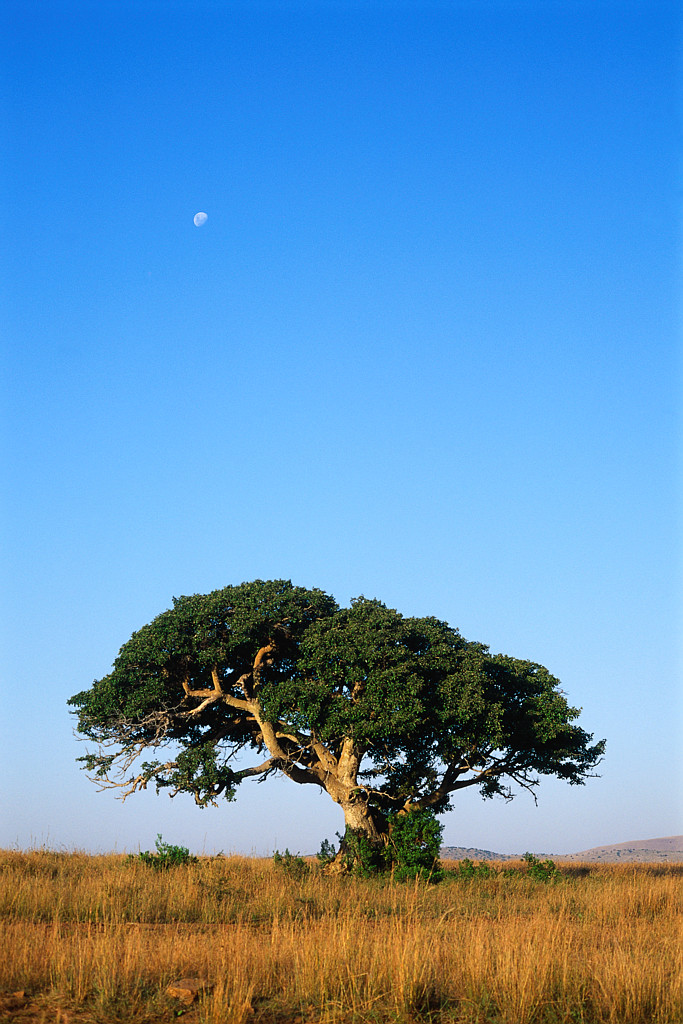
African Savanna

African Savanna

Dr. Eaton (M.D.) spoke at the last Ancestral Health Symposium about his own diet and exercise program.  He’s 74-years-old and has been following his paleo lifestyle for 30 years.  In this video, Dr. Eaton looks quite fit and is obviously mentally sharp.

He talks about a “weak form” of the paleo diet that would include relatively small amounts of whole grains (e.g., shredded wheat) and dairy (e.g., skim milk).  He doesn’t proscribe beans.  He limits saturated fat, but enjoys red wine.

Dr. Eaton also discusses a “strong form” diet that would cut out the dairy, grains, and probably alcohol.  This is for those with certain diseases of modern civilization, such as high blood pressure, coronary artery disease, metabolic syndrome, adverse blood lipids, etc.  He didn’t mention diabetes specifically, but I bet he would include it in the list.

He has an impressive daily exercise program that probably takes at least an hour, with weight training on machines plus an aerobics (stationary bike and swimming).

Dr. Eaton supplments with a multivitamin/multimineral (showed a picture of Centrum), EPA/DHA, and fiber (especially soluble fiber).

The video is only 20 minutes long and well worth a look.

Steve Parker, M.D.

h/t Melissa McEwen. (Melissa has the impression the Eaton partakes of whole grains and dairy.  I didn’t hear that in the video but may have missed it.)


Denmark’s Paleolithic Diet

ScienceNordic has an article about the diet of Paleolithic humans who lived in what is now Denmark.  It’s brief and written for the general public.  The author mistakenly characterizes the “modern paleo” diet as no- or very-low-carb.  It’s lower in carb content than the standard American diet, but by no means no-carb.

—Steve

Are We Eating Too Much Salt?

Unfairly demonized?

Most paleo diets are quite a bit lower in salt and sodium than standard American diets.  At the same time, they should be quite a bit higher in potassium, which may be very healthy.

Every 10 years or so, “the powers that be” make a push for population-wide salt restriction thinking that it will prevent cardiovascular disease and associated premature death.  The American Council on  Science and Health has a brief review of the latest research on salt restriction, and it’s not supportive of population-wide sodium restriction.

Remember, table salt molecules contain one sodium atom and one chloride atom.  Salt-restricted and low-sodium diets are usually designated by the amount of sodium, not salt.

That being said, I do believe some individuals have elevated blood pressure related to relatively high sodium intake.  This may apply to one of every five adults with high blood pressure.  To find out if you’re one of the five, you could go on a low-sodium diet—1.5 to 3 grams a day—for one or two months and see what it does to your blood pressure.  Get your personal physician’s blessing first.

Steve Parker, M.D.

Two Month Recap of the Parker Paleo Diet Trial

soup, home-made, potato, chicken, paleo diet, meal, Stone Age diet, recipe

Potato chicken soup

I’ve completed my two-month paleo diet trial.  I’m proud to say I’ve been fairly compliant with it, although certainly not 100%.  Perhaps 95%.

My major transgressions have been:

  • three diet sodas
  • a bottle of wine around Thanksgiving holiday
  • two or three pies around Thanksgiving (I couldn’t stand throwing them out)
  • other grain and refined sugar products around Thanksgiving
  • four servings of salad dressing made with industrial seed oils when I had no good alternative
  • a Blizzard (thick milk shake) from Dairy Queen
  • on 10–15 days I’ve exceeded my 2-ounce (60 g) limit on nuts

Results and Overall Impressions of Paleo Eating

It’s fairly easy, even when dining out or away from home.  Nevertheless, it requires some discipline and willpower.

My sense is that my meat, poultry, egg, and nut consumption stayed about the same as my baseline, pre-paleo levels.  I eliminated cheese and didn’t miss it much.  I ate more vegetables and fruit.

paleo diet, paleo meal, recipe, stone age diet, paleo food, hunter-gatherer food

I took my lunch meals to the hospital

My wife says paleo eating is at least a little more expensive than my prior eating habits, mostly related to fresh vegetables and fruit.  Grain products like bread, pasta, and rice are cheaper calories.  On the other hand, we saved money by not buying wine even though I don’t drink expensive wine.

I don’t miss grain products much at all.  I had already cut back on them over the last couple years as part of my experimentation with low-carb eating.  I do enjoy whole grain breads but could live a happy life without them if necessary.

I miss sweet items like cinnamon rolls, other pastries, cake, pie, ice cream, diet soda, and candy bars.  I don’t care for sugary soda pop and fruit juices.

I didn’t do this to lose weight, yet went from 171 lb (77.7 kg) down to 164 lb (74.5 kg).  So an unexpected loss of 7 lb (3.2 kg).  I hovered between 162 and 166 lb for the last few weeks so I don’t think I’ll keep losing weight if I stay with the program.

Do I feel any different eating this way?  No.  I’m blessed with good health, so wasn’t looking for any upgrades.  I have noticed more sweetness in a few foods, such as nuts and carrots.

I take nothing away from those who report more energy, better sleep, improved digestion, increased strength, less joint pain, etc., from paleo-style eating.  Undoubtedly, some of those apparent improvements are placebo effect, some are coincidental, and some are bona fide results of the paleo lifestyle.

Steve Parker, M.D.

PS: The paleo diet is also called the Paleolithic diet, hunter-gatherer diet, Stone Age diet, caveman diet, or ancestral diet.

Update December 16, 2012:  I wondered if lack of alcohol for the last two months had any effect on my weight loss.  For the last week I ate my usual paleo diet but added 3 fl oz (90 ml) of whiskey daily.  Weight today 163 lb (73.9 kg), so no real change over the short run.  That’s enough whiskey for a while.

Update December 27:  After three days of unrestrained Holiday eating, my weight is up 8 lb to 171 lb (77.7 kg).  Mostly thanks to pie, cookies, and candy.  I’m sure some of that extra weigh is glycogen, water, and intestinal contents, rather than fat.  Back on the paleo diet today, a low-carb version.

Update December 29:  Weight is down 5 lb to 166 lb (75.5 kg).  Amazing.

Pace salsa, paleo diet, Parker paleo diet

The contents of this salsa jar are all paleo-compliant

paleo diet, Parker paleo diet, canned pumpkin

Pure paleo contents unless there’s BPA in the can liner

pumpkin pie, paleo diet, Parker paleo diet

Definitely non-paleo pumpkin pie

wine bottle, red wine, paleo diet, meal,

Wine is not “paleo” by most definitions

paleo diet, paleo food, hunter-gatherer diet, macadamia nuts

L. Cordain likes the low omega-6/omega-3 ratio of macadamia nuts

A Default Position on the Omega-6/Omega-3 Debate

ASBMB Today has a well-written balanced article on the omega-6/omega-3 fatty acid ratio debate written by Rajendrani Mukhopadhyay.  A fair amount of it is understandable to non-science majors.  The main question is whether the high consumption of omega-6 fatty acids in Western societies is unhealthy.

It’s estimated that throughout most of human evolution, our dietary omega-6/omega-3 ration has been around 3:1 or 2:1.  Today, it’s about 15:1, thanks to a large increase in omega-6 consumption.  Are our bodies adapted for the lower ratio?  A hard-core paleo diet like Dr. Cordain’s aims for that lower ratio.

Both sides of the debate agree that we would probably be better off eating more omega-3 fatty acids, as found in cold-water fatty fish.

I’m an omega-6/omega-3 ratio agnostic at this point.  I’ve never studied it in depth, so I have no strong opinion either way.

Here are a couple excerpts from the article to pique your interest:

No one is disputing that we’re eating more omega-6 than our predecessors did. Over the past 100 years, consumption of linoleic acid [an omga-6] has increased dramatically in the U.S., mainly through the use of soybean oil. Soybean oil intake has gone up from being 1 percent of calories in the American diet to as much as 10 percent, according to Hibbeln. Lands, Salem and others contend that the rise, driven by the processed food and agriculture industries, has happened without anyone knowing its effects. “If I were now to try to get permission to change 10 percent of the calories in the U.S. diet, I would need a very large body of data unequivocally proving that it was safe,” says Hibbeln. “No such body of data exists for soybean oil. But it’s in our diet. We’re the experiment. It’s been a very large, uncontrolled intervention.”

Experts like Harris and Willett say this increase has been to our benefit. “We have seen a massive decline in cardiovascular disease mortality and huge increase in life expectancy,” says Willett. “Not all the benefit is due to the increase in linoleic acid, but almost certainly much of it is. It was not an absolute disaster.” But the lipid biochemists counter that it’s not just cardiovascular disease at stake. They say diabetes, obesity and even psychiatric disorders are some outcomes of a diet heavy on omega-6s.

I’ve never before heard anybody credit linoleic acid with a major role in our  “huge increase in life expectancy” over the last century.  I doubt that’s the case.  I vote more in favor of better sewage systems, cleaner water, better hygiene, antibiotics, or improvements in surgery and medical care.

Evolutionary biologist Theodosius Dobzhansky said, “Nothing in biology makes sense except in the light of evolution.”  If that’s true, the default position is that lower amounts of omega-6 fatty acid are better than our current high consumption.  It’s up to the high-consumption proponents to prove otherwise.

Steve Parker, M.D.

h/t David Despain

PS: Dobzhansky was a Christian, by the way.

PPS: A Twitter reader (@pronutritionist) suggested that the modern Western dietary omega-6/omega=3 ratio is 9.6, not 15:1, citing Amer J Clin Nutr.  My source for 15:1 is Journal of Nutrition and Metabolism, vol. 2012, article ID 539426, doi 10.1155/2912/539426, by E. Patterson et al. I admit it’s not a great reference. Cordain’s 2002 book, The Paleo Diet, says 10:1.  Maybe it is closer to 10:1.  I’m sure there’s lots of inter-person variability.

Dr. Frassetto Discusses Paleo Diet and Diabetes

Not Dr. Frassetto

Dr. Lynda Frassetto is a Professor of Medicine and Nephrology at the University of California San Francisco.  She and her colleagues have completed a study of the Paleolithic diet as a treatment for diabetes (type 2, I think).  As far as I know, details have not yet been published in the medical literature.

Dr. Frassetto spoke at the Ancestral Health Symposium-2012 earlier this year.  You can view the 35-minute video here.

She is convinced that a paleo diet, compared to a Mediterranean-style diet, is better at controlling blood sugars and “reducing insulin” in diabetics (presumably type 2s).  Insulin sensitivity is improved, particularly in those with insulin resistance to start with.  The paleo diet group saw an average drop of fasting glucose by 23 mg/dl (1.3 mmol/l).  One slide you’ll see in the video indicates the paleo diet reduced absolute hemoglobin A1c by 0.3%, compared to 0.2% with the “Mediterranean” diet.  (Let me know if I got the numbers wrong.)

Color me underwhelmed so far.

Questions raised by the video include:

  • what is the UCSF version of the paleo diet?
  • how many participants were in her study?
  • how long did her study last?
  • did she study only type 2 diabetics?
  • what exactly was the control diet?
  • how severe were the cases of diabetes studied?

For answers, we await publication of the formal report.

Steve Parker, M.D.

Ancestral Diet May Improve Diabetes in Pima Indians

Saguaro cactus fruit is edible

I ran across a 1991 New York Times article by Jane Brody discussing the benefits to Pima Indians of returning to their ancestral diet.  The Pima have major problems with obesity and diabetes.  (I frequently treat Pima Indians in the hospital.)  Some quotes:

Studies strongly indicate that people who evolved in these arid lands are metabolically best suited to the feast-and-famine cycles of their forebears who survived on the desert’s unpredictable bounty, both wild and cultivated.

By contrast, the modern North American diet is making them sick. With rich food perpetually available, weights in the high 200’s and 300’s are not uncommon among these once-lean people. As many as half the Pima and Tohono O’odham (formerly Papago) Indians now develop diabetes by the age of 35, an incidence 15 times higher than for Americans as a whole. Yet before World War II, diabetes was rare in this population.

Pima Indians traditionally ate a diet of tepary beans, mesquite seeds, corn, grains, greens, and other high-fiber/low-fat foods.  The switch to a diet high in sugar, refined grains, and other highly processed convenience foods may well be responsible for the current high rates of obesity and diabetes.  Australian aborigines have the same problem.

Steve Parker, M.D.