Ultra-Processed Diets Cause Excess Calorie Consumption and Weight Gain

Can you think of a diet that has less ultra-processed food than the paleo diet?

From Cell Metabolism:

We investigated whether ultra-processed foods affect energy intake in 20 weight-stable adults, aged (mean ± SE) 31.2 ± 1.6 years and BMI = 27 ± 1.5 kg/m2. Subjects were admitted to the NIH Clinical Center and randomized to receive either ultra-processed or unprocessed diets for 2 weeks immediately followed by the alternate diet for 2 weeks. Meals were designed to be matched for presented calories, energy density, macronutrients, sugar, sodium, and fiber. Subjects were instructed to consume as much or as little as desired. Energy intake was greater during the ultra-processed diet (508 ± 106 kcal/day; p = 0.0001), with increased consumption of carbohydrate (280 ± 54 kcal/day; p < 0.0001) and fat (230 ± 53 kcal/day; p = 0.0004), but not protein (−2 ± 12 kcal/day; p = 0.85). Weight changes were highly correlated with energy intake (r = 0.8, p < 0.0001), with participants gaining 0.9 ± 0.3 kg (p = 0.009) during the ultra-processed diet and losing 0.9 ± 0.3 kg (p = 0.007) during the unprocessed diet. Limiting consumption of ultra-processed foods may be an effective strategy for obesity prevention and treatment.

Source: Ultra-Processed Diets Cause Excess Calorie Intake and Weight Gain: An Inpatient Randomized Controlled Trial of Ad Libitum Food Intake: Cell Metabolism

Click pic to purchase book at Amazon in the U.S.


Beware Fournier Gangrene If You Take an SGLT2 Inhibitor for Diabetes

The FDA is warning doctors about the possibility of Fournier Gangrene in folks taking a particular class of diabetes drug. This gangrene is a nasty infection that I’ve seen only a few times, always in men. The FDA reports cases in both men and women taking SGLT2 inhibitors.

“Patients should seek medical attention immediately if you experience any symptoms of tenderness, redness, or swelling of the genitals or the area from the genitals back to the rectum, and have a fever above 100.4 F or a general feeling of being unwell. These symptoms can worsen quickly, so it is important to seek treatment right away.”

Source: FDA warns about rare occurrences of a serious infection of the genital area with SGLT2 inhibitors for diabetes | FDA

Exercise and proper diet can reduce your need to take drugs for diabetes.

Click pic to purchase book at Amazon in the U.S.

Effects of a Paleolithic Diet on Cardiovascular Disease Risk Factors: A Systematic Review and Meta-Analysis of Randomized Controlled Trials. – PubMed – NCBI

I’ve probably read and blogged here about most of the individual articles that comprise this meta-analysis.

Effects of a Paleolithic Diet on Cardiovascular Disease Risk Factors: A Systematic Review and Meta-Analysis of Randomized Controlled Trials.

Abstract

There is some evidence supporting the beneficial effects of a Paleolithic Diet (PD) on cardiovascular disease risk factors. This diet advises consuming lean meat, fish, vegetables, fruits, and nuts and avoiding intake of grains, dairy products, processed foods, and added sugar and salt. This study was performed to assess the effects of a PD on cardiovascular disease risk factors including anthropometric indexes, lipid profile, blood pressure, and inflammatory markers using data from randomized controlled trials. A comprehensive search was performed in the PubMed, Scopus, ISI Web of Science, and Google Scholar databases up to August, 2018. A meta-analysis was performed using a random-effects model to estimate the pooled effect size. Meta-analysis of 8 eligible studies revealed that a PD significantly reduced body weight [weighted mean difference (WMD) = -2.17 kg; 95% CI: -3.48, -0.87 kg], waist circumference (WMD = -2.90 cm; 95% CI: -4.51, -1.28 cm), body mass index (in kg/m2) (WMD = -1.15; 95% CI: -1.68, -0.62), body fat percentage (WMD = -1.38%; 95% CI: -2.08%, -0.67%), systolic (WMD = -4.24 mm Hg; 95% CI: -7.11, -1.38 mm Hg) and diastolic (WMD = -2.95 mm Hg; 95% CI: -4.72, -1.18 mm Hg) blood pressure, and circulating concentrations of total cholesterol (WMD = -0.22 mg/dL; 95% CI: -0.42, -0.03 mg/dL), TGs (WMD = -0.23 mg/dL; 95% CI: -0.46, -0.01 mg/dL), LDL cholesterol (WMD = -0.13 mg/dL; 95% CI: -0.25, -0.01 mg/dL), and C-reactive protein (CRP) (WMD = -0.41 mg/L; 95% CI: -0.81, -0.008 mg/L) and also significantly increased HDL cholesterol (WMD = 0.05 mg/dL; 95% CI: 0.005, 0.10 mg/dL). However, sensitivity analysis revealed that the overall effects of a PD on lipid profile, blood pressure, and circulating CRP concentrations were significantly influenced by removing some studies, hence the results must be interpreted with caution. Although the present meta-analysis revealed that a PD has favorable effects on cardiovascular disease risk factors, the evidence is not conclusive and more well-designed trials are still needed.

Advances in Nutrition. 2019 Apr 30. pii: nmz007. doi: 10.1093/advances/nmz007. [Epub ahead of print]. Authors are Ghaedi E., Mohammadi M, Mohammadi H, Ramezani-Jolfaie N, Malekzadeh J, Hosseinzadeh M, Salehi-Abargouei A.

Source: Effects of a Paleolithic Diet on Cardiovascular Disease Risk Factors: A Systematic Review and Meta-Analysis of Randomized Controlled Trials. – PubMed – NCBI

“Diabetes Care” Journal Considers the Paleo Diet for Diabetes

Caveman selfie

Concerning diet therapy for adults with diabetes and prediabetes, the Diabetes Care article has only this to say specifically about the paleo diet:

Research studies focused on a paleo eating pattern in adults with type 2 diabetes are small and few, ranging from 13–29 participants, lasting no longer than 3 months, and finding mixed effects on A1C, weight, and lipids.

Source: Nutrition Therapy for Adults With Diabetes or Prediabetes: A Consensus Report | Diabetes Care

Is Sodium Restriction Important?

I’m still not convinced that severe sodium restriction is necessary or even possible for most people

U.S public health authorities recommend maximum daily sodium consumption of 2.3 grams a day, in order to prevent cardiovascular disease. But a 2018 multi-country study published in Lancet supports a much different and higher maximum sodium intake level:

Sodium intake was associated with cardiovascular disease and strokes only in communities where mean intake was greater than 5 g/day. A strategy of sodium reduction in these communities and countries but not in others might be appropriate.

The researchers also found, “All major cardiovascular outcomes decreased with increasing potassium intake in all countries.”

Click for a list of potassium-rich foods from a .gov website.

You’ll find several cold-water fatty fish there.

My Paleobetic Diet recommends the fish but you’ll find no sodium restriction advice.

Source: Urinary sodium excretion, blood pressure, cardiovascular disease, and mortality: a community-level prospective epidemiological cohort study – The Lancet

Is There a Single Best Diet for Diabetes?

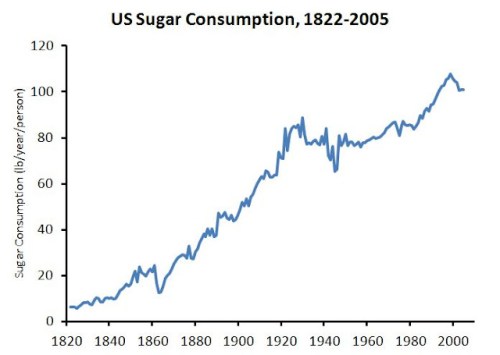
173 Years of U.S. Sugar Consumption

According to an article at Diabetes Care:

The Consensus Report highlights the role of weight management, dietary patterns, and technology-enabled tools in diabetes prevention and management. There is a clear consensus on reducing intake of added sugars, sodium, and unhealthy fats, especially trans fat, in the diet, although the panel does not recommend a “one-size-fits-all” eating plan. Instead, multiple eating patterns including the Mediterrranean diet, DASH (Dietary Approaches to Stop Hypertension) diet, and vegetarian and low-carbohydrate diets can be used for weight and diabetes management. However, the quality and food sources of the macronutrients are among the most critical factors determining the efficacy and long-term outcomes of these diets.

Source: Nutritional Strategies for Prevention and Management of Diabetes: Consensus and Uncertainties | Diabetes Care

How to Strengthen Your Core Without Injuring Your Back

A position you’ll see in the Five Tibetan Rituals for prevention and treatment of back pain

Fanatic Cook posted some (potentially) myth-busting videos featuring Dr Stuart McGill that may challenge your preconceptions about core exercises.

He [Dr McGill] says that a flexible back or a strong back are not protective of back injury. In fact, they are associated with more injury. The muscles of the back are meant to stabilize, to prevent movement. This is true for abdominal muscles and others of the core or torso. However, since back and stomach muscles are in constant use, they need to be maintained to provide endurance.

Now I don’t feel so bad about not being able to touch my toes by bending over at the waist. I regained the ability to do that eight years ago by following the Core Performance program. But that regimen took about five hours a week—more than I wanted to invest long-term

Source: How To Strengthen Abdominals Without Injuring The Back | Fanatic Cook

Looks Like “Diabetes Care” is Recommending a  Paleo Diet for Diabetes

From Diabetes Care:

Consensus recommendations:

A variety of eating patterns (combinations of different foods or food groups) are acceptable for the management of diabetes.

Until the evidence surrounding comparative benefits of different eating patterns in specific individuals strengthens, health care providers should focus on the key factors that are common among the patterns:

○ Emphasize nonstarchy vegetables.

○ Minimize added sugars and refined grains.

○ Choose whole foods over highly processed foods to the extent possible.

Reducing overall carbohydrate intake for individuals with diabetes has demonstrated the most evidence for improving glycemia and may be applied in a variety of eating patterns that meet individual needs and preferences.

For select adults with type 2 diabetes not meeting glycemic targets or where reducing antiglycemic medications is a priority, reducing overall carbohydrate intake with low- or very low-carbohydrate eating plans is a viable approach.

Source: Nutrition Therapy for Adults With Diabetes or Prediabetes: A Consensus Report | Diabetes Care

Urinary Sodium and Potassium Excretion Predict Adverse Cardiovascular Events

Heart attack is one of several cardiovascular diseases.

There’s a reason I take a magnesium supplement daily…

“In an observational study, lowest CV (cardiovascular) risk occurred with moderate sodium intake and high potassium intake.

The WHO recommends restricting sodium intake (to 3.5 g daily). However, prior research has shown a J-shaped association between sodium intake and cardiovascular (CV) disease. In this international cohort study, researchers evaluated the combined association of sodium and potassium excretion (as surrogate measures of intake) on major adverse CV events (i.e., myocardial infarction, stroke, and heart failure) and death.

More than 100,000 people in 18 countries provided morning fasting urine samples for estimation of 24-hour excretion of sodium and potassium. Median sodium and potassium excretions were 4.9 g and 2.1 g daily. After a mean 8.2 years, 6% of participants had experienced major adverse CV events or died. A J-shaped association between sodium excretion and adverse CV events and death was observed (risk nadir was at sodium excretion of 3–5 g daily). Lowest risk occurred in participants with moderate sodium excretion (3–5 g daily) and high potassium excretion (≥2.1 g daily). Compared with this combination, all other combinations were associated with higher risk, including lower sodium and higher potassium excretion. Higher potassium excretion significantly attenuated risk associated with higher sodium excretion.”

Source: Urinary Sodium and Potassium Excretion Predict Adverse Cardiovascular Events

For the  Multiple Sclerosis Community: Compare Low Saturated Fat and Modified Paleolithic Diets

Wahls or Low Saturated Fat? He needs the calories from fat.

“Abstract

The precise etiology of multiple sclerosis (MS) is unknown but epidemiologic evidence suggests this immune-mediated, neurodegenerative condition is the result of a complex interaction between genes and lifetime environmental exposures. Diet choices are modifiable environmental factors that may influence MS disease activity. Two diets promoted for MS, low saturated fat Swank and modified Paleolithic Wahls Elimination (WahlsElim), are currently being investigated for their effect on MS-related fatigue and quality of life (NCT02914964). Dr. Swank theorized restriction of saturated fat would reduce vascular dysfunction in the central nervous system (CNS). Dr. Wahls initially theorized that detailed guidance to increase intake of specific foodstuffs would facilitate increased intake of nutrients key to neuronal health (Wahls™ diet). Dr. Wahls further theorized restriction of lectins would reduce intestinal permeability and CNS inflammation (WahlsElim version). The purpose of this paper is to review the published research of the low saturated fat (Swank) and the modified Paleolithic (Wahls™) diets and the rationale for the structure of the Swank diet and low lectin version of the Wahls™ diet (WahlsElim) being investigated in the clinical trial.”

Source: Review of Two Popular Eating Plans within the Multiple Sclerosis Community: Low Saturated Fat and Modified Paleolithic. – PubMed – NCBI