Category Archives: Exercise

QOTD: J. Stanton on Weight Loss and Exercise

Let me be clear. Exercise is not important because it burns calories! Exercise without calorie restriction is a remarkably ineffective weight loss intervention, because it usually makes us hungry enough to replace the calories we burn. Exercise is important because it restores your ability to oxidize fat—both when fasting and after meals. And we can tie this in with mitochondrial dysfunction by noting that exercise is proven to increase mitochondrial volume.

J. Stanton

Highly Muscular Action Hero Actors: How Do They Do It?

She doesn't have enough testosterone to get bulky muscles, but that's OK

She doesn’t have enough testosterone to get bulky muscles, but she can get bigger and stronger

Logan Hill has an interesting article in Men’s Journal on how actors get that muscled-up lean action hero body. He talks about how an impressive physique is almost a bare minimum criterion to make it in Hollywood these days. It’s not like the good ol’ days when acting chops and charisma were enough. Note the difference between the James Bond of Sean Connery and Daniel Craig (photo at the link). A quote:

Even the type of muscle has changed. “In the Eighties, it was the bigger, the better,” says director Tim Burton. “Think of that shot from Rambo of Sly holding the machine gun and the veins in his forearms bulging.” Actors rarely bulk up like that anymore; they’re all trying to be Tyler Durden.

Every trainer interviewed for this story cited Brad Pitt’s ripped physique in 1999’s Fight Club as an inspiration. Previously known for his lush, golden hair, the girls’ guy Pitt was reborn as Durden, a sinewy, predatory man’s man. “Brad Pitt in Fight Club is the reference for 300,” says Mark Twight, who trained the cast for 300. “Everyone thought he was huge, but he was, like, 155 pounds. If you strip away fat and get guys to 3, 4 percent body fat, they look huge without necessarily being huge.”

To get that hungry look, trainers stress calorie-conscious diets and exercises that pump up fat-burning metabolism. No actor can gain 10 pounds of muscle in a six-week period, but he can lean down to reveal the muscle underneath. Trainers talk about the “lean out” – the final, preshoot crash period when actors drop their BMI (body-mass index) to its bare minimum and unveil muscle definition.

You’ll read about insane commitment to exercise, high-protein diets, rapid weight loss and muscle definition, HGH, anabolic steroids, and even insulin. I imagine a $6 million paycheck is a good motivator. Warning: it’s a fairly long article.

Read the whole enchilada.

Steve Parker, M.D.

Type 2 Diabetics Better Exercise as They Age

Steve Parker MD

Strength training (aka resistance training) is the way to build muscle mass and strength. Jogging’s more for cardiovascular endurance.

Compared to others, elderly type 2 diabetics are more afflicted with diminished leg muscle mass, leg strength, and functional capacity. Click for details.

The right exercise program can counteract these problems, improve quality of life, and prevent falls.

Steve Parker, M.D.

h/t Bill Lagakos

Obese Women Get Just One Hour of Vigorous Exercise PER YEAR

Steve Parker MD

Steve Parker and son Paul in a Boy Scout overnight backpacking trip on the Mogollon Rim in Arizona

Obese men in the U.S. don’t do much better at 3.6 hours. I exercise vigorously for about 50 hours a year, and many folks easily beat that. I exercise for longevity, weight management, better quality of life, and so I can keep up with the lads in my son’s Boy Scout troop.

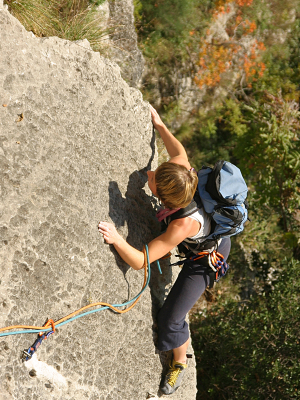
hypoglycemia, woman, rock-climbing

Not the best exercise if you’re markedly obese

myfoxny.com has the story on exercise habits of obese women, based on a recent article in Mayo Clinic Proceedings. A quote:

What kind of lives are the most inactive people living? “I think they’re living the typical life. They drive their children to school, they sit at a desk all day long, they may play some video games and they go to sleep,” Archer said.

He forgot about TV.

Without a doubt, it’s hard to exercise if you’re markedly obese. Here’s how.

Read more: http://www.myfoxny.com/story/24774893/average-obese-woman-gets-just-1-hour-of-exercise-a-year-study#ixzz2u2MMctiW

Steve Parker, M.D.

QOTD: Rippetoe on the Best Single Exercise

The below-parallel squat is the best exercise in the entire catalog for whole-body strength, power, balance, coordination, bone density, joint integrity, and mental toughness — good things to develop if you don’t have them.

—Mark Rippetoe

Does Stretching Prevent Sports Injuries?

No.

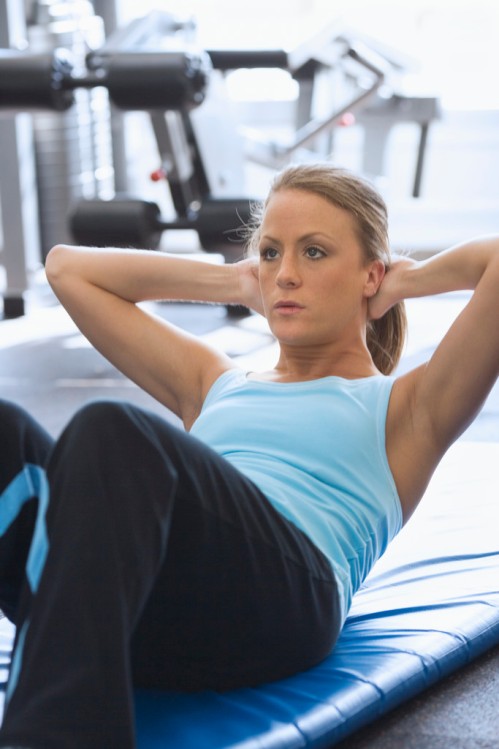
This is a U.S. Army-style sit-up. I do sit-ups with my arms folded across my chest, hands on my shoulders

This is a U.S. Army-style sit-up. I do sit-ups with my arms folded across my chest, hands on my shoulders

For a couple years I’ve thought that stretching didn’t prevent injuries. Now I’ve got a scientific reference to back up my contention. Also from the abstract:

Strength training reduced sports injuries to less than 1/3 and overuse injuries could be almost halved.

h/t James Steele II

How Much Exercise Does It Take To Improve Insomnia?

Paleobetic diet

Better to exercise than take a sleeping pill

It doesn’t take much exercise: 30 minutes of aerobic exercise thrice weekly.

The Well blog at the New York Times has details. The study at hand involved only 11 women with insomnia, mostly in their 60s. A key take-away is that it took as long as four months for some  to see an improvement. So don’t get discouraged and stop exercising too soon.

Read the whole thing (it’s brief).

Advice to New Muscleheads from Lou Schuler

Steve Parker MD, Advanced Mediterranean Diet, Ketogenic Mediterranean Diet

Not me or Mr. Schuler

I was glad to see that four of my basic exercises were listed by Schuler as foundational: squat, deadlift, pushup, and row. A little more from him:

Every good training program is based on bedrock principles like progressive overload. You give your body a stimulus. You repeat the stimulus an optimal number of times. And then you give your body the opportunity to recover from it. Every good lifter eventually learns how to apply the principles in a way that works for him or her, but it always starts with the basics: learn the movements, apply the movements, build on the movements.

Every bad training program ignores these fundamentals, but it ignores them in a unique way. Too much stimulus with too little recovery. Too little stimulus with too much recovery. Poor exercise selection for the individual’s abilities and goals.

Read the whole thing.


h/t Yoni Freedhoff, M.D.

Does Your Response to Physical Training Depend on Your Genes?

Steve Parker MD

Her response depends on genes, training program, nutrition, discipline, adequate sleep, adequate rest, etc.

Here’s an excerpt from an interview with author David Epstein in Outside online. Epstein wrote The Sports Gene: Inside the Science Of Extraordinary Athletic Performance:

Interviewer: That’s one of the most fascinating and unexpected parts of the book, where you discuss the Heritage study’s findings on trainability. Explain its implications.

Epstein: That’s the most famous exercise-genetics study ever done. It’s the collaboration of five colleges in the U.S. and Canada. They took sedentary, two-generation families, which didn’t have a training history, and put them through stationary-bike exercise plans that were totally controlled. Families had to go into the lab and exercise over five months. The goal was to see how people would improve, and they were split into four different university centers to do the training and every center saw the exact same pattern. About 15% of people improved their aerobic capacity very little or not at all. And 15% improved 50% or more doing identical training. Families tended to stick together in the improvement curve, so about half of any person’s improvement was determined by their parents. I remember the editorial that ran in the journal of applied physiology “some people’s alphabet soup—meaning their DNA—didn’t spell ‘runner.’” One person training the exact same as another person can have completely different outcomes.

Many folks don’t like to admit this, assuming it’s true. “Set your mind to it, work hard—10,000 hours—and you can do or be anything you want.” Have you ever been tortured by unrealistic expectations? The truth will set you free.

Read the rest.

Exercise for the Diabetic

GENERAL EXERCISE BENEFITS

Regular physical activity postpones death, mostly by its effect on cancer, strokes, and heart attacks.

Consider a personal trainer if you're not familiar with weight training

Consider a personal trainer if you’re not familiar with weight training

Exercise is a fountain of youth. Peak aerobic power (or fitness) naturally diminishes by 50 percent between young adulthood and age 65. Regular exercise increases fitness (aerobic power) by 15–20 percent in middle-aged and older men and women, the equivalent of a 10–20 year reduction in biological age.

Additional benefits of exercise include: 1) enhanced immune function, 2) stronger bones, 3) preservation and improvement of flexibility, 4) lower blood pressure by 8–10 points, 5) diminished premenstrual bloating, breast tenderness, and mood changes, 6) reduced incidence of dementia, 7) less trouble with constipation, 7) better ability to handle stress, 8) less trouble with insomnia, 9) improved self-esteem, 10) enhanced sense of well-being, with less anxiety and depression, 11) higher perceived level of energy, and 12) prevention of weight regain.

EFFECT ON DIABETES

Eighty-five percent of type 2 diabetics are overweight or obese. It’s not just a random association. Obesity contributes heavily to most cases of type 2 diabetes, particularly in those predisposed by heredity. Insulin is the key that allows bloodstream sugar (glucose) into cells for utilization as energy, thus keeping blood sugar from reaching dangerously high levels. Overweight bodies produce plenty of insulin, often more than average. The problem in overweight diabetics is that the cells are no longer sensitive to insulin’s effect. Weight loss and exercise independently return insulin sensitivity towards normal. Many diabetics can improve their condition through sensible exercise and weight management.

Muscles doing prolonged exercise soak up sugar from the blood stream to use as an energy source, a process occurring independent of insulin’s effect. On the other hand, be aware that blood sugar may rise early in the course of an exercise session.

EXERCISE RECOMMENDATIONS

You don’t have to run marathons (26.2 miles) or compete in the Ironman Triathlon to earn the health benefits of exercise. However, if health promotion and disease prevention are your goals, plan on a lifetime commitment to regular physical activity.

For the general public, the U.S. Centers for Disease Control and Prevention recommends:

  • at least 150 minutes per week of moderate-intensity aerobic activity (e.g., brisk walking) and muscle-strengthening activity at least twice a week, OR
  • 75 minutes per week of vigorous-intensity aerobic activity (e.g., running or jogging) plus muscle-strengthening activity at least twice a week. The muscle-strengthening activity should work all the major muscle groups: legs, hips, back, abdomen, chest, shoulders, arms.

I’m working on a program of combined aerobic (high intensity interval training) and strength training for just 70 minutes a week, but it’s not yet ready for prime time.

STRENGTH TRAINING

What’s “strength training”? It’s also called muscle-strengthening activity, resistance training, weight training, and resistance exercise. Examples include lifting weights, work with resistance bands, digging, shoveling, yoga, push-ups, chin-ups, and other exercises that use your body weight or other loads for resistance.
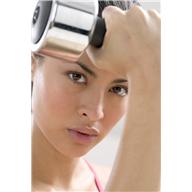
I prefer free weights over machines, but that's just me

I prefer free weights over machines, but that’s just me

Strength training just twice a week increases your strength and endurance, allows you to sculpt your body to an extent, and counteracts the loss of lean body mass (muscle) so often seen during efforts to lose excess weight. It also helps maintain your functional abilities as you age. For example, it’s a major chore for many 80-year-olds to climb a flight of stairs, carry in a bag of groceries from the car, or vacuum a house. Strength training helps maintain these abilities that youngsters take for granted.

According to the U.S. Centers for Disease Control and Prevention: “To gain health benefits, muscle-strengthening activities need to be done to the point where it’s hard for you to do another repetition without help. A repetition is one complete movement of an activity, like lifting a weight or doing a sit-up. Try to do 8–12 repetitions per activity that count as 1 set. Try to do at least 1 set of muscle-strengthening activities, but to gain even more benefits, do 2 or 3 sets.”

If this is starting to sound like Greek to you, consider instruction by a personal trainer at a local gym or health club. That’s a good investment for anyone unfamiliar with strength training, in view of its great benefits and the potential harm or waste of time from doing it wrong. Alternatives to a personal trainer would be help from an experienced friend or instructional DVD. If you’re determined to go it alone, Internet resources may help, but be careful. Consider “Growing Stronger: Strength Training for Older Adults” (ignore “older” if it doesn’t apply).

Current strength training techniques are much different than what you remember from high school 30 years ago—modern methods are better. Some of the latest research suggests that strength training may be even more beneficial than aerobic exercise.

AEROBIC ACTIVITY

“Aerobic activity” is just about anything that mostly makes you huff and puff. In other words, get short of breath to some degree. It’s also called “cardio.” Examples are brisk walking, swimming, golf (pulling a cart or carrying clubs), lawn work, painting, home repair, racket sports and table tennis, house cleaning, leisurely canoeing, jogging, bicycling, jumping rope, and skiing. The possibilities are endless. A leisurely stroll in the shopping mall doesn’t qualify, unless that makes you short of breath. Don’t laugh: that is a workout for many who are obese.

But which aerobic physical activity is best? Glad you asked!

Steve Parker MD

Not ready for this? Consider interval walking then.

Ideally, it’s an activity that’s pleasant for you. If not outright fun, it should be often enjoyable and always tolerable. Unless you agree with Ken Hutchins that exercise isn’t necessarily fun.

Your exercise of choice should also be available year-round, affordable, safe, and utilize large muscle groups. The greater mass and number of muscles used, the more calories you will burn, which is important if you’re trying to lose weight or prevent gain or regain. (Exercise isn’t a great route to weight loss in the real world, although it helps on TV’s Biggest Loser show.) Compare tennis playing with sitting in a chair squeezing a tennis ball repetitively. The tennis player burns calories much faster. Your largest muscles are in your legs, so consider walking, biking, many team sports, ski machines, jogging, treadmill, swimming, water aerobics, stationary cycling, stair-steppers, tennis, volleyball, roller-skating, rowing, jumping rope, and yard work.

Steve Parker MD

Yes, this is exercise, too

Walking is “just what the doctor ordered” for many people. It’s readily available, affordable, usually safe, and requires little instruction. If it’s too hot, too cold, or rainy outside, you can do it in a mall, gymnasium, or health club.

MEDICAL CLEARANCE  

Check this link.

SUMMARY

All I’m asking you to do is aerobic activity, such as walk briskly (3–4 mph or 4.8–6.4 km/h) for 30 minutes most days of the week, and do some muscle-strengthening exercises three times a week. These recommendations are also consistent with the American Diabetes Association’s Standards of Care–2013. This amount of exercise will get you most of the documented health benefits.

Steve Parker, M.D.