Category Archives: Exercise

HIIT IT!

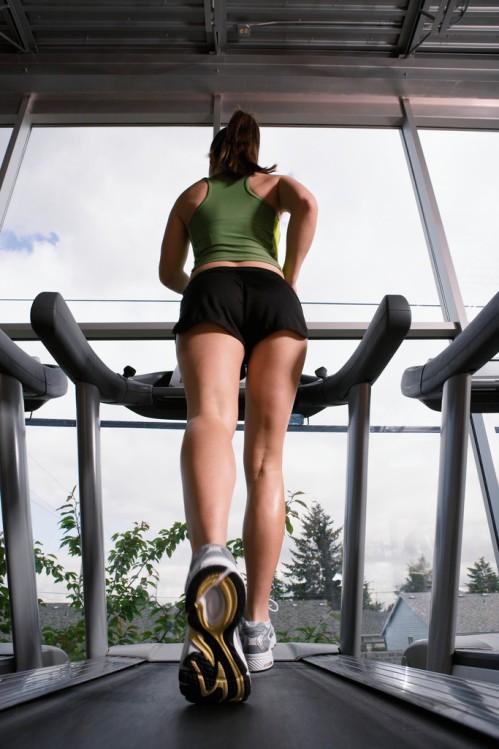
A treadmill is one of many ways to do high-intensity interval training.  Tabata's classic study used a stationary bicycle.

A treadmill is one of many ways to do high-intensity interval training. Tabata’s classic study used a stationary bicycle.

I found a free article by Martin Gibala,Ph.D., a major researcher into high-intensity interval training (HIIT).  He prefers to abbreviate it as HIT.

I don’t like to exercise, so I’ve been incorporating HIIT  into my workouts for over a year.  It’s helped me maintain my level of fitness to that required of U.S. Army soldiers, without being a exercise fanatic.

So what’s HIIT?  Gibala’s definition:

High-intensity interval training is characterized by repeated sessions of relatively brief, intermittent exercise, often performed with an “all out” effort or at an intensity close to that which elicits peak oxygen uptake (i.e., ≥90% of VO2peak).

HIIT involves short sessions of very intense exercise two or three times per week, for as little as 15 minutes.  That’s total time, not 15 minutes per session!  Yet you see a significant fitness improvement.  Be aware: the brief exercise bouts should be exhausting.

The Gibala article has all the scientific journal references you’d want, plus a suggested HIIT program for an absolute beginner.

One final quote from Dr. Gibala:

It is unlikely that high-intensity interval training produces all of the benefits normally associated with traditional endurance training. The best approach to fitness is a varied strategy that incorporates strength, endurance and speed sessions as well as flexibility exercises and proper nutrition. But for people who are pressed for time, high-intensity intervals are an extremely efficient way to train. Even if you have the time, adding an interval session to your current program will likely provide new and different adaptations. The bottom line is that — provided you are able and willing (physically and mentally) to put up with the discomfort of high-intensity interval training — you can likely get away with a lower training volume and less total exercise time.

Read the rest.

Steve Parker, M.D.

PS:  Why won’t Gibala give some credit to Izumi Tabata who did a pioneering study on HIIT in 1996?

PPS:  Gibala narrated this stationary bike HIIT video.

h/t Tony Boutagy

Exercise and the PWD (Person With Diabetes)

hypoglycemia, woman, rock-climbing

Hypoglycemia now would be a tad inconvenient

People with diabetes may have specific issues that need to be taken into account when exercising.

DIABETIC RETINOPATHY

Retinopathy, an eye disease caused by diabetes, increases risk of retinal detachment and bleeding into the eyeball called vitreous hemorrhage. These can cause blindness. Vigorous aerobic or resistance training may increase the odds of these serious eye complications. Patients with retinopathy may not be able to safely participate. If you have any degree of retinopathy, avoid the straining and breath-holding that is so often done during weightlifting or other forms of resistance exercise. Vigorous aerobic exercise may also pose a risk. By all means, check with your ophthalmologist first. You don’t want to experiment with your eyes.

DIABETIC FEET AND PERIPHERAL NEUROPATHY

Diabetics are prone to foot ulcers, infections, and ingrown toenails, especially if peripheral neuropathy (numbness or loss of sensation) is present. Proper foot care, including frequent inspection, is more important than usual if a diabetic exercises with her feet. Daily inspection should include the soles and in-between the toes, looking for blisters, redness, calluses, cracks, scrapes, or breaks in the skin. See your physician or podiatrist for any abnormalities. Proper footwear is important (for example, don’t crowd your toes). Dry feet should be treated with a moisturizer regularly. In cases of severe peripheral neuropathy, non-weight-bearing exercise (e.g., swimming or cycling) may be preferable. Discuss with your physician or podiatrist.

HYPOGLYCEMIA

Low blood sugars are a risk during exercise if you take diabetic medications in the following classes: insulins, sulfonylureas, meglitinides, and possibly thiazolidinediones and bromocriptine.

Hypoglycemia is very uncommon with thiazolidinediones. Bromocriptine is so new (for diabetes) that we have little experience with it; hypoglycemia is probably rare or non-existent. Diabetics treated with diet alone or other medications rarely have trouble with hypoglycemia during exercise.

Always check your blood sugar before an exercise session if you are at risk for hypoglycemia. Always have glucose tablets, such as Dextrotabs, available if you are at risk for hypoglycemia. Hold off on your exercise if your blood sugar is over 200 mg/dl (11.1 mmol/l) and you don’t feel well, because exercise has the potential to raise blood sugar even further early in the course of an exercise session.

As an exercise session continues, active muscles may soak up bloodstream glucose as an energy source, leaving less circulating glucose available for other tissues such as your brain. Vigorous exercise can reduce blood sugar levels below 60 mg/dl (3.33 mmol/l), although it’s rarely a problem in non-diabetics.

The degree of glucose removal from the bloodstream by exercising muscles depends on how much muscle is working, and how hard. Vigorous exercise by several large muscles will remove more glucose. Compare a long rowing race to a slow stroll around in the neighborhood. The rower is strenuously using large muscles in the legs, arms, and back. The rower will pull much more glucose out of circulation. Of course, other metabolic processes are working to put more glucose into circulation as exercising muscles remove it. Carbohydrate consumption and diabetic medications are going to affect this balance one way or the other.

If you are at risk for hypoglycemia, check your blood sugar before your exercise session. If under 90 mg/dl (5.0 mmol/l), eat a meal or chew some glucose tablets to prevent exercise-induced hypoglycemia. Re-test your blood sugar 30–60 minutes later, before you exercise, to be sure it’s over 90 mg/dl (5.0 mmol/l). The peak effect of the glucose tablets will be 30–60 minutes later. If the exercise session is long or strenuous, you may need to chew glucose tablets every 15–30 minutes. If you don’t have glucose tablets, keep a carbohydrate source with you or nearby in case you develop hypoglycemia during exercise.

Re-check your blood sugar 30–60 minutes after exercise since it may tend to go too low.

If you are at risk of hypoglycemia and performing moderately vigorous or strenuous exercise, you may need to check your blood sugar every 15–30 minutes during exercise sessions until you have established a predictable pattern. Reduce the frequency once you’re convinced that hypoglycemia won’t occur. Return to frequent blood sugar checks when your diet or exercise routine changes.

These general guidelines don’t apply across the board to each and every diabetic. Our metabolisms are all different. The best way to see what effect diet and exercise will have on your glucose levels is to monitor them with your home glucose measuring device, especially if you are new to exercise or you work out vigorously. You can pause during your exercise routine and check a glucose level, particularly if you don’t feel well. Carbohydrate or calorie restriction combined with a moderately strenuous or vigorous exercise program may necessitate a 50 percent or more reduction in your insulin, sulfonylurea, or meglitinide. Or the dosage may need to be reduced only on days of heavy workouts. Again, enlist the help of your personal physician, dietitian, diabetes nurse educator, and home glucose monitor.

Finally, insulin users should be aware that insulin injected over muscles that are about to be exercised may get faster absorption into the bloodstream. Blood sugar may then fall rapidly and too low. For example, injecting into the thigh and then going for a run may cause a more pronounced insulin effect compared to injection into the abdomen or arm.
medical clearance, treadmill stress test

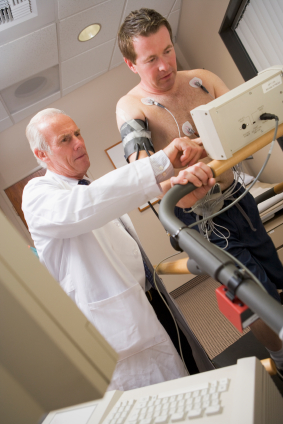
This treadmill stress test is looking for hidden heart disease

AUTONOMIC NEUROPATHY

This issue is pretty technical and pertains to function of automatic, unconscious body functions controlled by nerves. These reflexes can be abnormal, particularly in someone who’s had diabetes for many years, and are called autonomic neuropathy. Take your heart rate, for example. It’s there all the time, you don’t have to think about it. If you run to catch a bus or climb two flights of stairs, your heart rate increases automatically to supply more blood to exercising muscles. If that automatic reflex doesn’t work properly, exercise is more dangerous, possibly leading to passing out, dizziness, and poor exercise tolerance. Other automatic nerve systems control our body temperature regulation (exercise may overheat you), stomach emptying (your blood sugar may go too low), and blood pressure (it could drop too low). Only your doctor can tell for sure if you have autonomic neuropathy.

Steve Parker, M.D.

But, Doc, My Back and Joints Hurt Too Much To Exercise!

EXERCISE WITH JOINT AND BACK PAIN

Many of my obese patients have chronic low back and joint pains.  Painful lower limb joints and chronic or recurrent back pain are an exercise barrier to many people, whether skinny or fat. Those affected should consult a physician for a diagnosis, treatment, and advice on appropriate physical activity. If the physician isn’t sure about an exercise prescription, consultation with an orthopedist, physiatrist, or physical therapist should be helpful. Generally, weight-bearing on bad joints should be minimized by doing pool calisthenics, stationary cycling, swimming, etc. Use your imagination. Particularly bothersome joints may not tolerate exercise, if ever, until weight is lost by some method other than exercise. (Exercise by itself is typically an ineffective way to lose major weight.)

Light to moderate exercise actually reduces the pain and disability of knee degenerative arthritis. The effect is modest and comes with a small risk of injury such as bone fracture, cartilage tears, arthritis flare, and soft tissue strain.

But, Doc, I’m Too Fat to Exercise!

IF YOU ARE MARKEDLY OBESE

The more overweight you are, the harder it will be to exercise. At some point even light exercise becomes impossible. Average-height women tipping the scales at about 280 pounds (127 kg) and men at 360 pounds (164 kg) aren’t going to be able to jog around the block, much less run a marathon. These weights are 100 percent over ideal or healthy levels. An actual “exercise program” probably won’t be possible until some weight is lost simply through very-low-carb eating, calorie restriction, or bariatric surgery. The initial exercise goal for you may just be to get moving through activities of daily living and perhaps brief walks and calisthenics while sitting in a chair.

Markedly obese people who aren’t up to the aforementioned extreme weights can usually tolerate a low-intensity physical activity program. At 50 percent over ideal weight, an average-height woman of 210 pounds (95 kg) is carrying 70 excess pounds (32 kg) of fat. Her male counter-part lugs around 90 pounds (41 kg) of unnecessary fat. This weight burden causes dramatic breathlessness and fatigue upon exertion, and makes the joints and muscles more susceptible to aching and injury. If you’re skinny, just imagine trying to walk or run a mile carrying a standard five-gallon (19 liter) water cooler bottle, which weighs only 43 pounds (19.5 kg) when full. The burden of excess fat makes it quite difficult to exercise.

If you’re markedly obese, several tricks will enhance your exercise success. I want you to avoid injury, frustration, and burn out. Start with light activity for only 10 or 15 minutes, gradually increase session length (e.g., by two to four minutes every two to four weeks) and increase exercise intensity only after several months. Your joints and muscles may appreciate easy, low-impact exercises such as stationary cycling, walking, swimming, and pool calisthenics/water aerobics. You may also benefit from the advice of a personal fitness trainer arranged through a health club, gym, or YMCA/YWCA. Check out several health clubs before you join. Some of them are primarily meat markets for beautiful slender yuppies. You may feel more comfortable in a gym that welcomes and caters to overweight people. Hospitals are increasingly developing fitness centers with obese orthopedic, heart, and diabetic patients in mind.


Exercise Frequency: Are Two Sessions a Week as Good as Six?

exercise for weight loss and management, dumbbells

If you’re not familiar with weight training, a personal trainer is an great idea

Weight Maven Beth Mazur  found evidence in favor of the fewer days, at least in post-menopausal women.

I don’t like to exercise.  Too often I find excuses to avoid even my twice weekly 40-minute workouts.

You may well have good reasons to exercise every day.  Maybe you’re a competitive athlete or enjoy exercise.  If you just want the health benefits of exercise, I’m increasingly convinced that twice a week is enough.

Type 1s Exercising May Need to Reduce Insulin Both Before AND After Exercsise

…to avoid hypoglycemia, according to an article at DiabetesHealth. A snippet:

Previous research had suggested that reducing insulin intake before exercise was enough to prevent hypoglycemia.

“It’s been well known that people with type 1 diabetes need to heavily reduce their insulin before exercise, but now we’ve showed that it’s important to reduce it after exercise,” says lead author Daniel J. West, PhD, from North Umbria University in the United Kingdom, in an article that appeared on the Medscape Medical News website.

The article looks at the experience of only 11 exerciser, all men.

Physical Activity Reduces Prostate Cancer Risk

…according to an article in MedPageToday.

Not Darrin Carlson

Yet another reason to work out

In a forward-looking study, white men suspected of prostate cancer and scheduled for biopsy were less likely to have the disease if they were at least moderately active, according to Lionel Bañez, MD, of the Durham Veterans Affairs Medical Center in Durham N.C., and colleagues.

If they did have cancer, they were significantly less likely to have high-grade disease if they had been working out regularly, Bañez and colleagues reported  in Cancer.

Another way to reduce your risk of prostate cancer is to follow the Mediterranean diet.  Other cancers reduced by the Mediterranean diet are breast, colo-rectal, and uterus.

The association of exercise and lower prostate cancer risk was not noted in black men, for unclear reasons.

Not-So-Obvious Reasons To Be Fit and Athletic

PaleoPeriodical has the details. Highly recommended. A quote:

One of MovNat’s direct predecessors (and forefather of Parkour) is Georges Hébert, who I’ve quoted in the title of this post. As a French naval officer stationed off the coast of Martinique in 1902, he witnessed a volcanic eruption that wiped out the town of St. Pierre. He and his fellow shipmen rescued some 700 people in the chaos. When Hébert returned to France, he scanned the crowds of people and came to the sad realization that very few could save themselves if they had to. In response, he developed his “Natural Method”:

The final goal of physical education is to make strong beings. In the purely physical sense, the Natural Method promotes the qualities of organic resistance, muscularity and speed, towards being able to walk, run, jump, move on all fours, to climb, to keep balance, to throw, lift, defend yourself and to swim.

Sadly, when I scan a crowd of people today, I see the same problems Hébert saw over a hundred years ago. I can only imagine his shock at how much worse it is today.

Read the rest.

I sometimes scan survivalist blogs, where they consider “sh*t hits the fan” situations and TEOTWAWKI (the end of the world as we know it). Are you ready, physically?

Jamie Scott wrote about survival of the fittest in context of the devastating Christchurch, New Zealand, earthquake of 2012.

Resistance Versus Aerobic Training: Which Is Better?

iStock_000007725919XSmall

Weight training, also known as resistance training, may be just as effective as, or even superior to, aerobic training in terms of overall health promotion.  Furthermore, it’s less time-consuming according to a 2010 review by Stuart Phillips and Richard Winett.

I don’t like to exercise but I want the health benefits.  So I look for ways to get it done quickly and safely.

Here’s a quote from Phillips and Winett:

A central tenet of this review is that the dogmatic dichotomy of resistance training as being muscle and strength building with little or no value in promoting cardiometabolic health and aerobic training as endurance promoting and cardioprotective, respectively, largely is incorrect.

Over the last few years (decade?), a new exercise model has emerged.  It’s simply intense resistance training for 15–20 minutes twice a week.  It’s not fun, but you’re done and can move on to other things you enjoy.  None of this three to five hours a week of exercise some recommend.  We have no consensus on whether the new model is as healthy as the old.

More tidbits from Phillips and Winett:

  • they hypothesize that resistance training (RT) leads to improved physical function, fewer falls, lower risk for disability, and potentially longer life span
  • only 10–15% of middle-aged or older adults in the U.S. practice RT whereas 35% engage in aerobic training (AT) or physical activity to meet minimal guidelines
  • they propose RT protocols that are brief, simple, and feasible
  • twice weekly training may be all that’s necessary
  • RT has a beneficial effect on LDL cholesterol and tends to increase HDL cholesterol, comparable to effects seen with AT
  • blood pressure reductions with RT are comparable to those seen with AT (6 mmHg systolic, almost 5 mmHg diastolic)
  • RT improves glucose regulation and insulin activity in those with diabetes and prediabetes
  • effort is a key component of the RT stimulus: voluntary fatigue is the goal (referred to as “momentary muscular failure” in some of my other posts)
  • “In intrinsic RT, the focus and goal are to target and fatigue muscle groups.  A wide range of repetitions and time under tension can be used to achieve such a goal.  Resistance simply is a vehicle to produce fatigue and only is adjusted when fatigue is not reached within the designated number of repetitions and time under tension.”

Our thesis is that an intrinsically oriented (i.e., guided by a high degree of effort intrinsic to each subject) program with at minimum of one set with 10–15 multiple muscle group exercises (e.g., leg press, chest press, pulldown, overhead press) executed with good form would be highly effective from a public health perspective.

The authors cite 60 other sources to support their contentions.

These ideas are the foundation of time-efficient resistance training of the sort promoted by Dr. Doug McGuff, Skyler Tanner, Fred Hahn, Chris Highcock, James Steele II, and Jonathan Bailor, to name a few.

Only a minority will ever exercise as much as the public health authorities recommend.  This new training model has real potential to help the rest of us.

For folks with diabetes, the combination of aerobic and resistance training may be better than either alone, for control of glucose levels.

Steve Parker, M.D.

Reference:  Phillips, Stuart and Winett, Richard.  Uncomplicated resistance training and health-related outcomes: Evidence for a public health mandate.  Current Sports Medicine Reports, 2010, vol. 9 (#4), pages 208-213.

Exercise To Momentary Muscular Failure and You Can Skip the Cardio?

I was planning to review here an article, Resistance Training to Momentary Muscular Failure Improves Cardiovascular Fitness in Humans: A review of acute physiological responses and chronic physiological adaptations.  It’s by James Steele, et al, in the Journal of Exercise Physiology (Vol. 15, No. 3, June  2012).

But dayum, it’s too technical for me!  Too much cell biology and cell metabolism.  Those college classes were over three decades ago for me.

I’m just going to harvest a few pearls from the article that are important to me.  I ran across this in my quest for efficient exercise.  By efficient, I mean minimal time involved, yet good results.

The authors question the widespread assumption that aerobic and endurance training are necessary for development of cardiovascular fitness.  Like Dr. Doug McGuff, they wonder if resistance training alone is adequate for the development of cardiovascular fitness.  Their paper is a review of the scientific literature.  The authors say the literature is hampered by an inappropriate definition and control of resistance training intensity.  The only accurate measure of intensity, in their view, is when the participant reaches maximal effort or momentary muscular failure.

The authors, by the way, define cardiovascular fitness in terms of maximum oxygen consumption, economy of movement, and lactate threshold.

“It would appear that the most important variable with regards to producing improvement in cardiovascular fitness via resistance training is intensity [i.e., to muscle failure].”

The key to improving cardiovascular fitness with resistance training is high-intensity.  These workouts are not what you’d call fun.

"MMF? Yeah, I know all about it."

“MMF? Yeah, I know all about it.”

From a molecular viewpoint, “the adenosine monophosphate–activated protein kinase pathway (AMPK) is held as the key instigator of endurance adaptations in skeletal muscle.  Contrastingly, the mammalian target of rapamycin pathway (mTOR) induces a cascade of events leading to increased muscle protein synthesis (i.e.,[muscle] hypertrophy).”  Some studies suggest AMPK is an acute inhibitor of mTOR activation.  Others indicate that “resistance training to  failure should result in activation of AMPK through these processes, as well as the subsequent delayed activation of mTOR, which presents a molecular mechanism by which resistance training can produce improvement in cardiovascular fitness, strength, and hypertrophy.”

You’re not still with me, are you?

“… the acute metabolic and molecular responses to resistance training performed to failure appear not to differ from traditional endurance or aerobic training when intensity is appropriately controlled.”

Chronic resistance training to failure induces a reduction in type IIx muscle fiber phenotype and an increase in type I and IIa fibers.  (Click for Wikipedia article on skeletal muscle fiber types.)

“It is very likely that people who are either untrained or not involved in organized sporting competition, but you have the desire to improve their cardiovascular fitness may find value in resistance training performed to failure.  In fact, this review suggests that resistance training to failure can produce cardiovascular fitness effects while simultaneously producing improvements in strength, power, and other health and fitness variables. This would present an efficient investment of time as the person would not have to perform several independent training programs for differing aspects of fitness.”  [These statements may not apply to trained athletes.]

Before listing their 157 references, the authors note:

“It is beyond the scope of this review to suggest optimal means of employing resistance training (i.e., load, set volume, and/or frequency) in order to improve cardiovascular fitness since there are no published studies on this topic.”

In conclusion, if you’re going to do resistance training but not traditional aerobic/cardio exercise, you may not be missing out on any health benefits if you train with intensity.  And you’ll be done quicker.

Steve Parker, M.D.

PS: See Evidence-based resistance training recommendations by Fisher, Steele, et al.