For How Long Did Neanderthals Breast-Feed?

For 5-6 months.

Now aren’t you glad you read this blog? Where else you gonna get this vital info?

The discovery is based on dental analysis of a whopping three Neanderthals found in Italy.

The early onset of weaning in modern humans has been linked to the high nutritional demand of brain development that is intimately connected with infant physiology and growth rate. In Neanderthals, ontogenetic patterns in early life are still debated, with some studies suggesting an accelerated development and others indicating only subtle differences vs. modern humans. Here we report the onset of weaning and rates of enamel growth using an unprecedented sample set of three late (∼70 to 50 ka) Neanderthals and one Upper Paleolithic modern human from northeastern Italy via spatially resolved chemical/isotopic analyses and histomorphometry of deciduous teeth. Our results reveal that the modern human nursing strategy, with onset of weaning at 5 to 6 mo, was present among these Neanderthals. This evidence, combined with dental development akin to modern humans, highlights their similar metabolic constraints during early life and excludes late weaning as a factor contributing to Neanderthals’ demise.

Source: Early life of Neanderthals – PubMed

Steve Parker, M.D.

Chronic Proton Pump Inhibitor Use Linked to Type 2 Diabetes

prilosec, proton pump inhibitor
Neither the cited study nor I implicate Prilosec in particular

Regular use of proton-pump inhibitors (PPIs) increases patients’ risk of developing type 2 diabetes mellitus (T2DM) by 24%, an observational study published in Gut has suggested.

Source: Regular use of PPIs linked with increased risk of type 2 diabetes, study suggests | News | Pharmaceutical Journal

Proton pump inhibitors are widely used in the U.S. to treat esophageal reflux, ulcers, and dyspepsia. They are among the most widely prescribed drugs. You can also get them over-the-counter. Brand names include Protonix, Prilosec, and Nexium.

The study at hand defined “regular use” as at least twice per week. The study was an epidemiological one observing participants for 10-12 years. The more years of regular use, the greater risk of diabetes developing. Nearly all participants were White, so results may not apply to other ethnicities.

Note that this study doesn’t prove that PPIs cause diabetes. They just found a statistical linkage. As you know, correlation does not equal causation. We don’t know how PPIs could cause T2 diabetes. From the article:

According to the study, the possible mechanism for the association could be related to gut microbiota, as previous studies have shown that PPI use is associated with reduced diversity of gut microbiome and consistent changes in the microbiota phenotype.

Steve Parker, M.D.

Managing Diabetes on Sick Days

home glucose monitor, diabetes
How old is this device?

For folks taking insulin, Diabetes Daily has a good article by endocrinologist Dr Francine Kaufman. An excerpt:

Everyone with diabetes who takes insulin needs to have a sick day plan. This is something you develop with your healthcare professional to help you manage the high and low sugar levels that can be associated with an illness. The following advice applies to people with type 1 diabetes and people with type 2 diabetes who take insulin – the advice may be different if you have type 2 diabetes and do not take insulin.

Here’s what’s covered in the article:

  • Track your important numbers in a sick log
  • Glucose levels
  • Ketone levels
  • Temperature
  • Fluid intake
  • Urination
  • Vomiting, diarrhea, and dehydration
  • Insulin, amount and time
  • Medications

Key messages from Dr. Kaufman

When you get sick, you are at risk of becoming dehydrated from poor intake or from excessive loss of fluids due to nausea, vomiting, diarrhea, and fever (your body may lose more water when you have a high temperature). In addition, dehydration is common in diabetes because high glucose levels (above 180-200 mg/dL) cause sugar to enter your urine, dragging an excess amount of fluid with it. Illness also puts you at risk of developing ketones, which when coupled with high glucose levels can lead to diabetic ketoacidosis (DKA), a very serious condition. How do you know if you have ketones? Good question, click here!

The purpose of your sick day plan is to try to keep your glucose levels in a safe range – to avoid dehydration and to prevent ketones from rising to a dangerous level.

Source: Zoning in on Sick Day Management: Practical Tips, Strategies, and Advice – Diabetes Daily

Steve Parker, M.D.

PS: Avoid the medical-industrial complex by getting and staying as healthy as possible. Let me help:

How to Save $ on Your Diabetes Drugs

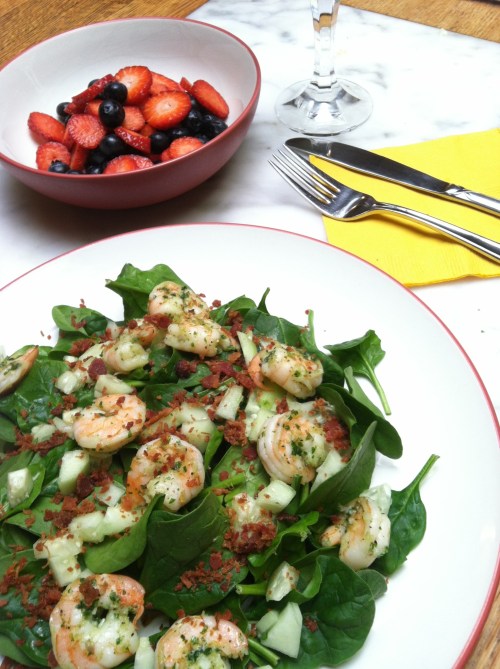
This Shrimp Salad is low-carb. Use the search box for recipe.

Christine Fallabel has an article at Diabetes Daily that may save you beaucoup bucks on your diabetes care, whether or not you have insurance coverage.

If you live in a country like the United States, where the majority of health insurance is privatized and there is no strong social safety net, it can feel as though managing a chronic disease like diabetes requires nothing but lots of money. And it does. As of 2017, diabetes cost the United States a staggering $327 billion dollars per year on direct health care costs, and people with diabetes average 2.3x higher health care costs per year than people living without the disease.

Diabetes is also devastatingly expensive personally: the cost of insulin has risen over 1200% in the past few decades, with no change to the chemical formula. In 1996, when Eli Lilly’s Humalog was first released, the price for a vial of insulin was $21. In 2019, that same vial costs around $275. Studies show that 1 in 4 people ration insulin simply due to cost. Diabetes Daily recently conducted a survey study, with almost 2,000 participants, of which an overwhelming 44% reported  struggling to afford their insulin.

So where does this leave patients who don’t have tons of money to spend on insulin and supplies, or who don’t have adequate health insurance coverage for the technology to help prevent complications? Can you manage diabetes well without lots of money? The short answer is yes. The long answer is a bit more complicated.

Source: Can You Manage Diabetes Well Without Lots of Money? – Diabetes Daily

Steve Parker, M.D.

PS: A low-carb paleo diet will also reduce your drug costs. 

PPI Drugs Linked to Doubled Risk of #COVID19

Click for details.

You should assume there’s a good reason or two why we have acidic stomach juice. One reason is to prevent infection.

I see two many patients who are put on these drugs are a good reason, but they keep taking them after the drug has finished it’s job.

An “as needed” H2 blocker like Pepcid may be a reasonable substitute for PPIs. Check with your personal physician.

I have nothing against Prilosec in particular. It can be very helpful. It’s one of several PPIs on the market.

Steve Parker, M.D.

Click pic to purchase book at Amazon.com. E-book versions available at Smashwords.com.

Are We Eff’d Up Due to Electric Light at Night?

No electricity

From the Journal of Pineal Research:

Key to the transition of humans from nomadic hunting-gathering groups to industrialized and highly urbanized societies was the creation of protected and artificially lit environments that extended the natural daylight hours and consolidated sleep away from nocturnal threats. These conditions isolated humans from the natural regulators of sleep and exposed them higher levels of light during the evening, which are associated with a later sleep onset. Here we investigated the extent to which this delayed timing of sleep is due to a delayed circadian system. We studied two communities of Toba/Qom Argentina, one with and the other without access to electricity. These communities have recently transitioned from a hunting-gathering subsistence to mixed subsistence systems and represent a unique model in which to study the potential effects of the access to artificial light on sleep physiology. We have previously shown that participants in the community with access to electricity had, compared to participants in the community without electricity, later sleep onsets and shorter sleep bouts. Here we show they also have a delayed dim light melatonin onset (DLMO). This difference is present during the winter but not during the spring when the influence of evening artificial light is likely less relevant. Our results support the notion that the human transition into artificially lit environments had a major impact on physiological systems that regulate sleep timing, including the phase of the master circadian clock.

Source: Access to electric light is associated with delays of the dim light melatonin onset in a traditionally hunter-gatherer Toba/Qom community – PubMed

Steve Parker, M.D.

Click pic to purchase book at Amazon.com. E-book versions available at Smashwords.com.


During Maintenance of Weight Loss, Low-Carb Eating Allows You to Eat More…Calories

Low-Carb: Spaghetti squash “spaghetti” with meaty sauce

From The Journal of Nutrition:

In this analysis of a large feeding study, we observed higher estimated energy requirement on a low- compared with high-carbohydrate diet during weight-loss maintenance. The magnitude of this effect (about 200 to 300 kcal/d, or ∼50 kcal/d for every 10% decrease in carbohydrate as a proportion of total energy) and the numerical order across groups (Low-Carb > Moderate-Carb > High-Carb) are commensurate with previously reported changes in TEE [total energy expenditure], supporting the carbohydrate-insulin model.

Source: Energy Requirement Is Higher During Weight-Loss Maintenance in Adults Consuming a Low- Compared with High-Carbohydrate Diet | The Journal of Nutrition | Oxford Academic

In other words, in order to maintain weight loss, you have to (or can) eat more calories if you’re eating low-carb versus high-carb. If your chosen calories are expensive, this could be a drawback. On the other hand, many folks who lose weight complain that they just can’t eat very much or they’ll gain the weight right back. So, if they eat low-carb style, they CAN eat more……calories. Just not more Doritos and Ding-Dongs.

Steve Parker, M.D.

Click pic to purchase book at Amazon.com. E-book versions available at Smashwords.com.

Steve Cooksey Returns to Full Carnivore Diet for Diabetes

Carnivore diet, but not raw

At Diabetes Warrior:

In this post I will be discussing my latest experiment. I am calling it “Diabetic Carnivore 2.0”. It’s 2.0 because I went ‘full-carnivore’ in 2017 for about three years, before tapering off earlier in 2020.

I’ll answer these questions in this post:

1) What is a carnivore in the context of this dietary experiment?
2) Why am I going ‘full-carnivore’ again?

*  *  *

Had we only grown lower carb, leafy green vegetables in our garden, I’d still be eating them probably … but we didn’t. We also grew higher carb vegetables and fruits like tomatoes, beets, turnips, onions and carrots.

We started out eating collards, chard and turnip green salads … all was well. Then I began easing turnips, carrots, beets, and tomatoes into our slaw. Small portions at first… but then the ‘carb creep’ happened. I would add more and more of the sugary, starchy veggies and fruits to the slaw, as well as eat more and more of them.

I only tracked my daily intake of carbs from the vegetables and fruits once. That one day, my carb totals were in the 70 gram range! Not a lot compared to ‘Standard American Diet’ but a lot compared to my typical ‘near zero carb’ meal plan.

Just like a previous high carb experiment (see this post, “Very Low Fat (and high carb) Experiment“), my body handled the sugar and starches from the vegetables pretty well at first but then the fasting blood sugars began to creep up.

Read on to see the connection to COVID-19.

In case you’re wondering, a carnivore diet is not a typical paleo diet.

Steve Parker, M.D.

Click pic to purchase book at Amazon.com. E-book versions available at Smashwords.com.

Public health for the hunter-gatherer in us

So cheesy…

From Canadian Journal of Public Health:

Abstract:

In evolutionary terms, the transformations which humans have engendered in social, ecological and built environments are increasingly out of step with their biological makeup. We briefly review the evidence on health-relevant practices and status of our Paleolithic ancestors and contrast these with current food, transportation, work and governance systems with their associated impacts on human health. As public health and planning practitioners engaged in the EcoHealth Ontario Collaborative, we argue for recognition of our hunter-gatherer nature to promote joint efforts in building sustainable and equitable community infrastructures, both built and green. Although such efforts are underway at multiple jurisdictional levels across Canada, the pace is frustratingly slow for the burden of endemic chronic diseases and global environmental change which humans face. Reminding reluctant stakeholders of the hunter-gatherers in us all could bring about deeper reflection on the urgent work in redirecting community planning.

Source: Public health for the hunter-gatherer in us all – PubMed

Click pic to purchase book at Amazon.com. E-book versions available at Smashwords.com.

If You Must Eat Grains, Minimally-Processed May Be Better for You

From Diabetes Care:

Consuming less-processed whole-grain foods over 2 weeks improved measures of glycemia in free-living adults with type 2 diabetes compared with an equivalent amount of whole-grain foods that were finely milled. Dietary advice should promote the consumption of minimally processed whole grains.

Source: Whole-Grain Processing and Glycemic Control in Type 2 Diabetes: A Randomized Crossover Trial | Diabetes Care

Steve Parker, M.D.

Click pic to purchase book at Amazon.com. E-book versions available at Smashwords.com.