Study Finds No Survival Advantage for Eight Classes of Type 2 Diabetes Drugs


A waste of money?

A waste of money?

A multinational group of researchers tried to determine which drugs for type 2 diabetes were better at prolonging life and preventing cardiovascular deaths. They reviewed the existing literature (i.e., they did a meta-analysis of prior clinical studies.

There are no clear winners. Placebo worked as well as the eight drug classes examined!

Unfortunately, the abstract doesn’t say how long the clinical studies lasted, only mentioning that they were at least 24 weeks long. It’s quite possible it would take at least three to five years to see an effect on death rates.

Selected quotes:

“Eight different diabetes drug classes examined in a meta-analysis failed to demonstrate improved cardiovascular or all-cause mortality compared with placebo.Researchers analyzed 301 randomized clinical trials of patients with type 2 diabetes, and found that, metformin outperformed some other drug classes for its effect on hemoglobin A1c levels, there were no significant differences in mortality — including when placebo was included as a drug class.”

***

“A central finding in this meta-analysis was that despite more than 300 available clinical trials involving nearly 120,000 adults and 1.4 million patient-months of treatment, there was limited evidence that any glucose-lowering drug stratified by coexisting treatment prolonged life expectancy or prevented cardiovascular disease,” the authors wrote.”

***

“The authors wrote that their findings are consistent with guidelines from the American Diabetes Association, which — like the algorithm from the American Association of Clinical Endocrinologists — recommend that metformin monotherapy be used for the initial treatment of patients with type 2 diabetes. “Based on this review, clinicians and patients may prefer to avoid sulfonylureas or basal insulin for patients who wish to minimize hypoglycemia, choose GLP-1 receptor agonists when weight management is a priority, or consider SGLT-2 inhibitors based on their favorable combined safety and efficacy profile,” the authors wrote.”

Source: No Clear Survival Benefit Seen Among Diabetes Drugs | Medpage Today

What Are Our Ancestral Sleep Patterns?

shutterstock_110802431

He got up before sunrise

Here are some answers in the summary of an article in Current Biology:

How did humans sleep before the modern era? Because the tools to measure sleep under natural conditions were developed long after the invention of the electric devices suspected of delaying and reducing sleep, we investigated sleep in three preindustrial societies. We find that all three show similar sleep organization, suggesting that they express core human sleep patterns, most likely characteristic of pre-modern era Homo sapiens. Sleep periods, the times from onset to offset, averaged 6.9–8.5 hr, with sleep durations of 5.7–7.1 hr, amounts near the low end of those industrial societies. There was a difference of nearly 1 hr between summer and winter sleep. Daily variation in sleep duration was strongly linked to time of onset, rather than offset. None of these groups began sleep near sunset, onset occurring, on average, 3.3 hr after sunset. Awakening was usually before sunrise. The sleep period consistently occurred during the nighttime period of falling environmental temperature, was not interrupted by extended periods of waking, and terminated, with vasoconstriction, near the nadir of daily ambient temperature. The daily cycle of tem- perature change, largely eliminated from modern sleep environments, may be a potent natural regulator of sleep. Light exposure was maximal in the morning and greatly decreased at noon, indicating that all three groups seek shade at midday and that light activation of the suprachiasmatic nucleus is maximal in the morning. Napping occurred on <7% of days in winter and <22% of days in summer. Mimicking aspects of the natural environment might be effective in treating certain modern sleep disorders.

RTWT.

Does Red Meat Cause Kidney Failure?

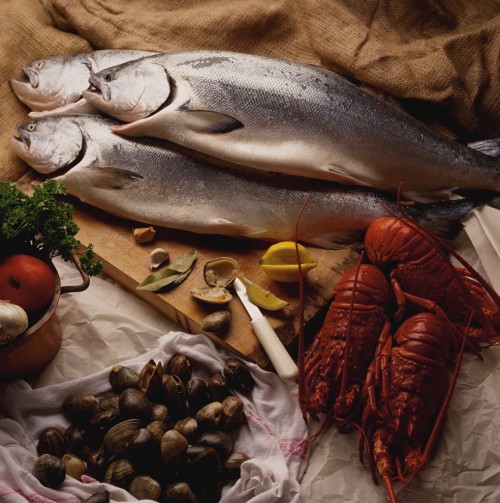
I don't know about these, but some fish have white meat (flesh), too

:Lobster meat is white, too

If you hear elsewhere about a recent study blaming red meat for kidney failure, be aware that the headline should read “pork.” Read on for details.

Wait, what? I thought pork was “the other white meat.”

First they told us red meat caused cancer. Then cardiovascular disease. Then diabetes. And now kidney failure. Why eat it at all? I still do, but in moderation.

You have to take studies like this with a grain of salt. There are numerous confounding factors that may invalidate results. For instance, if you’re not Chinese and living in Singapore, results of this study may not apply to you. For another instance, Chinese pork may be different from English, Indian, Canadian, and U.S. pork.

A quote from the article at MNT:

“Researcher Woon-Puay Koh and her team delved into data from the Singapore Chinese Health Study, which included more than 63,000 adults, aged 45-74. They linked the data with the Singapore Renal Registry, which holds the records of all Singapore ESRD patients [ESRD = end-stage renal disease]. The overall aim was to uncover the role of different protein sources on kidney health outcomes.

“We embarked on our study to see what advice should be given to chronic kidney disease patients or to the general population worried about their kidney health regarding types or sources of protein intake,” explains Koh.

In China, the primary red meat is pork, accounting for 97 percent of red meat intake. Other popular protein sources included eggs, dairy, shellfish, fish, soy, legumes, and poultry.

The participants were followed up for an average of 15.5 years. During that time, 951 cases of ESRD occurred; the resultant data showed a clear trend.

Red meat intake was associated with a dose-dependent increased ESRD risk. Individuals who consumed the highest amounts of red meat – the top 25 percent – showed a 40 percent higher risk of developing ESRD than those who consumed the least red meat – the bottom 25 percent.”

Source: Red meat consumption linked to kidney failure – Medical News Today

“Everything we love to eat is a scam” 

tuna, fishing, Steve Parker MD, paleo diet, tuna salad

Free-range bluefin tuna

I thought “langostino” was Spanish for lobster…Guess I’m wrong.

Click the link below for details.

“Unless your go-to sushi joint is Masa or Nobu, you’re not getting the sushi you ordered, ever, anywhere, and that includes your regular sushi restaurant where you can’t imagine them doing such a thing, Olmsted says. Your salmon is probably fake and so is your red snapper. Your white tuna is something else altogether, probably escolar — known to experts as “the Ex-Lax fish” for the gastrointestinal havoc it wreaks.

Source: Everything we love to eat is a scam | New York Post

Modern U.S. Women Weigh as Much as the Average Man of 1960


Way over 166 lb

Way over 166 lb

But women now are also about a half inch (2.2 cm) taller, so that explains it, right? Not by a long shot. The author of the article below blames unhealthy food, too much of it, plus physical inactivity. Since 1960, women’s average weight is up 18.5%, and men’s up 17.6%.

Click the link below for details. I quote:

The average American woman weighs 166.2 pounds, according to the Centers for Disease Control and Prevention. As reddit recently pointed out, that’s almost exactly as much as the average American man weighed in the early 1960s.

Men, you’re not looking too hot in this scenario either. Over the same time period you gained nearly 30 pounds, from 166.3 in the 60s to 195.5 today.

Source: The average American woman now weighs as much as the average 1960s man – The Washington Post

Steve Parker, M.D.

PS: You wanna do something about it? Send my book to someone you love.

PPS: Men are also a half inch taller.

Professor Tim Noakes: A Nutrition Heretic and His Low-Carb Epiphany

Paleo-compliant low-carb meal. I almost used this for my Paleobetic Diet book cover.

Paleo-compliant low-carb meal. I almost used this for my Paleobetic Diet book cover.

“I argue that the very reason we are facing an uncontrollable global diabetes/obesity pandemic at the moment, is because we have promoted dietary guidelines that are based solely on “evidence” from associational studies without acknowledging that RCTs [randomized controlled trials] have either not supported those conclusions or might have actively disproved them.

The solution in my mind is that we need to give dietary advice to persons with diabetes, T2DM [type 2 diabetes] especially, based on our understanding of the underlying patho-physiology of the condition, not on false information provided by associational epidemiological studies that are unable to prove causation.  I suggest that we know a number of features of the abnormal biology of T2DM with absolutely certainty.”

—Tim Noakes

Source: The Low Carb Diabetic: NOAKES: DOCTORS, DIETITIANS MAKE DIABETES A THREAT TO LIFE?

Why Not Try Gazpacho?

These are Hass or California avocados (the other common one in the U.S is the Florida avocado)

These are Hass or California avocados (the other common one in the U.S is the Florida avocado)

Here’s a recipe from The Low Carb Diabetic blog, one of my favorites. No carb count is provided but I bet it’s relatively low. If you know the carb count per serving, share in the comments. Calculate the carbs yourself at FitDay. Click the link below for the recipe. It’s paleo-diet compliant, if you don’t mind vinegar. A snippet:

“Gazpacho is a soup made of raw vegetables and served cold, usually with a tomato base, originating in the southern Spanish region of Andalucia, which some spell with a c, while others use an s! This soup can be great for a hot day when making a lunch that takes just a few minutes is exactly what you want. In our version of this Andalusian peasant dish we leave out the soaked bread and instead use a creamy avocado to give it substance.”

Source: The Low Carb Diabetic: Gazpacho – A taste of Andalucia

It’s the Carbs, Not Saturated Fat: Food consumption and the rate of cardiovascular diseases in 42 European countries 


Carcinogenic?

Carcinogenic?

The idea that heart attacks and other cardiovascular diseases are caused by dietary saturated fats is losing credibility. I lost faith in that theory in 2009.

Instead, cardiovascular disease is now linked to high consumption of carbohydrates, particularly those carbs that are rapidly absorbed and turned into blood sugar.

Unfortunately, the diet that reduces risk of cardiovascular disease may increase your risk of cancer. Keep reading.

If you’re a nutrition science nerd, here’s a pertinent report from researchers at Masaryk University in the Czech Republic:

“The results of our study show that high-glycaemic carbohydrates or a high overall proportion of carbohydrates in the diet are the key ecological correlates of cardiovascular disease (CVD) risk. These findings strikingly contradict the traditional ‘saturated fat hypothesis’, but in reality, they are compatible with the evidence accumulated from observational studies that points to both high glycaemic index and high glycaemic load (the amount of consumed carbohydrates × their glycaemic index) as important triggers of CVDs. The highest glycaemic indices (GI) out of all basic food sources can be found in potatoes and cereal products, which also have one of the highest food insulin indices (FII) that betray their ability to increase insulin levels.The role of the high glycaemic index/load can be explained by the hypothesis linking CVD risk to inflammation resulting from the excessive spikes of blood glucose (‘post-prandial hyperglycaemia’). Furthermore, multiple clinical trials have demonstrated that when compared with low-carbohydrate diets, a low-fat diet increases plasma triglyceride levels and decreases total cholesterol and HDL-cholesterol, which generally indicates a higher CVD risk. Simultaneously, LDL-cholesterol decreases as well and the number of dense, small LDL particles increases at the expense of less dense, large LDL particles, which also indicates increased CVD risk. These findings are mirrored even in the present study because cereals and carbohydrates in general emerge as the strongest correlates of low cholesterol levels.

In light of these findings, the negative correlation of refined sugar with CVD risk may seem surprising, but the mean daily consumption of refined sugar in Europe is quite low (~84 g/day), when compared with potato and cereal carbohydrates (~235 g/day), and makes up only ~20% of CA energy. Refined sugar is also positively tied to many animal products such as animal fat and total fat and animal protein, and negatively to % PC CARB energy and % CA energy. Therefore, a high consumption of refined sugar is accompanied by a high consumption of animal products and lower intakes of other carbohydrates. Furthermore, the glycaemic index of refined sugar (sucrose) is rather moderate (~65).”

Source: Food consumption and the actual statistics of cardiovascular diseases: an epidemiological comparison of 42 European countries | Grasgruber | Food & Nutrition Research

Elsewhere in this long article:

“Current rates of cancer incidence in Europe are namely the exact geographical opposite of CVDs. In sharp contrast to CVDs, cancer correlates with the consumption of animal food (particularly animal fat), alcohol, a high dietary protein quality, high cholesterol levels, high health expenditure, and above average height. These contrasting patterns mirror physiological mechanisms underlying physical growth and the development of cancer and CVDs. The best example of this health paradox is again that of French men, who have the lowest rates of CVD mortality in Europe, but the highest rates of cancer incidence. In other words, cancer and CVDs appear to express two extremes of a fundamental metabolic disbalance that is related to factors such as cholesterol and IGF-1 (insulin-like growth factor).”

I wish these researchers had looked at over death rates associated with various ways of eating. Perhaps that will be in a future paper.

I’d rather die of a heart attack than cancer.

Steve Parker, M.D.

Grain-free paleolithic diet improves cholesterol levels better than traditional “heart healthy diet”

See modern man walking off that cliff?

See modern man walking off that cliff?

I haven’t read the full text of this new study, but here’s the abstract in case you’re interested:

“Recent research suggests that traditional grain-based heart-healthy diet recommendations, which replace dietary saturated fat with carbohydrate and reduce total fat intake, may result in unfavorable plasma lipid ratios, with reduced high-density lipoprotein (HDL) and an elevation of low-density lipoprotein (LDL) and triacylglycerols (TG). The current study tested the hypothesis that a grain-free Paleolithic diet would induce weight loss and improve plasma total cholesterol, HDL, LDL, and TG concentrations in nondiabetic adults with hyperlipidemia to a greater extent than a grain-based heart-healthy diet, based on the recommendations of the American Heart Association.

Twenty volunteers (10 male and 10 female) aged 40 to 62 years were selected based on diagnosis of hypercholesterolemia. Volunteers were not taking any cholesterol-lowering medications and adhered to a traditional heart-healthy diet for 4 months, followed by a Paleolithic diet for 4 months. Regression analysis was used to determine whether change in body weight contributed to observed changes in plasma lipid concentrations. Differences in dietary intakes and plasma lipid measures were assessed using repeated-measures analysis of variance.

Four months of Paleolithic nutrition significantly lowered (P < .001) mean total cholesterol, LDL, and TG and increased (P < .001) HDL, independent of changes in body weight, relative to both baseline and the traditional heart-healthy diet. Paleolithic nutrition offers promising potential for nutritional management of hyperlipidemia in adults whose lipid profiles have not improved after following more traditional heart-healthy dietary recommendations.”


Source: Paleolithic nutrition improves plasma lipid concentrations of hypercholesterolemic adults to a greater extent than traditional heart-healthy dietar… – PubMed – NCBI

Meta-Analysis: Paleolithic Nutrition for Metabolic Syndrome

From the American Journal of Clinical Nutrition, 2015:

“Paleolithic nutrition, which has attracted substantial public attention lately because of its putative health benefits, differs radically from dietary patterns currently recommended in guidelines, particularly in terms of its recommendation to exclude grains, dairy, and nutritional products of industry.

Conclusions: The Paleolithic diet resulted in greater short-term improvements on metabolic syndrome components than did guideline-based control diets. The available data warrant additional evaluations of the health benefits of Paleolithic nutrition.”

Source: Paleolithic nutrition for metabolic syndrome: systematic review and meta-analysis