Do Diet Beverages Hinder Weight Loss?

ppp

That looks more like a beer than a diet soda bottle

Overweight and obese women who habitually drank diet beverages lost more weight if they substituted water for the diet beverage. Over the course of 24 weeks on a reduced calorie diet, the water drinkers lost an extra 1.2 kg (2.6 lb) compared to those who continued their diet beverage habit.

Furthermore, the researchers found that the water drinkers had healthier values on insulin levels, HOMA-IR (a measure of insulin resistance), and after-meal blood sugar levels.

I wonder if the sweet taste of diet drinks triggers an insulin release that inhibits fat-burning.

This was a small study with only about 30 in each experimental group. Whether similar results would be seen in men is unknown to me.

In the past, I’ve advised dieters it’s OK to drink diet drinks in moderation while trying to weight. I may have to revise my recommendations. On the other hand, if diet drinks help keep you happy and on a successful weight-loss journey, they may be helpful. The diet beverage consumers still lost 7.6 kg (16.7 lb) compared with 8.8 kg (19.4 lb) in the abstainers. But diets don’t work, right?

Steve Parker, M.D.

PS: I haven’t read the full text of the article; just the abstract.

PPS: Steven Novella at Science-Based Medicine blog concludes that low energy sweeteners probably help with weight control.

One Man’s N=1 Experiment Comparing Lower- Versus Moderate-Carb Diet For His Diabetes

Use the search box to find the recipe for this low-carb avocado chicken soup

Use the search box to find the recipe for this low-carb avocado chicken soup

Read his amazingly detailed post at Diatribe. Adam, who has type 1 diabetes, figured out during his college days that eating no more that 30 grams of carbs at a time was “a complete gamechanger” for improving his blood sugars. He experimented on himself to see if there was a difference between his usual lower-carb diet (146 grams/day) versus 313 grams/day.

A quote:

To my utter surprise, both diets resulted in the same average glucose and estimated A1c. But there were major tradeoffs:

The higher-carb, whole-grain diet caused four times as much hypoglycemia, an extra 72 minutes per day spent high, and required 34% more insulin. (A less healthy high-carb diet would have been far worse.)

Doubling my daily carbs also added much more effort and produced far more feelings of exhaustion and diabetes failure. It was not fun at all, and the added roller coaster, or glycemic variation, from all the extra carbs made it more dangerous.

See more at: http://diatribe.org/low-carb-vs-high-carb-my-surprising-24-day-diabetes-diet-battle#sthash.pZOgCWVl.dpuf

I think the lower-carb approach is healthier over the long run. Check with your own healthcare provider before making any drastic change in your diabetic diet.

Steve Parker, M.D.

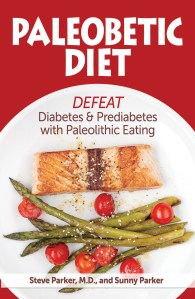
Paleobetic Diet-FrontCover_300dpi_RGB_5.5x8.5

Natural Versus Drug Therapy for Metabolic Syndrome

"These are flying off the shelves!"

“But selling drugs is good for the economy!”

Have you heard that 60% of adults in the U.S. are taking prescription drugs? That’s up from 50% a decade ago. UPI has the pertinent details. A snippet:

Many of the most used drugs reflect the effects of metabolic syndrome, a group of conditions tied to obesity and diet.

“Eight of the 10 most commonly used drugs in 2011–2012 are used to treat components of the cardiometabolic syndrome, including hypertension, diabetes, and dyslipidemia,” researchers wrote in the study, published in the Journal of the American Medical Association. “Another is a proton-pump inhibitor used for gastroesophageal reflux, a condition more prevalent among individuals who are overweight or obese. Thus, the increase in use of some agents may reflect the growing need for treatment of complications associated with the increase in overweight and obesity.”

I’m not anti-drug, generally. Lord knows I prescribe my fair share. But in addition to the cost of drugs, we have side effects and drug interactions to worry about. If we in the U.S. would effectively attack overweight and obesity, we’d be much better off.

But it’s a lot easier to just pop a pill, isn’t it?

Especially if someone else is paying for the pill.

Steve Parker, M.D.

Obesity Soon to Affect Average Life Span in U.S.

That excess weight can shorten your life

That excess weight can shorten your life

“The medical community seems to be under a fog that we can constantly and forever reduce death rates, and that’s simply not true,” said Professor Olshansky, who published a study in 2012 showing that life spans for white women without a high school diploma had declined, a rare event in developed countries.

“You need to look at the health status of the living,” not the mortality statistics of the dead, he said, adding that obesity is afflicting younger generations in a way that will eventually make the numbers worse.

RTWT at The New York Times. 

Do something about your obesity before it’s too late.

Steve Parker, M.D.


Paleobetic Diet-FrontCover_300dpi_RGB_5.5x8.5

If You’re Interested In Human Evolution, You Need to Know About the Denisovans

So here’s a 10-minute video from Pique. Denisovans are a hominin group, some remains of whom were discovered in the 1970s in or near Russia. Modern native Tibetans share at least one gene with the Denisovans, a gene that helps them tolerate hypoxia (low tissue levels of oxygen).

Paleo Diet Pioneer Melvin Konner’s Latest Thoughts on Healthy Eating

Back in 1985, Melvin Konner and S. Boyd Eaton got the ball rolling on the current Paleolithic diet movement. Thirty years later, what would Konner say is a healthy way to eat?

Recent data on these issues make me more comfortable today saying what not to eat. Our ancestors had no refined carbs, which are killing us. We’d be wise to limit salt and saturated fat, which our ancestors’ prey had little of, and fiber and omega-three fatty acids seem to be good. Most humans have to avoid dairy; many must avoid wheat. Find out if you’re one of them. Exercise. That’s about it.

I’ve seen good data saying salt restriction is both harmful an helpful. So flip a coin or talk to your personal physician. If I were looking at starting a drug for hypertension, I’d certainly cut back on salt first and see if that cured me.

Recent clinical studies show that saturated fat isn’t harmful to most of us.

Steve Parker, M.D.

No link to suicide

Bariatric Surgery Linked To Increased Suicide Attempts

according to an article at MedPageToday.

Steve Parker MD, bariatric surgery

Band Gastric Bypass Surgery

Self-harm emergencies rose by 50% after gastric bypass surgery in the Canadians in this study.

Folks on my diets lose weight without an increase in suicide risk, as far as I know. Click on my name for the diets.

For God’s sake, if you do nothing else, call the National Suicide Prevention Lifeline if you’re thinking about killing yourself. What have you got to lose? Suicide really is a permanent “solution” for a temporary problem.

Steve Parker, M.D.

No link to suicide

No link to suicide

For Seniors On Weight-Loss Diet, Strength Training Beats Aerobics For Preserving Bone Mineral Density

according to an article at MedPageToday.

"One more rep then I'm outa here!"

“One more rep then I’m outa here!”

The two experimental groups had about 60 participants each, so it was a relatively small study. (In general, the larger the study, the more reliable the findings.) Most participants were white women; mean age was 69. The experimental intervention ran for five months. An excerpt:

In one trial, the participants were randomized to a structured resistance training program in which three sets of 10 repetitions of eight upper and lower body exercises were done 3 days each week at 70% of one repetition maximum for 5 weeks, with or without calorie restriction of 600 calories per day.
In the second study, participants were randomized to an aerobic program which was conducted for 30 minutes at 65% to 70% heart rate reserve 4 days per week, with or without calorie restriction of 600 calories per day.

The beneficial bone effect was seen at the hip but not the lumbar spine.

Thin old bones—i.e., osteoporotic ones—are prone to fractures. Maintaining or improving bone mineral density probably prevents age-related fractures. In a five-month small study like this, I wouldn’t expect the researchers to find any fracture rate reduction; that would take years. 

Most elders starting a weight-training program should work with a personal trainer. I don’t quite qualify as elderly, but click if interested in my personal fitness program.

Steve Parker, M.D.

PS: Strength training is also known as weight training and resistance exercise.

Does Pollution Cause Type 2 Diabetes?

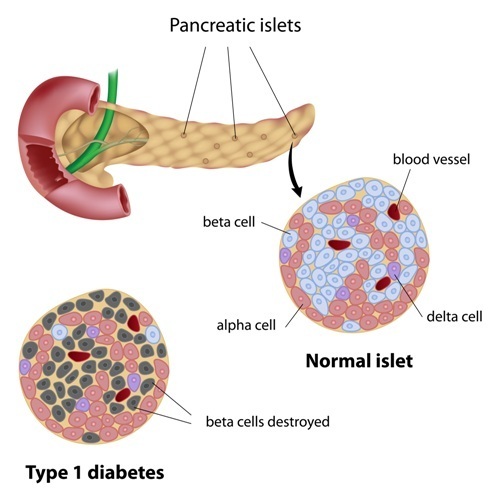
See text for mention of pancreatic alpha and beta cells

See text for mention of pancreatic alpha and beta cells

A panel of university-based scientists convened by The Endocrine Society recently reviewed the available literature on health effects of endocrine-disrupting chemicals (aka EDCs). The executive summary is available free online. Some excerpts:

The full Scientific Statement represents a comprehensive review of the literature on seven topics for which there is strong mechanistic, experimental, animal, and epidemiological evidence for endocrine disruption, namely: obesity and diabetes, female reproduction, male reproduction, hormone-sensitive cancers in females, prostate cancer, thyroid, and neurodevelopment and neuroendocrine systems. EDCs such as bisphenol A, phthalates, pesticides, persistent organic pollutants such as polychlorinated biphenyls, polybrominated diethyl ethers, and dioxins were emphasized because these chemicals had the greatest depth and breadth of available information.

*  *  *

Both cellular and animal models demonstrate a role for EDCs in the etiology of obesity and T2D [type 2 diabetes]. For obesity, animal studies show that EDC-induced weight gain depends on the timing of exposure and the age of the animals. Exposures during the perinatal period [the weeks before and after birth] trigger obesity later in life. New results covering a whole range of EDC doses have underscored the importance of nonmonotonic dose-response relationships; some doses induced weight increase, whereas others did not. Furthermore, EDCs elicit obesity by acting directly on white adipose tissue, al- though brain, liver, and even the endocrine pancreas may be direct targets as well.

Regarding T2D, animal studies indicate that some EDCs directly target 􏰁beta and alpha cells in the pancreas, adipocytes, and liver cells and provoke insulin resistance together with hyperinsulinemia. These changes can also be associated with altered levels of adiponectin and leptin— often in the absence of weight gain. This diabetogenic action is also a risk factor for cardiovascular diseases, and hyperinsulinemia can drive diet-induced obesity. Epide- miological studies in humans also point to an association between EDC exposures and obesity and/or T2D; however, because many epidemiological studies are cross-sectional, with diet as an important confounding factor in humans, it is not yet possible to infer causality.

RTWT.

Bix at Fanatic Cook blog says foods of animal origin are the major source of harmful persistent organic pollutants, some of which act as ECDs.

Keep your eyes and ears open for new research reports on this critically important topic.

Steve Parker, M.D.

Book front cover

Book front cover

The First Noel

Credit: Zvonimir Atletic / Shutterstock.com

Credit: Zvonimir Atletic / Shutterstock.com

Merry Christmas to all my readers!

-Steve