Category Archives: Exercise

Do You Need Medical Clearance Before Starting an Exercise Program?

medical clearance, treadmill stress test

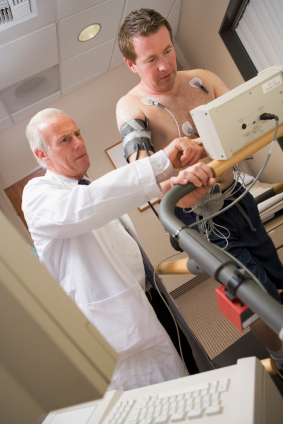
This treadmill stress test is looking for hidden heart disease

To protect you from injury, I recommend that you obtain “medical clearance” from a personal physician before starting an exercise program. A physician is in the best position to determine if your plans are safe for you, thereby avoiding complications such as injury and death. Nevertheless, most adults can start a moderate-intensity exercise program with little risk. An example of moderate intensity would be walking briskly (3–4 mph or 4.8–6.4 km/h) for 30 minutes daily.

Men over 40 and women over 50 who anticipate a more vigorous program should consult a physician to ensure safety. The physician may well recommend diagnostic blood work, an electrocardiogram (heart electrical tracing), and an exercise stress test (often on a treadmill). The goal is not to generate fees for the doctor, but to find the occasional person for whom exercise will be dangerous, if not fatal. Those who drop dead at the start of a vigorous exercise program often have an undiagnosed heart condition, such as blockages in the arteries that supply the heart muscle. The doctor will also look for other dangerous undiagnosed “silent” conditions, such as leaky heart valves, hereditary heart conditions, aneurysms, extremely high blood pressure, and severe diabetes.

She looks healthy enough, but how can you be sure?

She looks healthy enough, but how can you be sure?

The American Diabetes Association’s Standards of Care—2011 states that routine testing of all diabetics for heart artery blockages before an exercise program is not recommended; the doctor should use judgment case-by-case. Many diabetics (and their doctors) are unaware that they already have “silent” coronary artery disease (CAD). CAD is defined by blocked or clogged heart arteries, which reduced the blood flow to the hard-working heart muscle. Your heart pumps 100,000 times a day, every day, for years without rest. CAD raises the odds of fainting, heart attack, or sudden death during strenuous exercise. I recommend a cardiac stress test (or the equivalent) to all diabetics prior to moderate or vigorous exercise programs, particularly if over 40 years old. CAD can thus be diagnosed and treated before complications arise. Ask your personal physician for her opinion.

Regardless of age and diabetes, other folks who may benefit from a medical consultation before starting an exercise program include those with known high blood pressure, high cholesterol, joint problems (e.g., arthritis, degenerated discs), neurologic problems, poor circulation, lung disease, or any other significant chronic medical condition. Also be sure to check with a doctor first if you’ve been experiencing chest pains, palpitations, dizziness, fainting spells, headaches, frequent urination, or any unusual symptoms (particularly during exertion).

Physicians, physiatrists, physical therapists, and exercise physiologists can also be helpful in design of a safe, effective exercise program for those with established chronic medical conditions.

Steve Parker, M.D.

Ever Heard of “Interval Walking”? You Need To Know About It!

Not ready for this? Consider interval walking then.

Not ready for this? Consider interval walking then.

Compared to a regular continuous walking program, interval walking is superior for improving physical fitness, body composition (body mass and fatness), and blood sugar control according to new research reported in Diabetes Care.  Study participants were type 2 diabetics.

Training groups were prescribed five sessions per week (60 min/session) and were controlled with an accelerometer and a heart-rate monitor. Continuous walkers performed all training at moderate intensity, whereas interval walkers alternated 3-min repetitions at low and high intensity. Before and after the 4-month intervention, the following variables were measured: VO2max, body composition, and glycemic control (fasting glucose, HbA1c, oral glucose tolerance test, and continuous glucose monitoring.

I haven’t read the full report yet, but expect that the interval walkers walked as fast as they could for three minutes (4 mph?) then slowed down to a comfortable stroll (1–2 mph?) for three minutes, alternating thusly for 60 minutes.

This should easily do-able for nearly all type 2 diabetics.  The reported results jive with other studies of more vigorous and intimidating interval training.  The only caveat is that it was a small pilot study that may or may not be reproducible.

Steve Parker, M.D.

Surprising Results of a Three-Week Fitness Lay-Off

MP900182524[1]I’m reminded of a quote from a famous violinist: “If I don’t practice for one day, I can tell.  If I don’t practice for two days, my conductor can tell.  If I don’t practice for three days, the audience can tell.”

A few months ago, I laid off all exercise for three weeks straight, partly due to a long vacation, partly to see how much my fitness would deteriorate.

Here’s what I found:

  • My time for the one-mile run increased from 8 mins and 54 seconds to 9 mins and 30 seconds
  • My maximum number of push-ups increased from 32 to 36
  • My maximum number of sit-ups increased from 32 to 34
  • My maximum number of pull-ups increased from 8 to 9

CLOSING THOUGHTS

Strength measures increased, surprisingly.  Was it just a good day, or did my muscles need the time off to rest and re-build?  Over-training is a real problem for some folks.  At 20 minutes of weight-training twice a week, I doubt I was anywhere near what most consider over-training.  I don’t fiddle-fart around during my exercise sessions, but I’m not puking either.

So I won’t feel too bad in the future if I take a couple or three weeks off from strength training periodically.

My endurance for running deteriorated significantly.  Is it related to the lack of strength training, the lack of treadmill interval work, or both?

Your mileage will vary.

Steve Parker, M.D.

Five Tibetan Rituals for Relief of Low Back Pain

A position you’ll see in the video

I was browsing at author Jerry Pournelle’s blog recently and noticed his 2006 reference to five Tibetan rituals (sometimes called rites) that relieved his back pain.  He didn’t say, but I assume Mr. Pournelle has run-of-the-mill low back pain like most middle-aged folks.

I’m not recommending or endorsing these.  I may try them someday myself.  They just look like flexibility and strengthening exercises to me.

If interested, here’s a how-to article at eHow.com.  Here’s a video demonstration (ignore the top video of Dr. Oz; view the next one down).

Ignore any references you see to Ayurvedic medicine and chakras.

Don’t worry, I’m not going woo on you.

Please share if  you’ve had experience—good or bad—with these.

—Steve

Git’R Done: Efficient Exercise For Those Who Don’t Enjoy It

“Wanna arm wrestle?”

I hate exercising.

I’d rather watch TV, play Parcheesi, play my mandolin, bowl, go to a movie, sleep, blog, surf the ‘net, work on my next book, fish, visit with my wife and kids, practice shooting, work on new recipes, or even go to work.

But….

I want the health benefits of exercise.

Loren Cordain, a godfather of the modern paleo diet movement, characterizes the physical activity pattern of hunter-gatherers thusly: “periods of intense exertion generally alternated with days of rest and relaxation.”  Nevertheless, “the amount of physical activity performed by an average hunter-gatherer would have been about four times greater that that of a sedentary office worker….”

Eaton and Eaton suggest than ancient hunter-gatherers burned 490 calories a day in physical activity, which would require about an hour of modern exercise.

For much of this year I’ve been experimenting with various exercise programs that may yield the health benefits with minimal time commitment.  Like 60 minutes a week.  Not the 150 minutes recommended by some public health authorities.  In case you’re interested, here are some links that outline the programs:

If you’re tempted to try any of these programs, get your personal physician’s blessing first.  I’d love to hear about your experience with them.

Steve Parker, M.D.

PS: Cordain quotes are from The Paleo Diet (2002).

An Efficient Exercise Routine For Your Consideration

One……more……rep!

After finishing six weeks ofChris Highcock’s Hillfit earlier this year, I designed another fitness program using dumbbells and high intensity interval running on a treadmill.  Chris’s program is a good one, by the way, especially if you are a fitness neophyte.

I’ve preached about the benefits of baseline and periodic fitness measurements.  Here are mine, before and after roughly six weeks of my fitness experiment #3:

  • weight: no change (170 lb or 77.3 kg)
  • maximum consecutive push-ups: 34 before, 32 after
  • maximum consecutive pull-ups: no change (8)
  • maximum consecutive sit-ups: 37 before, 35 after
  • time for one-mile walk/run: 8 minutes and 35 seconds before, up to 8 minutes and 54 seconds after
  • vertical jump (highest point above ground I can jump and touch): 279.5 cm before, to 276 cm after

I know these numbers aren’t great—don’t judge me too harshly.  After all, I’m 58 years old.

I worked out twice weekly for a total of 70 minutes.  The U.S. Centers for Disease Control and Prevention recommends 150 minutes a week of moderate-intensity aerobic activity and muscle-strengthening exercise at least twice a week; or 75 minutes per week of vigorous-intensity aerobic activity plus muscle-strengthening activity at least twice a week.

Bottom Line

I was a bit fitter after completing Hillfit before this trial.

Or I just had a bad day when I tested this time.  Nevertheless, I prefer my current program to Hillfit.  (Click for report on my six-week Hillfit experience.)

What Next?

For strength and endurance gains, perhaps I should incorporate some Hillfit features into my current plan.

Is my current level of fitness good enough?  Not sure.

I’ll put together yet another fitness program within the next few months.  You need change-ups to prevent boredom, if nothing else.

I don’t like to exercise, but I want the health benefits.  Exercise postpones death.  My general goal is to maximize health benefits while minimizing exercise time.

I know that many paleo proponents like CrossFit.  If you have a favorite home-based exercise routine, please share in the Comments section.

Steve Parker, M.D.


QOTD: All You Need Is a Single Set of Reps

We recommend that appreciably the same muscular strength and endurance adaptations can be attained by performing a single set of ~8-12 repetitions to momentary muscular failure, at a repetition duration that maintains muscular tension throughout the entire range of motion, for most major muscle groups once or twice each week. All resistance types (e.g. free-weights, resistance machines, bodyweight, etc.) show potential for increases in strength, with no significant difference between them, although resistance machines appear to pose a lower risk of injury.

Fisher, James, et al. Evidence-based resistance training recommendations. Medicina Sportiva, 15 (2011): 147-162.

Random Thoughts On Fitness

A couple years ago, I was thinking about putting together a fitness program for myself.  My goals were endurance, strength, less low-back aching, flexibility, longevity, and being able to get on my horse bareback without a mounting block or other cheat.

I spent quite a bit of time at Doug Robb’s HeathHabits site.  He has a post called The “I don’t have time to workout” Workout.  I ran across some paper notes I made during my time there.  Doug recommended some basic moves to incorporate: air squat, Hindu pushup, dragon flag, shuffle of scissor lunge, Spiderman lung, hip thrust/bridge, swing snatch, dumbbell press, Siff lunge, jumping Bulgarian squat, band wood chops, stiff leg deadlift.  Click the link to see videos of most of these exercises.  The rest you can find on YouTube.

Another post is called “Do you wanna get big and strong? -Phase 1”.  The basic program is lifting weights thrice weekly.  Monday, work the chest and back.  Tuesday, legs and abs/core.  Friday, arms and shoulders.

  • Chest exercises: presses (barbell or dumbell, incline, decline, flat, even pushups with additional resistance  – your choice
  • Back: chins or rows
  • Legs: squats or deadlifts
  • Arms and shoulders: dips, presses, curls

Doug is a personal trainer with a huge amount of experience.  He’s a good writer, too, and gives away a wealth of information at his website.

Around this same time of searching a couple years ago, I ran across Mark Verstegen’s Core Performance, Mark Lauren’s book “You Are Your Own Gym,”  and Mark Sisson’s free fitness ebook that also  features bodyweight exercises. Lauren is or was a Navy Seal trainer.  His plan involves 30 minutes of work on four days a week and uses minimal equipment.  Lots of good reviews at Amazon.com.

I did the Verstegen program for 15 weeks and saw major improvements in my fitness and low-back aching.  It’s a good program.  The only drawback is that it required six hours a week of my time.

Newbies to vigorous exercise should seriously consider using a personal trainer.

If you’ve had any experience with these regimens, please share.  Or is there another you like?

Steve Parker, M.D.

Two Secrets to Prevention of Weight Regain

Resistance training

Regain of lost body fat is the most problematic area in the field of weight management.  Whoever solves this problem for good will win a Nobel Prize in Medicine.  Why do most diets ultimately fail over the long run?  Because people go back to their old habits.  Here are the two secrets to prevention of weight regain:

  • Restrained eating
  • Regular physical activity

“Successful losers” apply self-restraint on an almost daily basis, avoiding food they know will lead to weight regain.  They limit how much they eat.  They consciously choose not to return to their old eating habits, despite urges to the contrary.

The other glaring difference is that, compared to regainers, the successful losers are physically active.  Oftentimes, they exercised while losing weight, and almost always continue to exercise in the maintenance phase of their program.  This is true in at least eight out of 10 cases.  It’s clear that regular exercise isn’t always needed, but it dramatically increases your chances of long-term success.

Here are more tips for prevention of weight regain.

Steve Parker, M.D.

Does Exercise Help With Weight Loss?


Enjoy your dinner!

Skyler Tanner slaughters some sacred cows in his blog post June 4, 2012. I pulled the following bullet points from his post. Click on his embedded links for details.

Comparing the effects of food and exercise on weight loss, what you eat, and how much, are more important than your physical activity.  By far.

  • Your genetics largely determines your response to an exercise program
  • Physical activity isn’t a great way to lose weight
  • School-based or other programs to increase childhood physical activity probably won’t reverse childhood obesity statistics
  • Disregarding weight loss, exercise has other worthwhile metabolic advantages
  • Highly advanced societies shouldn’t blame our overweight problem on decreased levels of physical activity

Steve Parker, M.D.