I’ve long advocated that life-and health-insurance companies base their premiums on results of individual treadmill exercise tests or similar. Here’s why.
From CNN:
We’ve all heard exercise helps you live longer. But a new study goes one step further, finding that a sedentary lifestyle is worse for your health than smoking, diabetes and heart disease.
Dr. Wael Jaber, a cardiologist at the Cleveland Clinic and senior author of the study, called the results “extremely surprising.”
“Being unfit on a treadmill or in an exercise stress test has a worse prognosis, as far as death, than being hypertensive, being diabetic or being a current smoker,” Jaber told CNN. “We’ve never seen something as pronounced as this and as objective as this.”
Posted onOctober 13, 2018|Comments Off on What Fruits And Vegetables Looked Like Before We Domesticated Them
One of the paleo meals I took to the hospital to eat mid-shift
From Science Alert:
While GMOs may involve splicing genes from other organisms (such as bacteria) to give plants desired traits – like resistance to pests — selective breeding is a slower process whereby farmers select and grow crops with those traits over time.
From bananas to eggplant, here are some of the foods that looked totally different before humans first started growing them for food.
Posted onSeptember 30, 2018|Comments Off on Surprise, Surprise, Surprise!: High Cholesterol Doesn’t Cause Heart Disease, Say Doctors
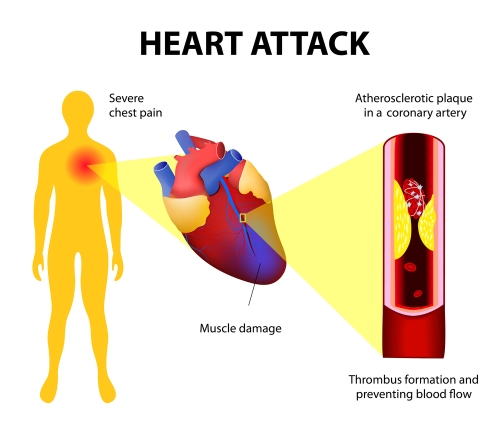
Plaque unrelated to cholesterol
This in not news to most of my readers here.
From The Irish Times:
There is no evidence that high levels of total cholesterol or of “bad” cholesterol cause heart disease, according to a new paper by 17 international physicians based on a review of patient data of almost 1.3 million people.
The authors also say their review shows the use of statins – cholesterol lowering drugs – is “of doubtful benefit” when used as primary prevention of cardiovascular disease.
The authors include Galway-based Prof Sherif Sultan, professor of the International Society for Vascular Surgery; Scottish-based Dr Malcolm Kendrick, author of The Great Cholesterol Con; and Dr David M Diamond, a US-based neuroscientist and cardiovascular disease researcher.
Prof Sultan said millions of people all over the world, including many with no history of heart disease, are taking statins “despite unproven benefits and serious side effects”.
Push-ups are a classic component of the Army Physical Fitness Test
I have long advocated measuring your fitness level periodically and seeing how you stack up against a benchmark. My favorite benchmark is the U.S. Army Physical Fitness Test (APFT).
The new Army standard testing will be too complicated for most non-military folks.
UPI has the story:
The U.S. Army is introducing an extensive overhaul of its physical fitness test that, with minor changes, has mostly been the same since 1980.The new test, announced this week, changes the name from the Army Physical Fitness Test to the Army Combat Fitness Test and is planned to become gender and age neutral. It will include a series of physical events, while the APFT was a series of pushups, situps and a 2-mile run.
The new standards call for deadlift tests, throwing ten-pound balls for distance backwards, and hand-relaese pushups that require hands to be taken off the ground for greater muscle tension. It also includes sled drags to simulate casualties, sprints with 40-pound kettle bells, hanging from a pull-up bar with legs up and the standard 2-mile run.
Posted onSeptember 4, 2018|Comments Off on Tighter Blood Pressure Control May Reduce Age-Related Memory Loss: How Low?
Exercise also seems to protect against memory loss and dementia
Keep your eyes on this development, folks. Potential game-changer. And a boon to Big Pharma. From NBCnews.com…
Lowering blood pressure to recommended levels can prevent dementia and the memory and thinking problems that often show up first [mild cognitive impairment], researchers reported Wednesday.
People whose top blood pressure reading was taken down to 120 were 19 percent less likely to develop mild cognitive impairment, the loss of memory and brain processing power that usually precedes Alzheimer’s, the study found. And they were 15 percent less likely to eventually develop cognitive decline and dementia.
***
It may take a few more years before the study conclusively shows whether the risk of Alzheimer’s was actually reduced because of the lower blood pressure,the researchers said.
It’s the first intervention that has been clearly demonstrated to lower rates of mental decline.
It has already found that lowering systolic blood pressure — the top number in a blood pressure reading — to 120 or less can prevent stroke, heart attacks, kidney disease and other problems.
Posted onAugust 16, 2018|Comments Off on Half of U.S. Adults Trying (and Failing) to Lose Weight
No wonder they’re not having much success:
“Exercise, eating less, consuming more fruits and vegetables and drinking more water were the most common strategies. The least common were skipping meals and cutting down on fatty foods.”
Posted onAugust 9, 2018|Comments Off on Jane Brody Asks: Is the Paleo Diet Right for You?
Not your average cave-woman
Jane Brody at the New York Times wrote an article critical of the paleo diet. One of her objections is that average life spans in the pre-agricultural era were hardly longer than 40 years, so we have no idea what effect the paleo diet would have on longevity and prevention of late-onset “diseases of civilization.”
She writes:
Keep in mind that the life expectancy of people before the advent of agriculture 15,000 years ago rarely reached or exceeded 40, so their risk of developing the so-called diseases of civilization is unknown.
First of all, the widespread adoption of agriculture is thought to have occurred 10-12,000 years ago, not 15,000 years.
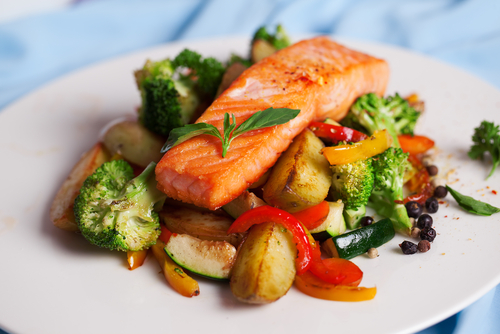
Salmon, a cold-water fatty fish, is a rich source of omega-3 fatty acids
That headline is the conclusion of a Cochrane systematic review of the evidence. As you read the summary below, be aware that the main omega-3 fatty acids are alpha-lenolinic acid (ALA), docosahexaenoic acid (DHA), and eicosapentaenoic acid (EPA).
From Cochrane Library:
Increasing EPA and DHA has little or no effect on all‐cause deaths and cardiovascular events (high‐quality evidence) and probably makes little or no difference to cardiovascular death, coronary deaths or events, stroke, or heart irregularities (moderate‐quality evidence, coronary events are illnesses of the arteries which supply the heart). EPA and DHA slightly reduce serum triglycerides and raise HDL (high‐quality evidence).
Eating more ALA (for example, by increasing walnuts or enriched margarine) probably makes little or no difference to all‐cause or cardiovascular deaths or coronary events but probably slightly reduce cardiovascular events, coronary mortality and heart irregularities (moderate/low‐quality evidence). Effects of ALA on stroke are unclear as the evidence was of very low quality.
There is evidence that taking omega‐3 capsules does not reduce heart disease, stroke or death. There is little evidence of effects of eating fish. Although EPA and DHA reduce triglycerides, supplementary omega‐3 fats are probably not useful for preventing or treating heart and circulatory diseases. However, increasing plant‐based ALA may be slightly protective for some heart and circulatory diseases.
Posted onAugust 3, 2018|Comments Off on Does a Modified Paleo Diet Improve Multiple Sclerosis Patients?
Dr. Terry Wahls saw a dramatic and major improvement in her multiple sclerosis after adopting a particular diet. I think she’s calling it a modified paleo diet and it was used in the study linked below. I haven’t read the whole thing yet, but you can see the entire journal article at the link below.
From YouTube:
Note this is a small pilot study with no control group. At first blush, it appears her dramatic diet-related improvement may be difficult to reproduce in others.
Effects of a multimodal intervention on gait and balance of subjects with progressive multiple sclerosis: a prospective longitudinal pilot study
Authors: Babita Bisht, Warren G Darling, Emily C White, Kaitlin A White, E Torage Shivapour, M Bridget Zimmerman, and Terry L Wahls
Purpose
To investigate the effects of a multimodal intervention including a modified Paleolithic diet, nutritional supplements, stretching, strengthening exercises with electrical stimulation of trunk and lower limb muscles, meditation and massage on walking performance and balance of subjects with progressive multiple sclerosis (MS).
Materials and methods
Twenty subjects with mean (standard deviation) age of 51.7 (6.4) years and Expanded Disability Status Scale score of 6.2 (1) participated in a 12-month study. Assessments were completed at baseline, 3, 6, 9, and 12 months.
Results
The entire cohort did not show significant changes in any of the assessments over 12 months except higher speed of walking toward the 10 feet mark during timed up and go (TUG) test at 6 months compared with baseline (mean change 7.9 cm/s [95% confidence interval {CI}]: 0.3, 15.2; p=0.041). Sub-group analysis revealed that 50% subjects (n=10) showed decrease in TUG time from baseline to at least 3 of 4 time-points post-intervention and were considered as responders (TUG-Res), the remaining 10 subjects were considered as nonresponders (TUG-NRes). Over 12 months, TUG-Res showed decreased mean TUG time by 31% (95% CI: −52%, −2%), increased median Berg Balance Scale scores (42 to 47), 30% increase in mean timed 25-foot walk speed (>20% considered clinically significant) and increased speed of walk toward 10 feet mark during TUG by 11.6 cm/s (95% CI: −3.0, 25.9) associated with increases in step lengths and decrease in step duration. TUG-NRes showed deterioration in walking ability over 12 months. Comparison of TUG-Res and TUG-NRes showed no significant differences in adherence to intervention but better stride duration and longer step length at baseline for TUG-Res than for TUG-NRes (p<0.05).
Conclusion
A multimodal lifestyle intervention may improve walking performance and balance in subjects with progressive MS who have mild-to-moderate gait impairment, whereas subjects with severe gait impairments may not respond to this intervention. Future trials should assess effects of this intervention in subjects with MS during early stages of the disease.
“Exercise, eating less, consuming more fruits and vegetables and drinking more water were the most common strategies. The least common were skipping meals and cutting down on fatty foods.”
Drinking more water? Come on, America, get serious. And it’s the rare person indeed who can lose with with exercise. You don’t have to cut down on fatty foods.