From 2012: Largest Healthcare Fraud Settlement In History Involves T2 Diabetes Drug Avandia

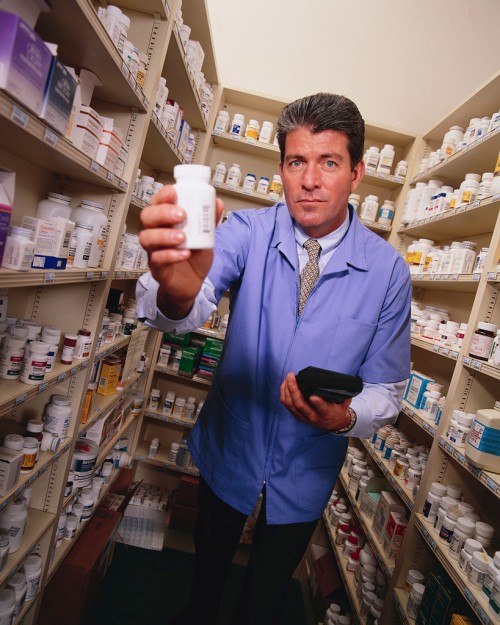
Your friendly neighborhood drug supplier

Your friendly neighborhood drug supplier

This will help you understand why I favor diet modification over drug therapy for type 2 diabetes:

“Global health care giant GlaxoSmithKline LLC (GSK) agreed to plead guilty and to pay $3 billion to resolve its criminal and civil liability arising from the company’s unlawful promotion of certain prescription drugs, its failure to report certain safety data, and its civil liability for alleged false price reporting practices, the Justice Department announced today. The resolution is the largest health care fraud settlement in U.S. history and the largest payment ever by a drug company. GSK agreed to plead guilty to a three-count criminal information, including two counts of introducing misbranded drugs, Paxil and Wellbutrin, into interstate commerce and one count of failing to report safety data about the drug Avandia to the Food and Drug Administration (FDA). Under the terms of the plea agreement, GSK will pay a total of $1 billion, including a criminal fine of $956,814,400 and forfeiture in the amount of $43,185,600. The criminal plea agreement also includes certain non-monetary compliance commitments and certifications by GSK’s U.S. president and board of directors. GSK’s guilty plea and sentence is not final until accepted by the U.S. District Court. GSK will also pay $2 billion to resolve its civil liabilities with the federal government under the False Claims Act, as well as the states. The civil settlement resolves claims relating to Paxil, Wellbutrin and Avandia, as well as additional drugs, and also resolves pricing fraud allegations.”

Source: GlaxoSmithKline to Plead Guilty and Pay $3 Billion to Resolve Fraud Allegations and Failure to Report Safety Data | OPA | Department of Justice

Regarding Avandia:

“The United States alleges that, between 2001 and 2007, GSK failed to include certain safety data about Avandia, a diabetes drug, in reports to the FDA that are meant to allow the FDA to determine if a drug continues to be safe for its approved indications and to spot drug safety trends. The missing information included data regarding certain post-marketing studies, as well as data regarding two studies undertaken in response to European regulators’ concerns about the cardiovascular safety of Avandia. Since 2007, the FDA has added two black box warnings to the Avandia label to alert physicians about the potential increased risk of (1) congestive heart failure, and (2) myocardial infarction (heart attack). GSK has agreed to plead guilty to failing to report data to the FDA and has agreed to pay a criminal fine in the amount of $242,612,800 for its unlawful conduct concerning Avandia.”

And…

“In its civil settlement agreement, the United States alleges that GSK promoted Avandia to physicians and other health care providers with false and misleading representations about Avandia’s safety profile, causing false claims to be submitted to federal health care programs. Specifically, the United States alleges that GSK stated that Avandia had a positive cholesterol profile despite having no well-controlled studies to support that message. The United States also alleges that the company sponsored programs suggesting cardiovascular benefits from Avandia therapy despite warnings on the FDA-approved label regarding cardiovascular risks. GSK has agreed to pay $657 million relating to false claims arising from misrepresentations about Avandia. The federal share of this settlement is $508 million and the state share is $149 million.”


Regain Muscle Mass Even If Over 60

She'll lose muscle fibers if she gets too sedentary as she ages

She’ll lose muscle if she gets too sedentary as she ages

“Our lab and others have shown repeatedly” that older muscles will grow and strengthen, says Marcas Bamman, a professor of integrative biology at the University of Alabama at Birmingham. In his studies, men and women in their 60s and 70s who began supervised weight training developed muscles that were as large and strong as those of your average 40-year-old.”

Source: Can You Regain Muscle Mass After Age 60? – The New York Times

Dr. Bamman says older folks (over 60?) don’t add new muscle fibers like young’uns do. But an effective exercise program will cause hypertrophy (growth) of the existing muscle fibers. “Effectiveness” probably depend on exhausting muscle groups during weight training.

Are Some T2 Diabetes Drugs Better Than Others?

From MPT:

“The number of type 2 diabetes drugs that have a proven cardiovascular benefit jumped from one to three this year, highlighting the changing landscape for diabetes treatments.”

Source: Year in Review: Type 2 Diabetes | Medpage Today

The article notes that liraglutide (Victoza), a GLP-1 analogue, was associated with a 13% relative risk reduction in a composite of cardiovascular death, nonfatal myocardial infarction, and nonfatal stroke.

Semaglutide, an experimental GLP-1 analogue, also has evidence for cardiovascular death prevention.

Another diabetes drug, Jardiance or empagliflozin, also has evidence for cardiovascular death prevention. Jardiance is an SGLT2 inhibitor.

Read the full MPT article for more details. I find the cost of these drugs to be an interesting yet little discussed detail.

Let’s assume these drugs actually reduce cardiovascular disease risk in T2 diabetics. What if they increase death and disease rates from cancer and infection? You don’t hear much about that, do you?

We still don’t know much about the long-term adverse effects of most of our diabetes drugs. That’s one reason I tend to favor diet modification as a primary diabetes treatment.

No degludec up in here!

FDA Says Jardiance Can Be Marketed as Cardiovascular Death-Defying

Jardiance is a diabetes drug in the class called SGLT2 inhibitors.

How do they work? Our kidneys filter glucose (sugar) out of our bloodstream, then reabsorb that glucose back into the bloodstream. SGLT2 inhibitors impair that reabsorption process, allowing some glucose to be excreted in our urine. You could call it a diuretic effect. For example, an SGLT 2 inhibitor called dapagliflozin, at a dose of 10 mg/day, causes the urinary loss of 70 grams of glucose daily.

How drugs like this could prevent cardiovascular disease in type 2 diabetics is a mystery to me.

From MPT:

“The diabetes drug empagliflozin (Jardiance) may be marketed for prevention of cardiovascular death in patients with type 2 diabetes and co-existing cardiovascular disease, the FDA said Friday.

It’s the first such claim ever allowed for a diabetes drug.

Empagliflozin, first approved in 2014, is an inhibitor of the sodium-glucose co-transporter 2 (SGLT2) pathway, reducing blood glucose by causing it to be excreted in urine.Its benefit for cardiovascular risk reduction was demonstrated in the so-called EMPA-REG trial, results of which were reported in 2015.”

Source: Jardiance Wins CV Prevention Indication | Medpage Today

Do You Eat Food or Feed?

Future Feed

From Hawaiian Libertarian:

“Food is grown, raised, harvested and processed — and if not consumed while fresh — preserved in as natural and organic a state as possible to keep most of it’s nutritious and nourishing qualities intact.

Feed is mass produced by a few large multinational corporations line using bio-technological innovations to quickly and efficiently manufacture product units ready for global distribution and a near infinite shelf life. Its primary traits are using genetically modified grain products to create a marketable product that is usually adulterated with preservatives and flavor enhancements that give it a long shelf life in airtight packaging and designed in a laboratory to stimulate the taste buds to fool the human body into thinking it’s something good for you.

But above all, the primary difference between Food and Feed can be discerned by this: most real food requires little (if any) corporate mass media marketing campaigns to sell product and expand market shares and waistlines alike.”

Source: Hawaiian libertarian: FEED Inc. & The Corporate Campaign Dialectic

Does a Low-Carb Vegetarian Diet Work for Diabetes?

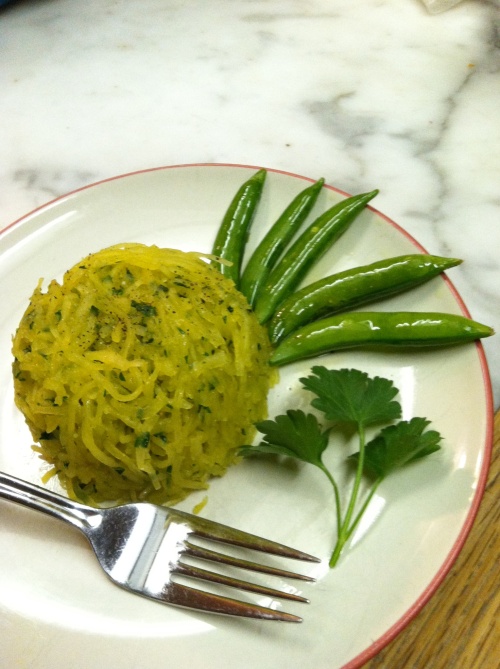
Spaghetti squash with parsley, olive oil, snow peas, garlic, salt, pepper

Spaghetti squash with parsley, olive oil, snow peas, garlic, salt, pepper

It does for type 2 diabetic David Mendosa, who’s been doing it for three years. He shares some ideas on how to do it at the link below. From the intro:

About nine years ago, I started to eat only food low in carbohydrates that don’t have a high glycemic index.  I knew that this was the only proven way to bring my blood glucose level down where I wanted it to be without using drugs or supplements. My most recent A1C test showed that my level is 5.1 percent, well within the range considered normal.

While continuing to eat this way, about three years ago I added the further restriction of eating no meat, fish, or seafood. This was a substantial shift in what I was eating, and I made it mainly because I don’t want to be intentionally responsible for the death of animals or other sentient beings. Only later did I begin to realize its health benefits.

Source: How to Manage Your Diabetes with a Low-Carb Vegetarian Diet – Diabetes

David seems to adhere to the lacto-ovo strain of vegetarianism, rather than vegan or pesco-vegetarian. In other words, he’ll eat eggs and milk products but not fish. I suspect he eats under 40 grams/day of digestible carbohydrate.

Here are more of David’s ideas on implementation of a very low-carb vegetarian diet.

Recipe: Rosemary Roasted Brussels Sprouts and Onion

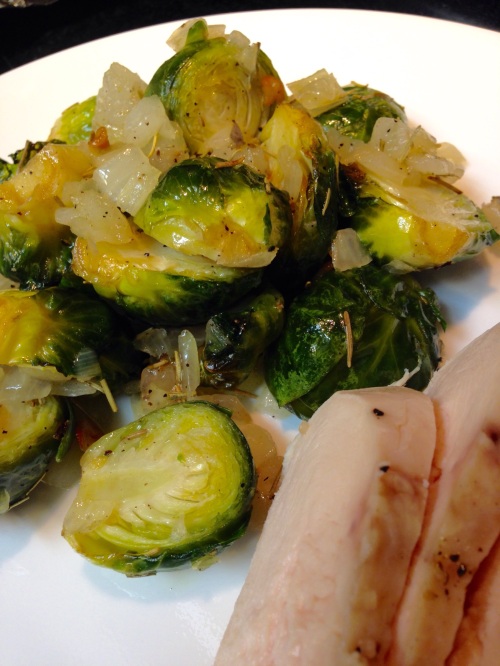
Final product without Parmesan sprinkles. That's sous vide chicken in the foreground.

Final product without Parmesan sprinkles. That’s sous vide chicken in the foreground.

At my request, my wife bought me a mess o’ Brussels sprouts, and I’ve been experimenting with recipes.

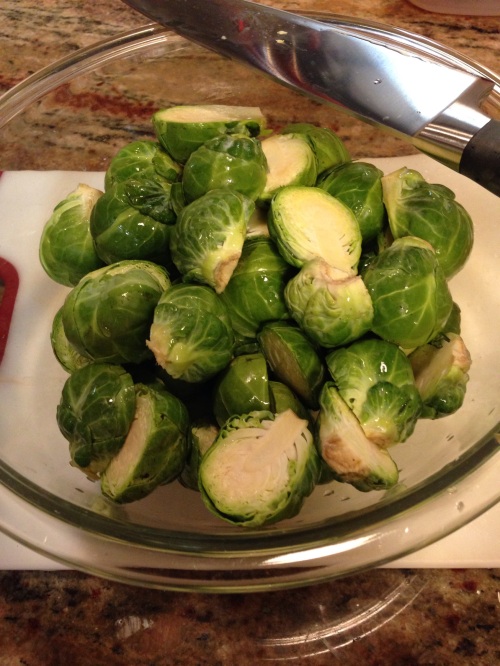
Sprouts sliced in half

Sprouts sliced in half

Ingredients this time are the sprouts, dried rosemary (i.e., not fresh although it’s a landscaping plant where I live), salt, pepper, extra virgin olive oil, fresh garlic, and diced onion.

FYI, rosemary is used as an ornamental landscaping plant in southern Arizona.

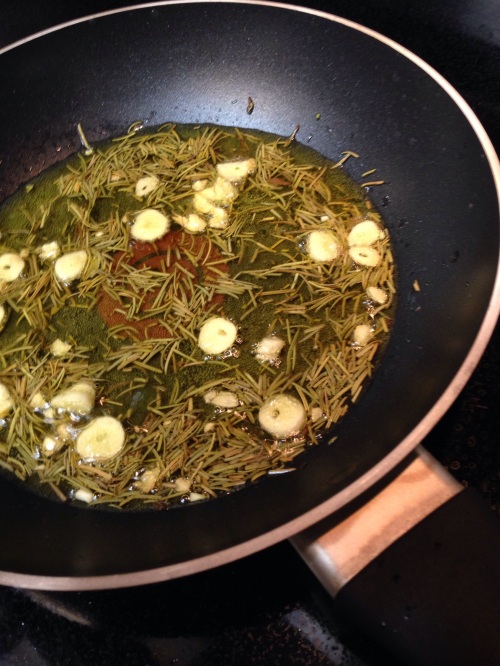
To promote release of flavor, I sautéed three garlic cloves and the rosemary in EVOO.

Releasing the flavors of garlic and rosemary over medium heat for perhaps 3 minutes

Releasing the flavors of garlic and rosemary over medium heat for perhaps 3 minutes

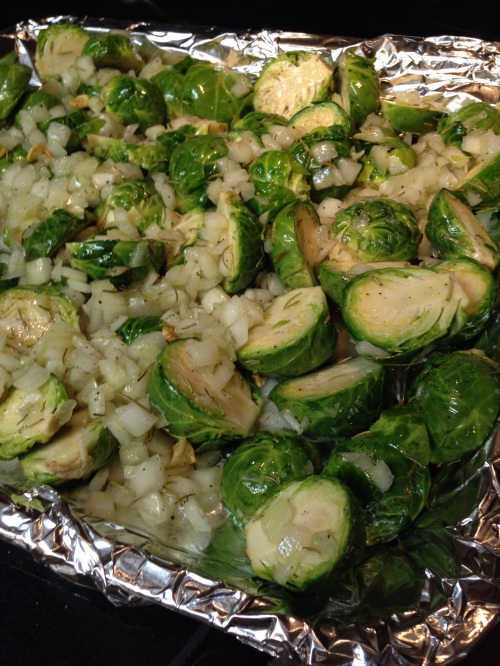
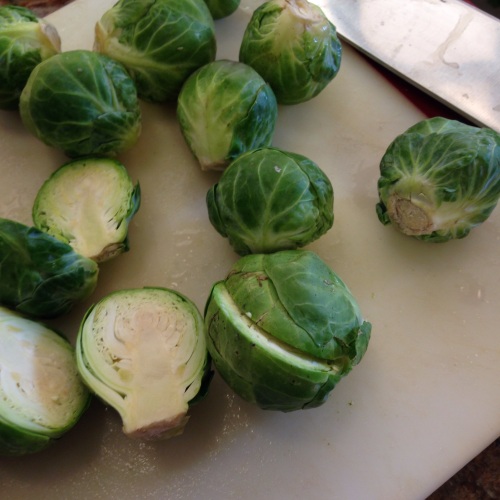
Then I sliced the sprouts in half along their long axis, to reduce cooking time. (Cut them so the leaves stay attached to the internal stalk.) You’d have to cut them in half before you eat ’em anyway.

I dumped all ingredients into a bowel and mixed thoroughly to ensure the sprouts were coated with oil.

Ready for the oven

Ready for the oven. I used about 3/4 cup of diced onion.

Everything except the bowl was transferred to a cooking sheet covered with aluminum foil (easy clean-up!), which I then popped into an oven pre-heated to 425°F. I cooked for 25 minutes. At around the 10 and 17-minute marks, I pulled the concoction out of the oven and stirred/flipped the ingredients to promote even cooking and browning. Your cooking time will vary from 17 to 25 minutes depending on your preferences. If you want some browning of the sprouts, you likely need to cook longer than 17 minutes. Unless your oven runs hotter than mine.

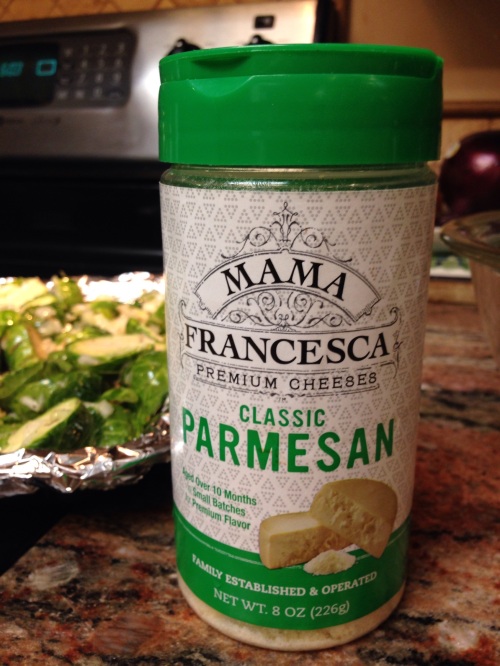
This is my favorite roasted Brussels sprouts recipe thus far. For an extra flavor zing, sprinkle with some Parmesan cheese just before eating. In the future, I may  top the ingredients with some other type of cheese a minute before the cooking is completed. Of course, if you eat pure paleo, you don’t eat cheese. Bacon bits are another tasty option.

Steve Parker, M.D.

Not "real" Parmesan from Italy. For example, this one contains cellulose "to prevent caking."

Not “real” Parmesan from the Parma region of Italy. For example, this one contains cellulose “to prevent caking.”


Recipe: Roasted Brussels Sprouts and Radishes

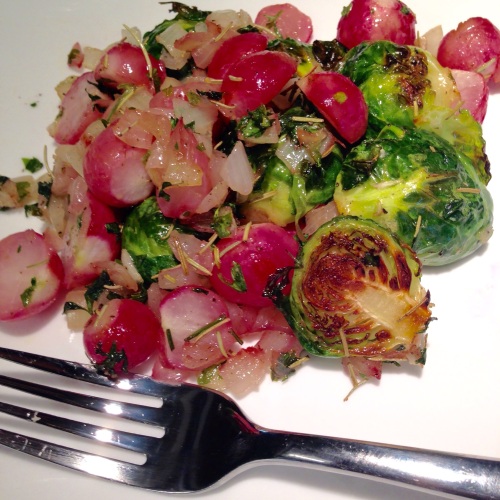
Roasted Radishes and Brussels Sprouts. Copyright Steve Parker MD

Roasted Radishes and Brussels Sprouts.
Photo Copyright Steve Parker MD

A year ago I ran across online praise for roasted radishes. I’m not a big fan of radishes, perhaps because they weren’t part of Parker family cuisine when I was growing up, but I finally gave them a try.

Beautiful, huh?

Beautiful, huh?

This won’t be as detailed as most of my recipes because I need to get into the hospital soon.

Raw Brussels Sprouts

Raw Brussels Sprouts

My basic ingredients were raw radishes and Brussels sprouts, diced onions, a bit of parsley (probably not needed), extra virgin olive oil, dried rosemary (i.e., not fresh), coarse salt, and pepper.

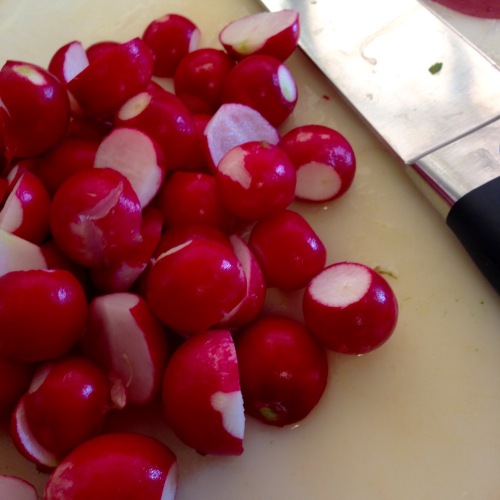
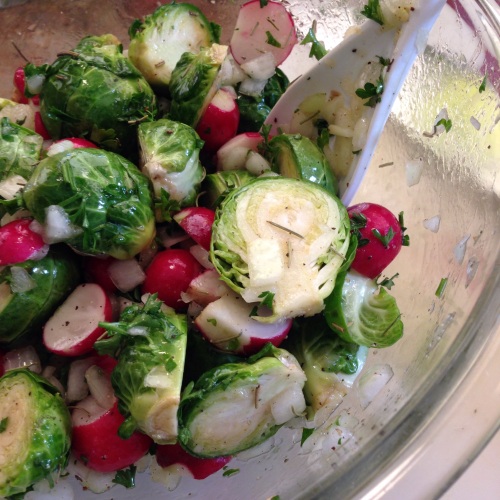
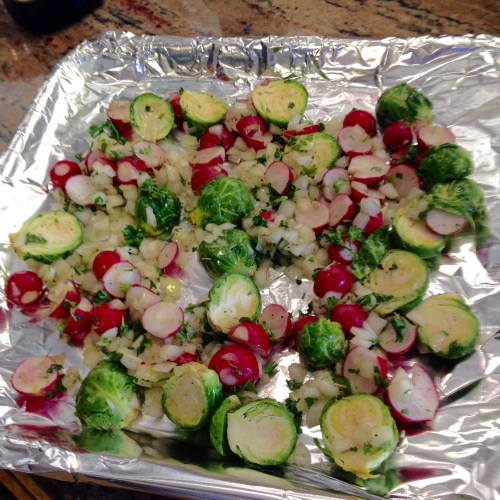
With the radishes, I cut off the little rootlet and green top, then cut them in half unless they were tiny radishes. Brussel sprouts take longer to cook, so I cut them in half, too. I put all the veggies  into a bowl, added just enough olive oil to coat them, sprinkled in some salt and pepper, then mixed with a spoon. Then I spread all that on a cooking sheet and popped it into an oven pre-heated to 425°F. (I covered my cooking sheet with aluminum foil to ease cleanup.)

All ingredients mixed in a bowl

All ingredients mixed in a bowl

I cooked in the oven for 17 minutes (15-20), using a turner to flip the veggies once or twice while cooking.

Ready for roasting

Ready for roasting

They were a little bland, so I topped off with Weber Roasted Garlic and Herb Seasoning. I enjoyed them and will do it again. Next time I may try coating with melted butter rather than olive oil. I felt very virtuous for eating my vegetables.

Steve Parker, M.D. 

PS: I ate half of this in one sitting. I refrigerated the rest and ate it about six hours later, after warming in the microwave. It was much more flavorful. If you’re one of those people who never eats leftovers…

…reconsider.

New Blood Glucose Monitors Should Be More Accurate in Near Future

The U.S. Food and Drug Administration has issued new guidelines for manufacturers of home glucose monitoring devices. The old standard was that the glucose reading of the device had to be within 20% of the actual or true value compared to a medical lab-grade machine.

For example, if the device read 165 mg/dl, the true value could be anywhere from 132 to 198 mg/dl. Or if you think in mmol/l terms, a reading of 9.2 could be anywhere from 7.3 to 11.

Under the new +/- 15% rule, the true number should be between 140 and 190  mg/dl.

I bet you thought your device was more accurate than that.

From the FDA:

“Blood glucose test results are used by people with diabetes to make critical decisionsabout their treatment; therefore, it is important that the results are accurate so that nutritional and drug dosing errors are better avoided. Your studies should demonstrate that your SMBG is sufficient for this purpose by showing that 95% of all SMBG results in this study are within +/- 15% of the comparator results across the entire claimed measuring range of the device and that 99% of all SMBG results are within +/- 20% of the comparator results across the entire claimed measuring range of the device.”

Steve Parker, M.D.

My Video Experiment…

I need to reach more people. Last fall I tripled my blogging frequency and it did nothing to increase viewership. I plan to cut back on written blogging and Tweeting, but will be doing more videos. It’s an experiment.

I’ll try to keep all videos under six minutes out of respect for your time.

This video mentions the topics I’ll be covering. If they sound interesting, please subscribe to the pxHealth YouTube Channel.