What’s This Diet Doctor Look Like?

I don’t post many pictures of myself here. It’s appropriate for you to wonder what a “diet doctor” looks like. I tell anyone interested about the benefits of weight management and exercise, and how to do it. I practice what I preach, mostly. At a shade under 6 feet tall (183 cm), I weigh 170 lb (77.3 kg).

—Steve

Steve Parker MD

Steve Parker and son Paul in a Boy Scout overnight backpacking trip on the Mogollon Rim in Arizona

Inuits of Northern Canada Undergoing Rapid Diet Transition

…and it’s not in a healthy direction, I suspect. Details are at Nutrition Journal.

But, Doc, My Back and Joints Hurt Too Much To Exercise!

EXERCISE WITH JOINT AND BACK PAIN

Many of my obese patients have chronic low back and joint pains.  Painful lower limb joints and chronic or recurrent back pain are an exercise barrier to many people, whether skinny or fat. Those affected should consult a physician for a diagnosis, treatment, and advice on appropriate physical activity. If the physician isn’t sure about an exercise prescription, consultation with an orthopedist, physiatrist, or physical therapist should be helpful. Generally, weight-bearing on bad joints should be minimized by doing pool calisthenics, stationary cycling, swimming, etc. Use your imagination. Particularly bothersome joints may not tolerate exercise, if ever, until weight is lost by some method other than exercise. (Exercise by itself is typically an ineffective way to lose major weight.)

Light to moderate exercise actually reduces the pain and disability of knee degenerative arthritis. The effect is modest and comes with a small risk of injury such as bone fracture, cartilage tears, arthritis flare, and soft tissue strain.

“Scientific American” Pooh-Pooh’s the Paleo Diet

Click through for details. The writer mentions our pals Marlene Zuk and Christine Warinner. A snippet:

The Paleo diet not only misunderstands how our own species, the organisms inside our bodies and the animals and plants we eat have evolved over the last 10,000 years, it also ignores much of the evidence about our ancestors’ health during their—often brief—individual life spans (even if a minority of our Paleo ancestors made it into their 40s or beyond, many children likely died before age 15). In contrast to Grok, neither Paleo hunter–gatherers nor our more recent predecessors were sculpted Adonises immune to all disease.

Were Hominins Eating Grains 3 Million Years Ago?

A guest blogger at Discover magazine tackles some recent evidence that our hominin ancestors ate more grain than we might think. Her conclusion:

So while there remains little doubt that many modern humans eat too much sugar and processed foods, these studies show that identifying a particular “paleo” diet is impossible. Researchers are just beginning to understand what ancient humans ate, and these recent studies show that grasses and grains have been part of the human diet for millions of years.

Read the rest. You may find the comments interesting.

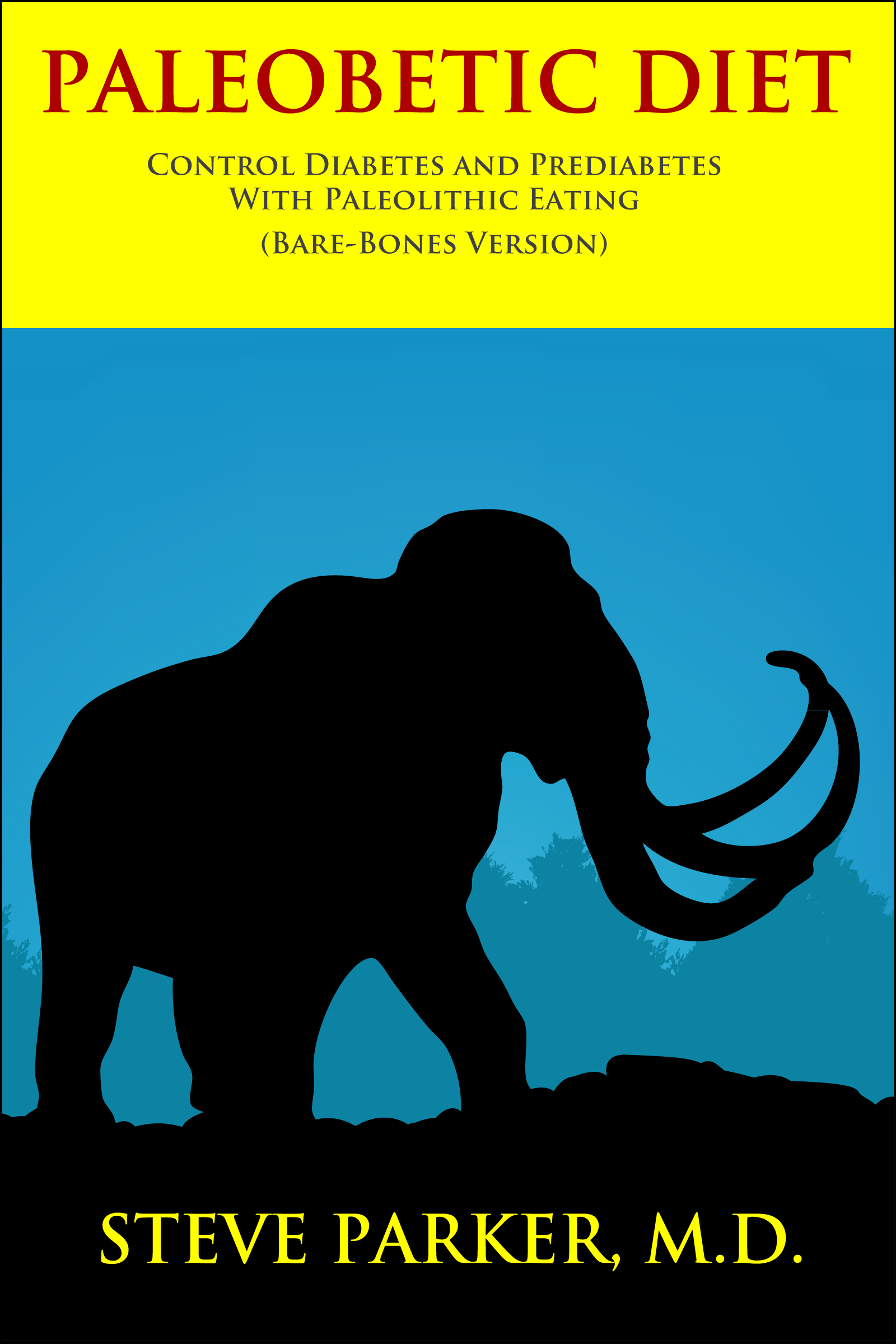
Win a Paleobetic Diet E-Book – It’s Easy!

Paleobetic diet, Steve Parker MD,paleo diet, diabetic diet, diabetes

Cover designed by my 14-year-old son, Paul

Just be one of the first 100 people to email me asking for it.

Why am I giving it away? I need some feedback on it.

You don’t have to be a PWD to get a copy. Perhaps you’re just a curious dietitian, nutritionist, certified diabetes educator, nurse, or physician.

If you get the e-book, please seriously consider giving me feedback via email:

  • What do you think of the Paleobetic Diet?
  • How could I make it better?
  • How was your experience with the distributor, Smashwords?
  • Would more recipes be helpful?
  • What did you think of the sections on diabetes drugs, hypoglycemia, and exercise?
  • If you tried it, did it affect your blood sugars? How did you feel, physically? Was your healthcare provider supportive? Did you lose any excess weight?
  • What do you think of the food options on the diet?

Be aware that the Paleobetic Diet e-book bare-bones version is only 9,000 words long. That’s short. It’s a how-to primer. I don’t go into evolutionary theory and the scientific underpinnings of the diet.

Here’s How You Win:

  1. Email a request for the e-book, to steveparkermd (at) gmail (dot) com, putting “paleobetic diet” in the subject line.
  2. I’ll email you back a coupon code that gives you a 100% discount on the e-book at Smashwords.
  3. You set up a free account at Smashwords, then act like you’re purchasing the book. Before checkout, you’ll be asked for the coupon code or discount code I gave you. Enter it. Bingo! Free e-book. You’ll get a choice of multiple e-book formats.
  4. Note that I only check my email every week or two, so don’t get in a big hurry.

Thanks in advance for your thoughts! If you win the e-book and never give me feedback, I won’t bug you about it.

Steve Parker, M.D.

PS: Remember, this offer is only for the first hundred people who email me. I don’t know if those copies will be gone in a few days or six months.

But, Doc, I’m Too Fat to Exercise!

IF YOU ARE MARKEDLY OBESE

The more overweight you are, the harder it will be to exercise. At some point even light exercise becomes impossible. Average-height women tipping the scales at about 280 pounds (127 kg) and men at 360 pounds (164 kg) aren’t going to be able to jog around the block, much less run a marathon. These weights are 100 percent over ideal or healthy levels. An actual “exercise program” probably won’t be possible until some weight is lost simply through very-low-carb eating, calorie restriction, or bariatric surgery. The initial exercise goal for you may just be to get moving through activities of daily living and perhaps brief walks and calisthenics while sitting in a chair.

Markedly obese people who aren’t up to the aforementioned extreme weights can usually tolerate a low-intensity physical activity program. At 50 percent over ideal weight, an average-height woman of 210 pounds (95 kg) is carrying 70 excess pounds (32 kg) of fat. Her male counter-part lugs around 90 pounds (41 kg) of unnecessary fat. This weight burden causes dramatic breathlessness and fatigue upon exertion, and makes the joints and muscles more susceptible to aching and injury. If you’re skinny, just imagine trying to walk or run a mile carrying a standard five-gallon (19 liter) water cooler bottle, which weighs only 43 pounds (19.5 kg) when full. The burden of excess fat makes it quite difficult to exercise.

If you’re markedly obese, several tricks will enhance your exercise success. I want you to avoid injury, frustration, and burn out. Start with light activity for only 10 or 15 minutes, gradually increase session length (e.g., by two to four minutes every two to four weeks) and increase exercise intensity only after several months. Your joints and muscles may appreciate easy, low-impact exercises such as stationary cycling, walking, swimming, and pool calisthenics/water aerobics. You may also benefit from the advice of a personal fitness trainer arranged through a health club, gym, or YMCA/YWCA. Check out several health clubs before you join. Some of them are primarily meat markets for beautiful slender yuppies. You may feel more comfortable in a gym that welcomes and caters to overweight people. Hospitals are increasingly developing fitness centers with obese orthopedic, heart, and diabetic patients in mind.


Aside

I don’t think it’ll catch on. “IH” isn’t much better. Some of the old-timers still call it AODM: adult onset diabetes mellitus.

Read the rationale at MedPageToday.

Do High Insulin Levels Cause Memory Loss and Dementia?

dementia, memory loss, Mediterranean diet, low-carb diet, glycemic index, dementia memory loss

Don’t wait to take action until it’s too late

Insulin resistance and high blood insulin levels promote age-related degeneration of the brain, leading to memory loss and dementia according to Robert Krikorian, Ph.D. He’s a professor in the Department of Psychiatry and Behavioral Neuroscience, University of Cincinnati Academic Health Center.  He has an article in a recent issue of Current Psychiatry – Online.

Proper insulin signaling in the brain is important for healthy functioning of our brains’ memory centers.  This signaling breaks down in the setting of insulin resistance and the associated high insulin levels.  Dr. Krikorian makes much of the fact that high insulin levels and insulin resistance are closely tied to obesity.  He writes that:

Waist circumference of ≥100 cm (39 inches) is a sensitive, specific, and independent predictor of hyperinsulinemia for men and women and a stronger predictor than body mass index, waist-to-hip ratio, and other measures of body fat.

Take-Home Points

Dr. Krikorian thinks that dietary approaches to the prevention of dementia are effective yet underutilized.  He mentions reduction of insulin levels by restricting calories or a ketogenic diet: they’ve been linked with improved memory in middle-aged and older adults. His theory is also consistent with the commonly seen association of type 2 diabetes with dementia: overweight and obese type 2’s quite often have high insulin levels, at least in the early years.

Dr. K suggests the following measures to prevent dementia and memory loss:

  • eliminate high-glycemic foods like processed carbohydrates and sweets
  • replace high-glycemic foods with fruits and vegetables (the higher polyphenol intake may help by itself)
  • certain polyphenols, such as those found in berries, may be particularly helpful in improving brain metabolic function
  • keep your waist size under 39 inches (99 cm), or aim for that if you’re higher and overweight

Nearly all popular versions of the paleo diet would qualify as being low glycemic index.

I must mention that many dementia experts, probably most, are not as confident  as Dr. Krikorian that these dietary changes are effective.  I think they are, to a degree.

The Mediterranean diet is high in fruits and vegetables and relatively low-glycemic.  It’s usually mentioned by experts as the diet that may prevent dementia and slow its progression.

Read the full article.

I’ve written before about how blood sugars in the upper normal range are linked to brain degeneration.  Dr. Krikorian’s recommendations would tend to keep blood sugar levels in the lower end of the normal range.

Steve Parker, M.D.

PS: Speaking of dementia and ketogenic, have you ever heard of the Ketogenic Mediterranean Diet?  (Free condensed version here.)

“It Is the Soldier”: A U.S. Memorial Day Poem

It is the Soldier, not the minister

Who has given us freedom of religion.

It is the Soldier, not the reporter

Who has given us freedom of the press.

It is the Soldier, not the poet

Who has given us freedom of speech.

It is the Soldier, not the campus organizer

Who has given us freedom to protest.

It is the Soldier, not the lawyer

Who has given us the right to a fair trial.

It is the Soldier, not the politician

Who has given us the right to vote.

It is the Soldier who salutes the flag,

Who serves beneath the flag,

And whose coffin is draped by the flag,

Who allows the protester to burn the flag.

 —Charles M. Province