Raging Debate: Are Primitive Societies More or Less War-Like than Modern Man?

Mangan introduces the two sides.

Was Steve Jobs Orthorexic?

Maybe so.  Read Bix’s (Fanatic Cook) last post and decide for yourself.

World Health Organization Recommends Healthy Potassium and Sodium Intake Levels

Our Paleolithic ancestors ate much more potassium and less sodium that we do.  The World Health Organization has new Guidelines for lowering sodium and increasing potassium, which may reduce cardiovascular disease.  That’s debatable, of course.  I haven’t read the guidelines, but here they are:

Potassium

Sodium

The Linus Pauling Institute says fruits and vegetables are the best sources of potassium.  Beans are also good, but you won’t be eating those on most versions of the paleo diet.  WHO recommends similar natural sources, and against simple supplementation.

Dr. Emily Deans Has More on Orthorexia

Part II from earlier today.  An excerpt:

I don’t want my children to grow up neurotic about food. On the other hand, when you look at the advertisements and the grocery stores and the incentives out there, popular kid food is pretty wretched, processed, sugary, blue gooey crap. Kids have growing brains and bodies and need appropriate nutrition to fuel that growth.

Amen, sister.

Ideas For A Paleo Diabetic Diet

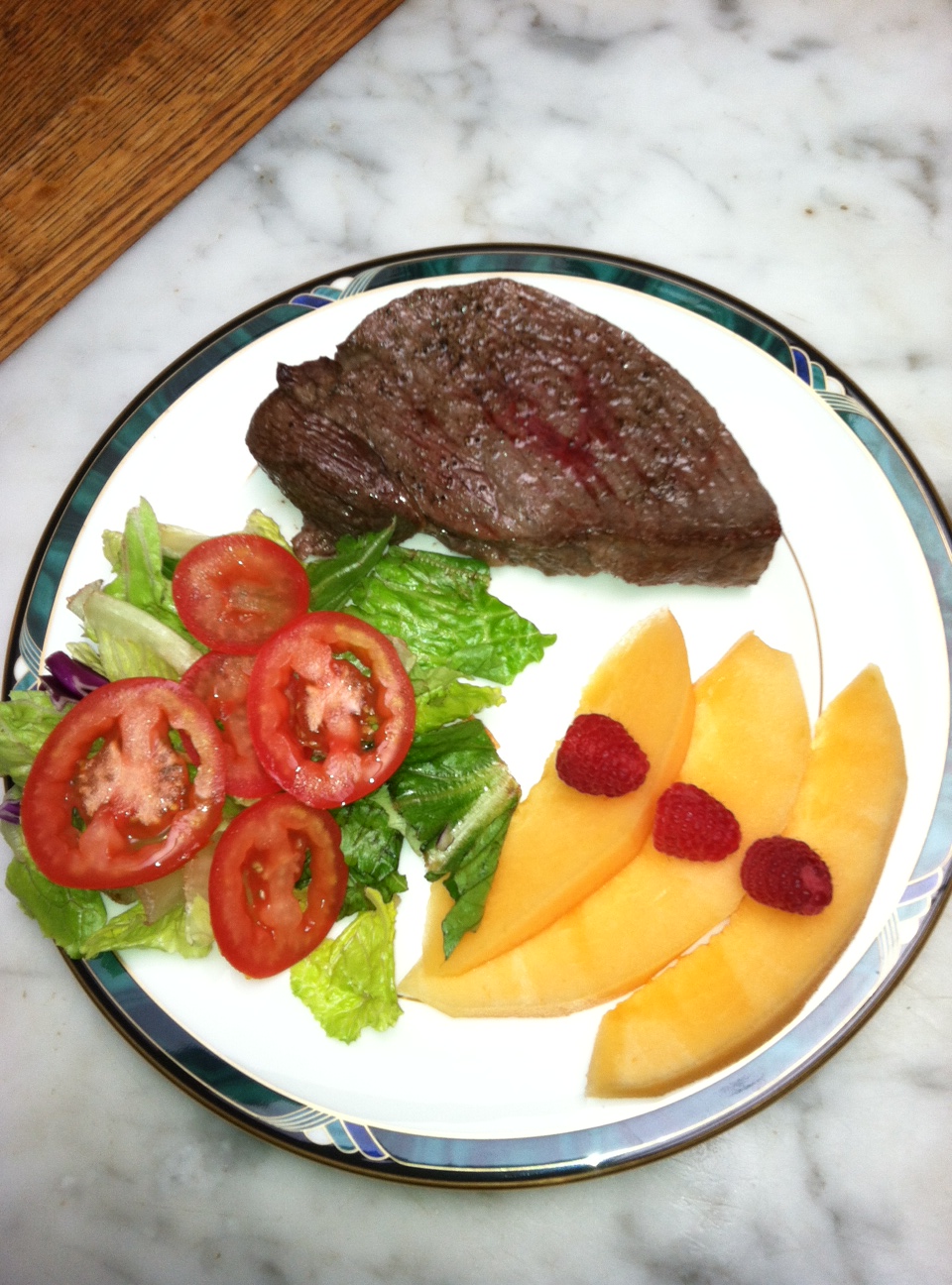
Sirloin steak, salad, cantaloupe, 3 raspberries

Sirloin steak, salad, cantaloupe, 3 raspberries

I’ve been thinking about a paleo-style diabetic diet for over a year.  Here are some miscellaneous ideas for your consideration.

A paleo diabetic diet will have the following major food groups:

  • vegetables
  • fruits
  • nuts and seeds
  • proteins (e.g., meat, fish, eggs)
  • condiments

A paleo diabetic diet could (should?) emphasize salads and low-carb colorful vegetables and only (?) low-carb or low-glycemic-index fruits.

Calories

Total calories?  Probably in the range of 1,800 to 3,000 calories daily with an average of 2,000.  Remember that 85% of type 2 diabetics are overweight or obese. Calorie restriction—regardless of macronutrient ratios (% carb, protein, fat)—tends to improve or normalize blood sugar levels.  Weight loss will likely entail some caloric restriction, whether consciously or not.

Type 1 Versus Type 2 Diabetes

Type 1 and type 2 diabetics have many pathophysiologic differences.  Could a single paleo diabetic diet serve both populations equally well?  That’s the goal.

Carbohydrates

Diabetics have trouble metabolizing carbohydrates, so a paleo diabetic diet should probably be lower-than-average in digestible carbs.  100 g/day?  30 g/day?  I’m leaning toward 60 g ± 25%, so 45–75 g.  Smaller, less active folks could eat 45 g/day; larger, more active guys eat closer to 75 g.

Is there a role for very-low-carb or ketogenic eating patterns?  For most folks, that’s less than 50 g of digestible carbohydrate daily.  Under 30 g for some.  Use that only for those needing to lose weight?  Start everybody at  very low carb levels then increase carbs as tolerated?  On the other hand, there’s a lot to be said for simplicity.  It might be best to avoid very-low-carb (ketogenic) eating entirely.  Anyone not losing the desired amount of fat weight could cut portion sizes, especially carbohydrates.

Fish

I encourage fish consumption twice a week, diabetes or no.  Cold-water fatty fish have more of the healthy omega-3 fatty acids than other fish.

Nuts

I’d encourage 1–2 ounces (28–56 g) of nuts or seeds daily.  Any more than that might crowd out other healthful nutrients.  Nuts are protective of the heart.

Proteins

Protein-rich foods can definitely raise insulin requirements and blood sugar levels, but not in an entirely predictable way, and not to the extent we see with carbohydrates.  Should insulin users dose insulin based on a protein gram sliding scale?  I’m leaning towards simply recommending the same amount of protein at each meal, perhaps 4–8 ounces (113–229 g).

Fruit and Starchy Vegetables

Could a paleo diabetic diet even be “paleo” without fruit?  The problem with classic fruits is that they spike blood sugars too high for many diabetics.  To prevent that, Dr. Richard Bernstein outlaws all classic fruits (and other starchy carbs), even limiting tomatoes and onions to small amounts.  E.g., a wedge of tomato in a salad.  He doesn’t allow carrots either, unless raw (lower glycemic index than when cooked).  A paleo diabetic diet eater may be able to get away with eating lower-carb, lower-GI (glycemic index) fruits such as cantaloupe, honeydew, strawberries and other berries.  Some paleo diabetic dieters will tolerate half an apple twice a day.

Different diabetics will have different blood sugar effects when eating starchy vegetables and higher-carb fruits.  Type 1 diabetics will tend to be more predictable than type 2s.  Both may just need to “eat to the meter”: try a serving and see what happens to blood sugar over the next hour or two.

Starchy vegetables—potatoes and carrots, for example—may well have to be limited.  Again, eat to the meter.

Gluten

This is looking to be gluten-free.  How trendy!  It’s a paleo celiac diet.

Use “natural” stevia as a sweetener?  If you read about how the product on your supermarket shelf  is made, it’s not at all natural.

Omega-6/Omega-3 Fatty Acids

A strict focus on omega-6/omega-3 fatty acid ratio will not appeal to many folks, even if it’s important from a health viewpoint.  Reserve this for advanced dieters who have mastered the basics?  Modern Western diets have an omega-6/omega-3 ratio around 10 or 15:1.  Paleolithic diets were closer to 2 or 3:1.  So we have an over-abundance of omega-6 fatty acid or deficiency of omega-3 that may be unhealthy.

Implementation

To get dieters started, I’d design a week of meals based on 2,000 to 2,200 calories.  If still hungry, eat more protein, fat, and low-carb vegetables (and fruits?).

What do you think?

Steve Parker, M.D.

Disclaimer:  All matters regarding your health require supervision by a personal physician or other appropriate health professional familiar with your current health status.  Always consult your personal physician before making any dietary or exercise changes.  

PS: See Dr. Bernstein’s “no-no” foods on page 151 of his Diabetes Solution book.

PPS: The paleo diet is also known as the Paleolithic diet, Stone Age diet, caveman diet, hunter-gatherer diet, and ancestral diet.

Ever Heard of “Interval Walking”? You Need To Know About It!

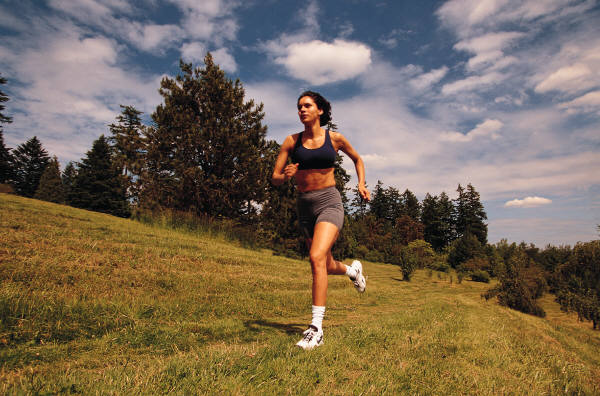
Not ready for this? Consider interval walking then.

Not ready for this? Consider interval walking then.

Compared to a regular continuous walking program, interval walking is superior for improving physical fitness, body composition (body mass and fatness), and blood sugar control according to new research reported in Diabetes Care.  Study participants were type 2 diabetics.

Training groups were prescribed five sessions per week (60 min/session) and were controlled with an accelerometer and a heart-rate monitor. Continuous walkers performed all training at moderate intensity, whereas interval walkers alternated 3-min repetitions at low and high intensity. Before and after the 4-month intervention, the following variables were measured: VO2max, body composition, and glycemic control (fasting glucose, HbA1c, oral glucose tolerance test, and continuous glucose monitoring.

I haven’t read the full report yet, but expect that the interval walkers walked as fast as they could for three minutes (4 mph?) then slowed down to a comfortable stroll (1–2 mph?) for three minutes, alternating thusly for 60 minutes.

This should easily do-able for nearly all type 2 diabetics.  The reported results jive with other studies of more vigorous and intimidating interval training.  The only caveat is that it was a small pilot study that may or may not be reproducible.

Steve Parker, M.D.

Back to the Drawing Board: Clovis Comet Questioned

“Comet explosions did not end the prehistoric human culture, known as Clovis, in North America 13,000 years ago, according to research published in the journal Geophysical Monograph Series.

Researchers from Royal Holloway university, together with Sandia National Laboratories and 13 other universities across the United States and Europe, have found evidence which rebuts the belief that a large impact or airburst caused a significant and abrupt change to the Earth’s climate and terminated the Clovis culture. They argue that other explanations must be found for the apparent disappearance.

Clovis is the name archaeologists have given to the earliest well-established human culture in the North American continent. It is named after the town in New Mexico, where distinct stone tools were found in the 1920s and 1930s.”

Source: press release

Clear Thinking On Orthorexia From Dr. Emily Deans

Are folks in the paleo/primal community more at risk for orthorexia? Well, obviously. Here we have a pre-selected population of folks who tend to be on the obsessive side who care a great deal about food, and many of them have had great health benefits from some dietary changes. It’s very tempting to look to solve the next health problem with a tweak in diet or supplements. Unfortunately, one could tweak forever, with additional restrictions in diet leading to smaller and smaller benefits, no benefits at all, or even health problems derived from the diet. One can easily eat too little and intermittent fast too much on a strict paleo/primal diet, causing hormonal problems as the starvation response kicks in. One can also develop nutritional deficiencies from a very restricted diet. And some folks will delay going to the doctor for a serious medical problem, trying to find a solution by surfing the internet and eating zero carb (or only raw food, or cutting out every last molecule of fructose, or eating only this or that…).

Here’s the rest.

The Traveling Sweet Potato

If you like sweet potatoes, ScienceNOW has an interesting article on the travels and domestication of the humble sweet potato.  An excerpt:

Humans domesticated the sweet potato in the Peruvian highlands about 8000 years ago, and previous generations of scholars believed that Spanish and Portuguese explorers introduced the crop to Southeast Asia and the Pacific beginning in the 16th century. But in recent years, archaeologists and linguists have accumulated evidence supporting another hypothesis: Premodern Polynesian sailors navigated their sophisticated ships all the way to the west coast of South America and brought the sweet potato back home with them. The oldest carbonized sample of the crop found by archaeologists in the Pacific dates to about 1000 C.E.—nearly 500 years before Columbus’s first voyage.

Some versions of the paleo diet don’t include white or sweet potatoes, probably because they originated in the New World (particularly Peru).  They wouldn’t have been eaten by our prehistoric ancestors in Africa.  I haven’t done the research yet, but I bet northeast Africa had a starchy tuber roughly equivalent to potatoes.

Steve Parker, M.D.

h/t Ivor Goodbody

Sarah Hoyt on Differences Between Men and Women

Sarah’s a writer, not a paleoanthropologist.  Nevertheless, you might find one of her recent blog posts interesting.  Or infuriating.  It’s followed by a lively comment section.  An excerpt:

Look, men and women are not the same.  They can be equal before the law, but they can’t be EQUAL.  They serve different functions in society, or in a sane society at any rate.

Or look at it another way: men and women were shaped by different evolutionary pressures.  I remember reading that human ancestors first formed in bands because of pregnant females, who needed someone to look after them, and who couldn’t walk as far as the males.  I don’t know if that’s true, (I read it in Scientific American) but considering how complicated our pregnancies are compared to most animals, it might very well be.  Our young CERTAINLY require a lot more care and vigilance than most young.  And for a longer time.  It’s the price we pay for the brain.

What this means is that in general, the pregnant women and the old ones, and perhaps the juvenile males or the older males, stayed behind in camp and looked after the littles, while the men went out and hunted.  We do know from primitive tribes, most women forage.  The men hunt.

BOTH functions are essential.  Yes, meat in the diet is important, particularly for large brains.  BUT often the men come back empty handed, and it’s the women’s berries and tubers that allow the tribe to live to hunt another day.

Would a female who wanted to hunt be accepted?  I understand in some tribes they are, at least while unmarried.  BUT would it be practical to encourage all the females to hunt, and all the men to gather berries and look after toddlers?

Um…

Let’s leave aside for a moment the fact that violent exercise of that sort while pregnant might not be the smartest idea and that frankly you don’t FEEL like doing it.  Also that women athletes, who run miles every day often stop ovulating.