Paleo Pioneer S. Boyd Eaton’s Personal Lifestyle

African Savanna

African Savanna

Dr. Eaton (M.D.) spoke at the last Ancestral Health Symposium about his own diet and exercise program.  He’s 74-years-old and has been following his paleo lifestyle for 30 years.  In this video, Dr. Eaton looks quite fit and is obviously mentally sharp.

He talks about a “weak form” of the paleo diet that would include relatively small amounts of whole grains (e.g., shredded wheat) and dairy (e.g., skim milk).  He doesn’t proscribe beans.  He limits saturated fat, but enjoys red wine.

Dr. Eaton also discusses a “strong form” diet that would cut out the dairy, grains, and probably alcohol.  This is for those with certain diseases of modern civilization, such as high blood pressure, coronary artery disease, metabolic syndrome, adverse blood lipids, etc.  He didn’t mention diabetes specifically, but I bet he would include it in the list.

He has an impressive daily exercise program that probably takes at least an hour, with weight training on machines plus an aerobics (stationary bike and swimming).

Dr. Eaton supplments with a multivitamin/multimineral (showed a picture of Centrum), EPA/DHA, and fiber (especially soluble fiber).

The video is only 20 minutes long and well worth a look.

Steve Parker, M.D.

h/t Melissa McEwen. (Melissa has the impression the Eaton partakes of whole grains and dairy.  I didn’t hear that in the video but may have missed it.)
 

Paleo Diet is the Most Sought After

According to Janet Helm, RD.

Are You Afraid of the Night(shades)?

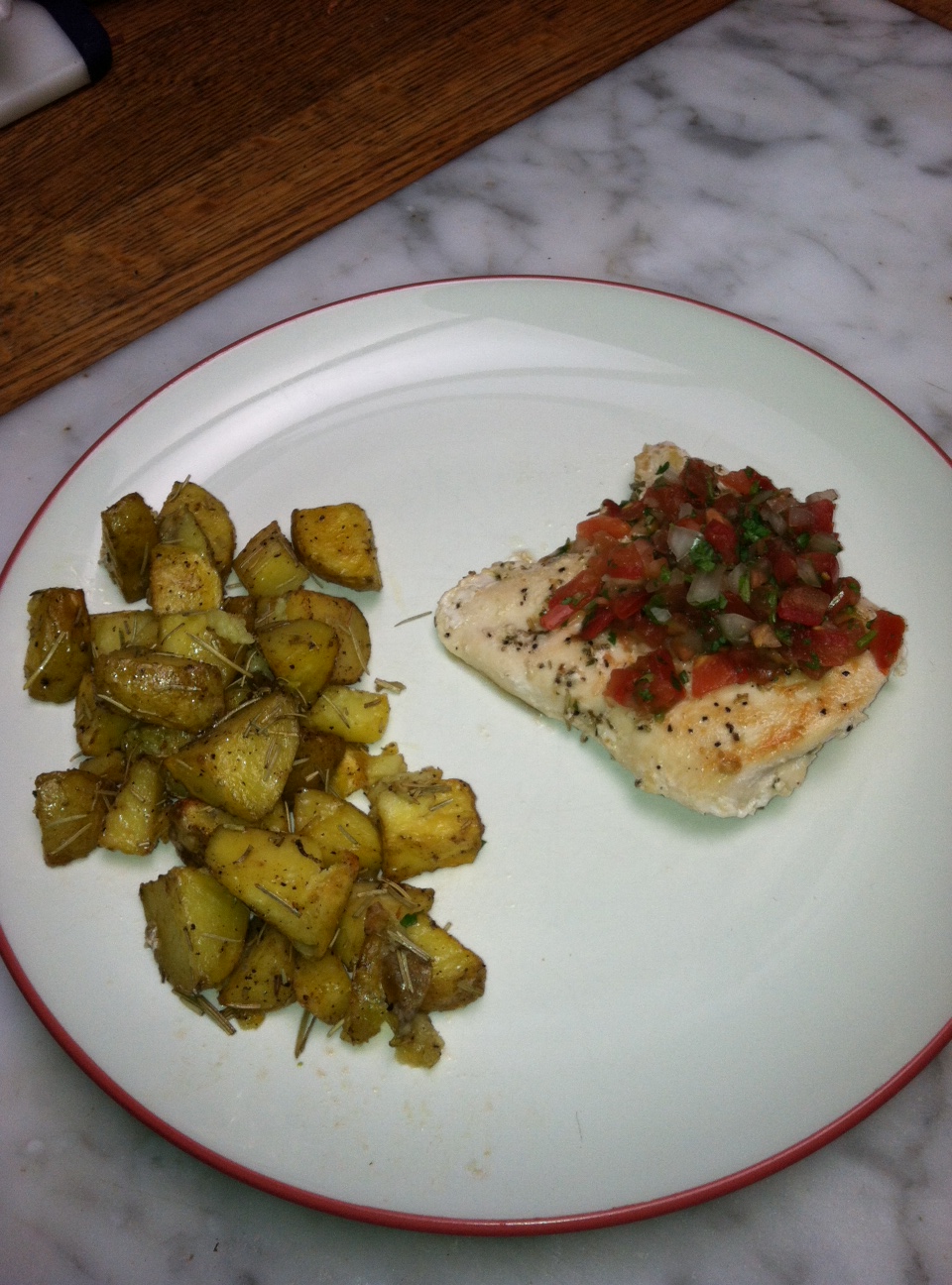
Rosemary Chicken (garnished with pico de gallo) and Rosemary Potatoes

Rosemary Chicken (garnished with pico de gallo) and Rosemary Potatoes

The nightshade family includes potatoes (not sweet potatoes or yams), tomatoes, eggplant, peppers, goji berries, and even tobacco.  Anecdotal reports indicate that consumption of these either cause or aggravate certain chronic medical conditions, such as arthritis, chronic fatigue, or irritable bowel syndrome.

Georgia Ede, M.D., has an article on medical effects of nightshades at her website.  The potentially offensive chemicals in nightshades are called glycoalkaloids.  I looked into this issue when deciding whether to include potatoes in my version of the paleo diet.  (They’re included).

Dr. Ede’s writes:

As with any food sensitivity, the only way to find out is to remove nightshades from your diet for a couple of weeks or so to see if you feel better.  There are ZERO scientific articles about nightshade sensitivity, chronic pain, or arthritis in the literature, however, the internet is full of anecdotal reports of people who have found that nightshades aggravate arthritis, fibromyalgia, or other chronic pain syndromes.

I bet I could eat a couple potatoes and tomatoes every day without ill effect.  And there’s Chris Voigt, head of the Washington State Potato Commission, famous for his 60-day potato diet.  As they say, your mileage may vary.

Steve Parker, M.D.

Carbohydrates and Sugar Increase Risk of Elderly Cognitive Impairment


How many brain cells with this roll kill?

How many brain cells with this roll kill?

The Mayo Clinic recently reported that diets high in carbohydrates and sugar increase the odds of developing cognitive impairment in the elderly years.

Mild cognitive impairment is often a precursor to incurable dementia.  Many authorities think dementia develops more often in people with diabetes, although some studies refute the linkage.

Researchers followed 940 patients with normal baseline cognitive functioning over the course of four years. Diet was assessed via questionnaire. Study participants were ages 70 to 89. As the years passed, 200 of them developed mild cognitive impairment.

Compared with those eating at the lowest level of carbohydrate consumption, those eating at the highest levels were almost twice as likely to go to develop mild cognitive impairment.

The scientists note that those eating lower on the carbohydrate continuum were eating more fats and proteins.

Steve Parker, M.D.

Denmark’s Paleolithic Diet

ScienceNordic has an article about the diet of Paleolithic humans who lived in what is now Denmark.  It’s brief and written for the general public.  The author mistakenly characterizes the “modern paleo” diet as no- or very-low-carb.  It’s lower in carb content than the standard American diet, but by no means no-carb.

—Steve

An Efficient Exercise Routine For Your Consideration

One……more……rep!

After finishing six weeks ofChris Highcock’s Hillfit earlier this year, I designed another fitness program using dumbbells and high intensity interval running on a treadmill.  Chris’s program is a good one, by the way, especially if you are a fitness neophyte.

I’ve preached about the benefits of baseline and periodic fitness measurements.  Here are mine, before and after roughly six weeks of my fitness experiment #3:

  • weight: no change (170 lb or 77.3 kg)
  • maximum consecutive push-ups: 34 before, 32 after
  • maximum consecutive pull-ups: no change (8)
  • maximum consecutive sit-ups: 37 before, 35 after
  • time for one-mile walk/run: 8 minutes and 35 seconds before, up to 8 minutes and 54 seconds after
  • vertical jump (highest point above ground I can jump and touch): 279.5 cm before, to 276 cm after

I know these numbers aren’t great—don’t judge me too harshly.  After all, I’m 58 years old.

I worked out twice weekly for a total of 70 minutes.  The U.S. Centers for Disease Control and Prevention recommends 150 minutes a week of moderate-intensity aerobic activity and muscle-strengthening exercise at least twice a week; or 75 minutes per week of vigorous-intensity aerobic activity plus muscle-strengthening activity at least twice a week.

Bottom Line

I was a bit fitter after completing Hillfit before this trial.

Or I just had a bad day when I tested this time.  Nevertheless, I prefer my current program to Hillfit.  (Click for report on my six-week Hillfit experience.)

What Next?

For strength and endurance gains, perhaps I should incorporate some Hillfit features into my current plan.

Is my current level of fitness good enough?  Not sure.

I’ll put together yet another fitness program within the next few months.  You need change-ups to prevent boredom, if nothing else.

I don’t like to exercise, but I want the health benefits.  Exercise postpones death.  My general goal is to maximize health benefits while minimizing exercise time.

I know that many paleo proponents like CrossFit.  If you have a favorite home-based exercise routine, please share in the Comments section.

Steve Parker, M.D.


QOTD: All You Need Is a Single Set of Reps

We recommend that appreciably the same muscular strength and endurance adaptations can be attained by performing a single set of ~8-12 repetitions to momentary muscular failure, at a repetition duration that maintains muscular tension throughout the entire range of motion, for most major muscle groups once or twice each week. All resistance types (e.g. free-weights, resistance machines, bodyweight, etc.) show potential for increases in strength, with no significant difference between them, although resistance machines appear to pose a lower risk of injury.

Fisher, James, et al. Evidence-based resistance training recommendations. Medicina Sportiva, 15 (2011): 147-162.

Stephan Guyenet on “The Potato Diet”

Dr. Guyenet has a recent post on The Potato Diet.  It caught my eye since I include potatoes in my version of the paleo diet.  He starts thusly:

In 2010, I wrote a series of blog posts on the health properties of potatoes.  The evidence showed that potatoes are non-toxic, filling per calorie, remarkably nutritious, and can be eaten as almost the sole source of nutrition for extended periods of time (though I’m not recommending this).

Follow all of

Rosemary Chicken (garnished with pico de gallo) and Rosemary Potatoes

Rosemary Chicken (garnished with pico de gallo) and Rosemary Potatoes

Dr. Guyenet’s links and you’re sure to learn something new about potatoes.

-Steve

Are We Eating Too Much Salt?

Unfairly demonized?

Most paleo diets are quite a bit lower in salt and sodium than standard American diets.  At the same time, they should be quite a bit higher in potassium, which may be very healthy.

Every 10 years or so, “the powers that be” make a push for population-wide salt restriction thinking that it will prevent cardiovascular disease and associated premature death.  The American Council on  Science and Health has a brief review of the latest research on salt restriction, and it’s not supportive of population-wide sodium restriction.

Remember, table salt molecules contain one sodium atom and one chloride atom.  Salt-restricted and low-sodium diets are usually designated by the amount of sodium, not salt.

That being said, I do believe some individuals have elevated blood pressure related to relatively high sodium intake.  This may apply to one of every five adults with high blood pressure.  To find out if you’re one of the five, you could go on a low-sodium diet—1.5 to 3 grams a day—for one or two months and see what it does to your blood pressure.  Get your personal physician’s blessing first.

Steve Parker, M.D.

QOTD: Homeopathy

I love it when ads for medical remedies claim to be “homeopathic.” That way I know straight away they’re no better than placebo.

—Steve Parker, M.D.