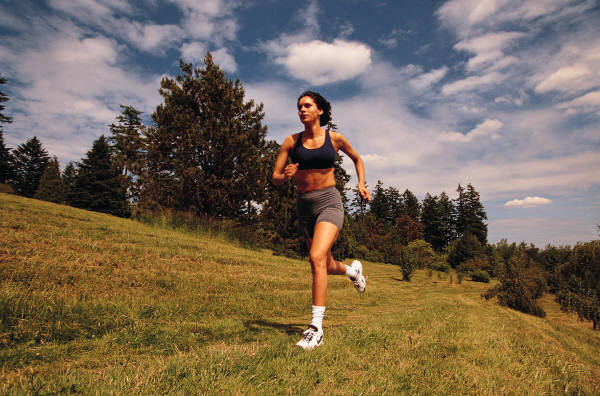
Ever Heard of “Interval Walking”? You Need To Know About It!

Not ready for this? Consider interval walking then.

Not ready for this? Consider interval walking then.

Compared to a regular continuous walking program, interval walking is superior for improving physical fitness, body composition (body mass and fatness), and blood sugar control according to new research reported in Diabetes Care.  Study participants were type 2 diabetics.

Training groups were prescribed five sessions per week (60 min/session) and were controlled with an accelerometer and a heart-rate monitor. Continuous walkers performed all training at moderate intensity, whereas interval walkers alternated 3-min repetitions at low and high intensity. Before and after the 4-month intervention, the following variables were measured: VO2max, body composition, and glycemic control (fasting glucose, HbA1c, oral glucose tolerance test, and continuous glucose monitoring.

I haven’t read the full report yet, but expect that the interval walkers walked as fast as they could for three minutes (4 mph?) then slowed down to a comfortable stroll (1–2 mph?) for three minutes, alternating thusly for 60 minutes.

This should easily do-able for nearly all type 2 diabetics.  The reported results jive with other studies of more vigorous and intimidating interval training.  The only caveat is that it was a small pilot study that may or may not be reproducible.

Steve Parker, M.D.

Back to the Drawing Board: Clovis Comet Questioned

“Comet explosions did not end the prehistoric human culture, known as Clovis, in North America 13,000 years ago, according to research published in the journal Geophysical Monograph Series.

Researchers from Royal Holloway university, together with Sandia National Laboratories and 13 other universities across the United States and Europe, have found evidence which rebuts the belief that a large impact or airburst caused a significant and abrupt change to the Earth’s climate and terminated the Clovis culture. They argue that other explanations must be found for the apparent disappearance.

Clovis is the name archaeologists have given to the earliest well-established human culture in the North American continent. It is named after the town in New Mexico, where distinct stone tools were found in the 1920s and 1930s.”

Source: press release

Clear Thinking On Orthorexia From Dr. Emily Deans

Are folks in the paleo/primal community more at risk for orthorexia? Well, obviously. Here we have a pre-selected population of folks who tend to be on the obsessive side who care a great deal about food, and many of them have had great health benefits from some dietary changes. It’s very tempting to look to solve the next health problem with a tweak in diet or supplements. Unfortunately, one could tweak forever, with additional restrictions in diet leading to smaller and smaller benefits, no benefits at all, or even health problems derived from the diet. One can easily eat too little and intermittent fast too much on a strict paleo/primal diet, causing hormonal problems as the starvation response kicks in. One can also develop nutritional deficiencies from a very restricted diet. And some folks will delay going to the doctor for a serious medical problem, trying to find a solution by surfing the internet and eating zero carb (or only raw food, or cutting out every last molecule of fructose, or eating only this or that…).

Here’s the rest.

The Traveling Sweet Potato

If you like sweet potatoes, ScienceNOW has an interesting article on the travels and domestication of the humble sweet potato.  An excerpt:

Humans domesticated the sweet potato in the Peruvian highlands about 8000 years ago, and previous generations of scholars believed that Spanish and Portuguese explorers introduced the crop to Southeast Asia and the Pacific beginning in the 16th century. But in recent years, archaeologists and linguists have accumulated evidence supporting another hypothesis: Premodern Polynesian sailors navigated their sophisticated ships all the way to the west coast of South America and brought the sweet potato back home with them. The oldest carbonized sample of the crop found by archaeologists in the Pacific dates to about 1000 C.E.—nearly 500 years before Columbus’s first voyage.

Some versions of the paleo diet don’t include white or sweet potatoes, probably because they originated in the New World (particularly Peru).  They wouldn’t have been eaten by our prehistoric ancestors in Africa.  I haven’t done the research yet, but I bet northeast Africa had a starchy tuber roughly equivalent to potatoes.

Steve Parker, M.D.

h/t Ivor Goodbody

Sarah Hoyt on Differences Between Men and Women

Sarah’s a writer, not a paleoanthropologist.  Nevertheless, you might find one of her recent blog posts interesting.  Or infuriating.  It’s followed by a lively comment section.  An excerpt:

Look, men and women are not the same.  They can be equal before the law, but they can’t be EQUAL.  They serve different functions in society, or in a sane society at any rate.

Or look at it another way: men and women were shaped by different evolutionary pressures.  I remember reading that human ancestors first formed in bands because of pregnant females, who needed someone to look after them, and who couldn’t walk as far as the males.  I don’t know if that’s true, (I read it in Scientific American) but considering how complicated our pregnancies are compared to most animals, it might very well be.  Our young CERTAINLY require a lot more care and vigilance than most young.  And for a longer time.  It’s the price we pay for the brain.

What this means is that in general, the pregnant women and the old ones, and perhaps the juvenile males or the older males, stayed behind in camp and looked after the littles, while the men went out and hunted.  We do know from primitive tribes, most women forage.  The men hunt.

BOTH functions are essential.  Yes, meat in the diet is important, particularly for large brains.  BUT often the men come back empty handed, and it’s the women’s berries and tubers that allow the tribe to live to hunt another day.

Would a female who wanted to hunt be accepted?  I understand in some tribes they are, at least while unmarried.  BUT would it be practical to encourage all the females to hunt, and all the men to gather berries and look after toddlers?

Um…

Let’s leave aside for a moment the fact that violent exercise of that sort while pregnant might not be the smartest idea and that frankly you don’t FEEL like doing it.  Also that women athletes, who run miles every day often stop ovulating.


Is Schizophrenia an Autoimmune Disorder?

Dr. Emily Deans reviews the evidence at her blog.  Here’s the conventional explanation of schizophrenia from UpToDate.com:

“Although the pathogenesis [cause] of the disorder is unknown, it is almost certain that schizophrenia represents a syndrome comprised of multiple diseases that present with similar signs and symptoms. This heterogeneity complicates the elucidation of the etiological and pathophysiological factors that underlie the group of disorders. Schizophrenia appears to be a uniquely human condition, which limits the utility of animal models. There is little doubt that schizophrenia proceeds from a complex interaction between genes and the environment, but even the attempt to differentiate genetic from environment risk factors may be artificial, since environmental factors can influence gene expression just as a person’s genetic make-up can influence response to environmental stressors.”

Weight-Loss Tricks and Tips

“Look…the soda’s not for me, OK?”

These have worked for lots of my patients.  Take what works for you and discard the rest.

  1. Plan on grocery shopping, meal preparation, and taking meals to your workplace.
  2. Keeping a record of your food consumption is often the key to success.
  3. Accountability is another key.  Do you have a friend or spouse who wants to lose weight?  Start the same program at the same time and support each other.  That’s one of many ways to have accountability.
  4. If you tend to over-eat or snack too much, floss and brush your teeth after you’re full.  You’ll be less likely to go back for more anytime soon.
  5. Eat at least two or three meals daily.  Eat breakfast every day.  Ignore the diet gurus who say you must eat every two or three hours.
  6. Eat slowly and allow yourself time to enjoy your food.  You’ll be a better judge of when your’re full.
  7. Don’t eat while watching TV.
  8. Give yourself a specific reward for every 10 pounds (4.5 kg) of weight lost.  Consider a weekend get-way, jewelry, new clothes, an evening at the theater, a professional massage, etc.  Choose the reward in advance, to give you something to work toward.
  9. Don’t start a diet during a time of stress.
  10. Maintain a consistent eating pattern throughout the week and year.
  11. If you know you’ve eating enough at a meal to satisfy your nutritional requirements yet you still feel hungry, drink a large glass of water and wait a while.  Or try a sugar-free psyllium fiber supplement: three grams of fiber in 8 oz (240 ml) of water.
  12. Weigh yourself frequently: daily during your active weight-loss phase and during the first two months of your maintenance-of-weight-loss phase.  Weekly thereafter.
  13. Be aware that you’ll probably regain five or 10 pounds (2.3 or 4.5 kg) of fat now and then.  That’s normal.  Just get back on your original weight-loss plan for a month or two.
  14. Tell your housemates you’re on a diet and ask for their support.  You may also need to tell your co-workers and others with whom you spend significant time.  If they care about you, they’ll be careful not to tempt you off the diet.

Steve Parker, M.D.

What Causes Type 2 Diabetes?

“Beats me. I teach math!”

There’s no simple answer, unfortunately.

You can lower your risk of type 2 diabetes significantly by avoiding overweight and obesity, by exercising regularly, and by choosing the right parents.  These provide clues as to the causes of diabetes.  The Mediterranean diet also prevents diabetes.

UpToDate.com offers a deceptively simple answer:

Type 2 diabetes mellitus is caused by a combination of varying degrees of insulin resistance and relative insulin deficiency. [Insulin is the pancreas hormone that lowers blood sugar.] Its occurrence most likely represents a complex interaction among many genes and environmental factors, which are different among different populations and individuals.

So, what causes the insulin resistance and relative insulin deficiency?

Understanding the pathogenesis [cause] of type 2 diabetes is complicated by several factors. Patients present with a combination of varying degrees of insulin resistance and relative insulin deficiency, and it is likely that both contribute to type 2 diabetes. Furthermore, each of the clinical features can arise through genetic or environmental influences, making it difficult to determine the exact cause in an individual patient. Moreover, hyperglycemia itself can impair pancreatic beta cell function and exacerbate insulin resistance, leading to a vicious cycle of hyperglycemia causing a worsening metabolic state.

The UpToDate article then drones on, discussing mouse studies, various genes, free fatty acids, adiponectin, leptin, amylin, insulin secretion, insulin resistance, impaired insulin processing, insulin action, body fat distribution, inflammation, various inflammatory markers, low birth weight, high birth rate, prematurity, etc.

More excerpts:

Increased free fatty acid levels, inflammatory cytokines from fat, and oxidative factors, have all been implicated in the pathogenesis of metabolic syndrome, type 2 diabetes, and their cardiovascular complications.

Insulin resistance may, at least in part, be related to substances secreted by adipocytes [fat cells] (“adipokines” including leptin adiponectin, tumor necrosis factor alpha, and resistin).

Type 2 diabetes most likely represents a complex interaction among many genes and environmental factors.

That’s the simplest answer I can give now.

Steve Parker, M.D.

Reference: “The Pathogensis of Type 2 Diabetes Mellitus”  by David K McCulloch, MD, and R Paul Robertson, MD, at UpToDate.com, updated June 2012, and accessed November 19, 2012.

Elizabeth Hughes, Dogs, and the Discovery of Insulin

Man’s best friend, especially if you have take insulin

Dr. Harriet Hall over at Science-Based Medicine reviews the Canadian  discovery and purification of insulin, truly a modern medical miracle.  Thanks to Banting and Best.  One of the first human users was Elizabeth Hughes.

—Steve

Should Our Dietary Fats Be More Saturated Or Unsaturated?

The jury’s still out, but the editors at The Evolution and Medicine Review discuss dietary fat effects on gut microbiota and systemic inflammation.  The authors tend to favor unsaturated fats at this point.