Book Review: Low-Carbing Among Friends, Volume 1

About six months ago I read Low-Carbing Among Friends, Volume 1 by Jennifer Eloff, Maria Emmerich, Carolyn Ketchum, Lisa Marshall, and Kent Altena.

The paleo diet is often thought of as low-carbohydrate, even though Eaton and Konner have convinced me that’s not necessarily the case.  Eaton and Konner suggest that an ancestral diet, on average, provides 35 to 40% of total calories as carbohydrate.  Compare that to the 50-55% of carb-derived calories in the Standard American Diet.  Many hard-core low-carbers restrict digestible carbs to 10 or 20% of total calories.

Old Stone Age diet followers nearly always exclude grains.  Cookbooks that exclude gluten, derived from certain grains, could appeal to paleo dieters.  In that spirit, here’s my review of Low-Carbing Among Friends, Volume 1.  Many of these recipes use dairy products and artificial sweeteners, so if you’re eating strict pale, look for a different cookbook.

If you have a favorite pure paleo cookbook, do me a favor and tell me in the comment section.

♦   ♦   ♦

If you’re serious about low-carb eating, you’ll want this book.  Five well-known low-carb cooks and chefs present many of their best recipes in a straightforward format.  All 300+ recipes are gluten-free, wheat-free, and sugar-free.  I read through over half of the recipes and understood all the instructions; I’m confident I could make anything in this book.

Some of of the recipe ingredients will be a little hard to find. You may have to order a few of them online, and the authors tell you where to order. Unless you’re just dabbling in low-carb eating, you’ll want to stock up on some of these anyway.

I have an incurable sweet tooth.  I like to share my cooking with my wife, but she has, um, (ahem)… “gastrointestinal problems” with my usual non-caloric sweetener, Splenda.  That’s not very common, but is a well-known phenomenon.  I was glad to learn herein that erythritol is a trouble-free alternative, GI-wise.

One thing I miss about standard high-carb eating is baked sugary items like cakes and muffins.  Sure, I’ve read that if you stay away from those for four to six months, you’ll lose your desire.  Not me.  And I tried.  In my next stretch of days off, I’m making a batch of Jennifer Eloff’s Splendid Gluten-Free Bake Mix and spending some time in the kitchen!

Not being previously familiar with him, I was particularly impressed with Kent Altena’s background.  Starting at over 400 pounds (182+ kg), he lost over 200 pounds (91+ kg) and reenlisted in the U.S. National Guard and started running marathons (26.2 miles)!  Thank you for your service to our country, Mr. Altena.

The book is laced with commentary from low-carb proponents, including Dana Carpender, Jimmy Moore, Dr. John Briffa, Dr. Andreas Eenfeldt, Dr. Robert Su, and me.  I am honored to have been invited.

By the way, recipe measurements are given in both U.S. customary and metric units, which non-U.S. residents will appreciate.  Serving size nutrient analysis includes digestible carb grams (aka net carbs).  All recipe carb counts are under 10 g; most are under 5 g.

If you’re tired of eating the same old things, I’m sure you’ll find many new dishes here that will become time-honored classics in your household.

Steve Parker, M.D.

Disclosure: As a supporter of low-carb eating, I contributed two pages to the book.  I did not and will not recieve any remuneration, and I purchased my own copy of the book.

PS: Recipes I want to try: Cinnamon Swirl Cookies, Green Bean and Bacon Salasd, Gingerbread Biscotti, Tuan Burgers, Blueberry Muffins, Pecan Sun-Dried Tomato and Bacon Cauli-Rice, Spicy Shrimp with Avocado Dressing, 24-Hour Chili, Harvest Pancakes, Breakfast Casserole, Bacon Wrapped Jalapeno Poppers, Stuffed Mushrooms, Broccoli Bacon Salad, Seven Layer Salad, Sausage Quiche, Low-Carb Pancakes, Stuffed Hamburgers, Eggplant Parmeson, Flax Bread, Splendid Gluten-Free Bake Mix, and Mock Danish.


Aerobic Versus Strength Training?

“Resistance training, similarly to aerobic training, improves metabolic features and insulin sensitivity and reduces abdominal fat in type 2 diabetic patients,” according to a recent report in Diabetes Care.

Italian researchers randomized 40 type 2 diabetics to follow either an aerobic or strength training program for four months.  The increase in peak oxygen consumption (VO2 peak) was greater in the aerobic group, whereas the strength training group gained more strength.  Hemoglobin A1c was similarly reduced in both groups, about 0.37%.  Body fat content was reduced in both groups, and insulin sensitivity and lean limb mass were similarly increased.  Pancreas beta-cell function didn’t change.

According to this one study, neither type of training seems superior overall.  If you’re just going to do one type of exercise program, choose your goal.  Do you want more strength, or more sustainable “windpower”?

The Pennington Biomedical Research Center found somewhat different results in their larger and more complex study published in 2010.  However, they were primarily testing for diabetes control (as judged by hemoglobin A1c improvement), rather the improvements in strength or aerobic power.  They found the combination of aerobic and strength training is needed to improve diabetic blood sugar levels.  Both types of exercise—when considered alone—did not improve diabetes control.

As for me, I do both strength and aerobic training.

By the way, I only read the abstract of the current research, not the full report.

Steve Parker, M.D.

PS: PWD = people or person with diabetes.  Do you like that term or would you prefer “diabetic”?

Reference:  Bacchi. Elizabeth, et al.  Metabolic Effects of Aerobic Training and Resistance Training in Type 2 Diabetic Subjects
A randomized controlled trial (the RAED2 study)
Diabetes Care.  Published online before print February 16, 2012, doi: 10.2337/dc11-1655

Book Review: The Blood Sugar Solution

A few months ago, I read The Blood Sugar Solution: The UltraHealthy Progam for Losing Weight, Preventing Disease, and Feeling Great Now!  Published in 2012, the author is Dr. Mark Hyman. I give it three stars per Amazon’s rating system (“It’s OK”).  Actually, I came close to giving it two stars, but was afraid the review would have been censored at the Amazon site.

♦   ♦   ♦

The book’s promotional blurbs by the likes of Dr. Oz, Dr. Dean Ornish, and Deepak Chopra predisposed me to dislike this book.  But it’s not as bad as I thought it’d be.

The good parts first.  Dr. Hyman favors the Mediterranean diet, strength training, and high-intensity interval training.  His recommended way of eating is an improvement over the standard American diet, improving prospects for health and longevity.  His dietary approach to insulin-resistant overweight/obesity and type 2 diabetes includes 1) avoidance of sugar, flour, processed foods, 2) preparation of your own meals from natural, whole food, and 3) keeping glycemic loads low.  All well and good for weight loss and blood sugar control.  It’s not a vegetarian diet.

The author proposes a new trade-marked medical condition: diabesity. It refers to insulin resistance in association with (usually) overweight, obesity, and/or type 2 diabetes mellitus.  Dr. Hyman says half of Americans have this brand-new disorder, and he has the cure.  If you don’t have overt diabetes or prediabetes, you’ll have to get your insulin levels measured to see if you have diabesity.

He reiterates many current politically correct fads, such as grass-fed/pastured beef, organic food, detoxification, and strict avoidance of all man-made chemicals, notwithstanding the relative lack of scientific evidence supporting many of these positions.

Dr. Hyman bills himself as a scientist, but his biography in the book doesn’t support that label.  Shoot, I’ve got a degree in zoology, but I’m a practicing physician, not a scientist.

The author thinks there are only six causes of all disease: single-gene genetic disorders, poor diet, chonic stress, microbes, toxins, and allergens.  Hmmm… None of those explain hypothyroidism, rheumatoid arthritis, systemic lupus erythematosis, tinnitus, migraines, irritable bowel syndrome, Parkinsons disease, chronic fatigue syndrome, or multiple sclerosis, to name a few that don’t fit his paradigm.

Dr. Hyman makes a number of claims that are just plain wrong.  Here are some:
– Over 80% of Americans are deficient in vitamin D
– Lack of fiber contributes to cancer
– High C-reactive protein (in blood) is linked to a 1,700% increased probability of developing diabetes
– Processed, factory-made foods have no nutrients
– We must take nutritional supplements

Furthermore, he recommends a minimum of 11 and perhaps as many as 16 different supplements even though the supportive science is weak or nonexistent.  Is he selling supplements?  You betcha!

After easily finding these bloopers, I started questioning many other of the author’s statements.

I was very troubled by the apparent lack of warning about hypoglycemia (low blood sugar).  Many folks with diabetes will be reading this book.  They could experience hypoglycemia on this diet if they’re taking certain diabetes drugs: insulin, sulfonylureas, meglitinides, pramlintide plus insulin, exenatide plus sulfonylurea, and possibly thiazolidinediones, to name a few instances.

If you don’t have diabetes but do need to lose weight, this book may help.  If you have diabetes, strongly consider an alternative such as Dr. Bernstein’s Diabetes Solution or my Conquer Diabetes and Prediabetes.

In the interest of brevity, I’ll not comment on Dr. Hyman’s substitution of time-tested science-based medicine with his own “Functional Medicine.”

Steve Parker, M.D.

FDA Approves Exenatide for Once Weekly Injection

Once-weekly injection of exenatide, sold in the U.S. as Bydureon, has been approved for use by the U.S. Food and Drug Administration.  It’s the first-ever once-weekly drug for type 2 diabetes.  Bydureon’s main competitors are Byetta (exenatide  injected twice daily) and Victoza  (liraglutide).  Byetta and Bydureon are made by the same company, Amylin Pharmaceuticals.  Bydureon is a slow-release formulation of exenatide.

Victoza is the one that celebrity chef Paula Deen endorsed about a month ago, around the same time she revealed she’s had type 2 diabetes for three years.  Victoza’s injected once daily.

The New York Times has a January 27, 2012, article on Bydureon, focusing on business and investing.  The new drug is expected to retail for $4,200 (USD) a year.

Click for complete prescribing information.

Click for a press release approved by Amylin.

David Mendosa is excited about Bydureon.

These drugs are in a class called GLP-1 receptor agonists, which mimic the effect of glucagonlike peptide-1, a hormone that increases insulin secretion by the pancreas when blood sugar levels are high.  They are prescribed as adjuncts to diet and exercise in adults with type 2 diabetes.

Steve Parker, M.D.

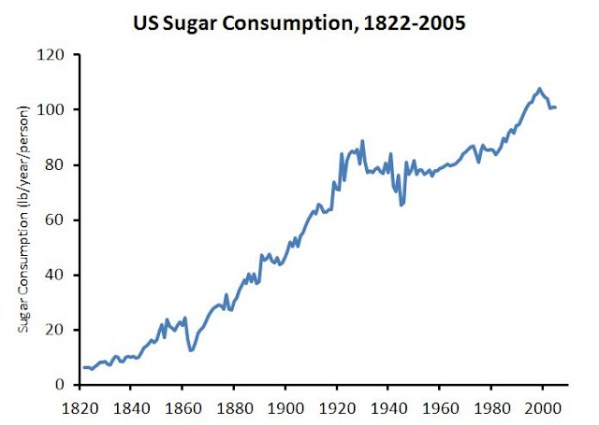
173 Years of U.S. Sugar Consumption

Thanks to Dr. Stephan Guyenet and Jeremy Landen for this sugar consumption graph.  I’d never seen one going this far back in time. 

 Dr. Guyenet writes:
It’s a remarkably straight line, increasing steadily from 6.3 pounds per person per year in 1822 to a maximum of 107.7 lb/person/year in 1999.  Wrap your brain around this: in 1822, we ate the amount of added sugar in one 12 ounce can of soda every five days, while today we eat that much sugar every seven hours.
The U.S. Department of Agriculture estimates that added sugars provide 17% of the total calories in the average American diet.  A typical carbonated soda contain the equivalent of 10 tsp (50 ml) of sugar.  The average U.S. adult eats 30 tsp  (150 ml) daily of added sweeteners and sugars.
 
Note that added sugars overwhelmingly supply only one nutrient: pure carbohdyrate without vitamins, minerals, protein, fat, antioxidants, etc.
 
Do you think sugar consumption has anything to do with diseases of affluence, also known as diseases of modern civilization?  I do.
 
Was our pancreas designed to handle this much sugar?  Apparently not, judging from skyrocketing rates of diabetes and prediabetes.
 

Famous People With Diabetes

dLife maintains a list of famous, prominent, or noteworthy folks who have or had diabetes.  I mention it here in case you have diabetes and sometimes feel like it’s got you by the throat and is ruining your life.  Be inspired.

Steve Parker, M.D.

B.B. King is No.3 on Rolling Stone’s list of 100 Best Guitarists of All Time.  King has diabetes.

PS: Who has a list of infamous diabetics?

Right Diet Preserves Brain Function and Size

mp9004223691.jpgThe journal Neurology reports that the proper diet seems to help prevent age-related brain shrinkage and cognitive decline.

From the press release:

People with diets high in several vitamins or in omega 3 fatty acids are less likely to have the brain shrinkage associated with Alzheimer’s disease than people whose diets are not high in those nutrients, according to a new study published in the December 28, 2011, online issue of Neurology, the medical journal of the American Academy of Neurology.

Those with diets high in omega 3 fatty acids and in vitamins C, D, E and the B vitamins also had higher scores on mental thinking tests than people with diets low in those nutrients. These omega 3 fatty acids and vitamin D are primarily found in fish. The B vitamins and antioxidants C and E are primarily found in fruits and vegetables.

So the dietary pattern linked to preservation of brain size and function in this study is: high omega-3 fatty acids and vitamins B, C, D, and E. I don’t know if study participants were getting these nutrients from supplements or from food or a combination. (I haven’t read the full article.)

To find foods high in the aforementioned nutrients, you can use NutritionData’s Nutrient Search Tool.

Note that the time-honored Mediterranean diet is also associated with lower rates of dementia and slower rate of age-related mental decline.

I previously reported that a supplement cocktail of three B vitamins slowed the rate of brain shrinkage.

Steve Parker, M.D.

Reference: Bowman, G.L., et al. Nutrient biomarker patterns, cognitive function, and MRI measures of brain aging. Neurology. doi: 10.1212/WNL.0b013e3182436598

h/t to Randall Parker at FuturePundit

Baseline Measurements Before Starting a Fitness Program

Impressive jump!

Before beginning or modifying a fitness program, it’s important to take some baseline physical measurements. Re-measure periodically. That way you’ll know whether you’re making progress, holding steady, or regressing. Seeing improvement in the numbers also helps to maintain motivation.

Not taking measurements would be like starting a weight loss plan without a baseline and subsequent weights.

Around this time last year, I finished a home-based, 15-week, six-days-a-week fitness program called Core Performance, designed by Mark Verstegen. I was pleased with the results. The only problem is that it’s very time-consuming. Perhaps fitness just has to be that way.

I regret that I didn’t take any fitness measurements before and after starting Core Performance.

For much of the last year, I modified Core Performance to a thrice weekly, then twice weekly program, until a couple months ago when I pretty much abandoned it. I miss the benefits now, but just didn’t want to put in the time to achieve them. In other words, I lost my motivation.

Who needs this much flexibility?

Intellectually, I know that regular exercise is important. I’m starting to get motivated again. Not sure why. Perhaps because I’ve read that you can be fairly fit with as little as 30 minutes of exercise a week. I’m not convinced yet. I’ll be test-driving some of these time-efficient programs soon.

This new style of fitness is promoted by the likes of Dr. Doug McGuff, Chris Highcock, Skyler Tanner, Nasim Taleb, and Jonathan Bailor, among others.

What to Measure

  1. Weight
  2. Blood pressure
  3. Resting heart rate (first thing in the AM before getting out of bed)
  4. Waist circumference (upright and supine)
  5. Height
  6. Body mass index
  7. Mid-arm circumference, both arms, hanging relaxed at your sides
  8. Maximal calf circumference, both calves, while standing at ease
  9. Maximum number of consecutive pull-ups
  10. Maximum number of consecutive push-ups
  11. Maximum number of consecutive sit-ups
  12. Run/walk one mile as fast as you can
  13. Maximum vertical jump (stand by a tall wall then jump and reach up as high as you can with one arm, noting the highest point above ground your fingers can reach)
  14. Can you touch your toes? Stand up straight, locking knees in extension, then bend over at your waist and touch your toes with your fingertips. If you can touch toes, can you flatten your palms against the floor? If you can’t reach your toes, measure the distance from your fingertips to the floor.
  15. Optional blood work for special situations: fasting blood sugar, hemoglobin A1c, triglycerides, cholesterols (total, HDL, LDL, sub-fractions)

The particular aspects of fitness these measure are strength and endurance in major muscle groups, cardiovascular and pulmonary endurance, a little flexibility, and a hint of body composition.

You may appreciate an assistant to help you measure some of these.

Record your numbers. Re-test some or all of these periodically. If you’re in fairly poor condition at the outset, you’ll see some improved numbers after a couple or three weeks of a good exercise program. It takes months to build significant muscle mass; you’ll see improved strength and endurance before mass.

Am I missing anything?

Steve Parker, M.D.

Minimalist Exercise

Not Darrin Carlson

Darrin Carlson on March 23, 2012, shared his ideas on the minimal amount of exercise and equipment needed to achieve reasonable fitness benefits.

Public health authorities for years have recommended physical activity in the range of 150 minutes a week.  That ain’t gonna happen for most folks.  Darrin says “Two hours a week will work for most people….”

Jonathan BailorChris Highcock, and others suggest 30-60 minutes a week may be enough.  Even Darrin admits as much, for the super-dedicated.

-Steve

Sources of Calories in U.S. Diet Over Last Four Decades

Italian seaside totally unrelated to this post

Do you ever wonder how many of the total calories in the aveage U.S. diet come from added sugars? Grains? Dairy products? Added fats?

You’d have to do some detailed nutrient analysis to get your personal numbers, but if you’d like U.S. averages, see this cool infographic at Civil Eats.

The graph also shows how many calories are or were available for consumption per capita over time (without accounting for wastage in restaurants). It’s based on U.S. Department of Agriculture data.

A superficial glance suggests that U.S. per capita daily calorie consumption has increased by about 600 from the 1970s until now. But remember, these numbers don’t discount for restaurant wastage. Nor do I see an adjustment for children versus adults. I’ve seen other calculations of an extra daily 150 calories (women) to 300 calories (men). Even the lower numbers could explain our explosion of overweight and obesity.

Steve Parker, M.D.