Dietitian Amy Kubal Answers, “Are Potatoes Paleo?”

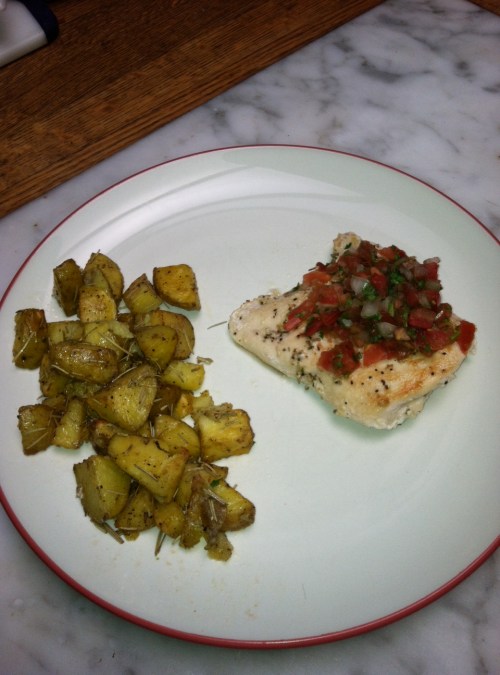
Rosemary Chicken (garnished with pico de gallo) and Rosemary Potatoes

Rosemary Chicken (garnished with pico de gallo) and Rosemary Potatoes

“The whole “to spud or not to spud” issue is seriously ‘no small potatoes’ in the Paleosphere. It’s highly debated as to whether or not white potatoes are ‘safe’ or ‘allowed’, and if they are okay, the questions really start rolling in – Can I eat the skin? I should only eat the red ones, right? How should I prepare them? Do I need to only eat them cold? If I do eat them, does it mean I’m not ‘doing Paleo’? It’s exhausting and absolutely amazing how such an innocent looking food can create so much controversy. Seriously, people are VERY opinionated on the issue, and I’m sure my opinions will not go unopposed. Well, haters be damned, you’re going to get them anyway.”

RTWT.

Source: “Ask Amy The RD”: Are Those Spuds For You?? The “Paleoness” of Potatoes

paleo diet, Steve Parker MD

Sweet potatoes ready to pop in the oven

O’Dea Says the Transnational Food Industry Is Likely to Block Cure of T2 Diabetes

Australian Aborigine in Swamp Darwin

Australian Aborigine in Swamp Darwin

Kerin O’Dea (School of Population Health, U. of South Australia) performed one of the first clinical studies utilizing the paleo diet for treatment of type 2 diabetes. I discuss it in my Paleobetic Diet book and here.

O’Dea recently wrote:

“The most important lesson that can be drawn from this study is that metabolic control in type 2 diabetes can be greatly improved with healthy lifestyle interventions. The diet in the 1982 study was rich in very lean meat from wild animals: its high protein content aided satiety despite low energy intake [1,200 cal/day]. The carbohydrate was mostly high fibre and slowly digested. The fat content was low, but relatively rich in long chain highly polyunsaturated fats (omega-3 and omega-6). Recent research has demonstrated  that ectopic fat is a driver of both defects of type 2 diabetes: insulin resistance when in the liver, and impaired insulin secretion when in the pancreas. Both are potentially reversible by healthy diets instituted early in the disease process. However, current population trends to increased obeisty are driven by the powerful transnational food industry. Preventive interventions will therefor be very challenging.”

Source: Pathology (2016), 48(S1), Abstract Supplement

Improve Knee Osteoarthritis With Strength Training

Osteoarthritis, aka degenerative joint disease, is quite common in folks over 45 and eventually may require knee replacement surgery. Recovery from that surgery is slow and painful; best to avoid it if you can.

Having good strength in the muscle that extends the knee helps to preserve the knee joint. That muscle is the quadriceps.

Click below for the evidence:

“Although limited, the reviewed studies suggest that participation in a resistance training program can potentially counteract the functional limitations seen in knee osteoarthritis; positive associations were found between increased muscle strength and walking self-efficacy, reduced pain, improved function, and total WOMAC score. Notably, improvements were greater in maximal versus submaximal effort testing, possibly due to a ceiling effect.”

Source: Strength training for treatment of osteoarthritis of the knee: A systematic review – Lange – 2008 – Arthritis Care & Research – Wiley Online Library

To get started on strengthening the quadriceps muscle, consider the following four-minute video that is two minutes too long:

Note her mention of ankle weights.

Steve Parker, M.D.

PS: If you’re overweight or obese, you lower limb joints will last longer if you lose the fat by following one of my books.

Hmmm: Spend $26,000 on Weight-Loss Surgery, Or Just Cut Carb Consumption?

Dr. Sarah Hallberg got some well-deserved publicity from the New York Times:

“Once a fad diet, the safety and efficacy of the low-carb diet have now been verified in more than 40 clinical trials on thousands of subjects. Given that the government projects that one in three Americans (and one in two of those of Hispanic origin) will be given a diagnosis of diabetes by 2050, it’s time to give this diet a closer look.

When someone has diabetes, he can no longer produce sufficient insulin to process glucose (sugar) in the blood. To lower glucose levels, diabetics need to increase insulin, either by taking medication that increases their own endogenous production or by injecting insulin directly. A patient with diabetes can be on four or five different medications to control blood glucose, with an annual price tag of thousands of dollars.”

Source: Before You Spend $26,000 on Weight-Loss Surgery, Do This – The New York Times

Fish Fraud: 1 in 5 Seafoods Are Labeled Wrong

Wish I were here

Wish I were here

Fraudulent labeling of fish and other seafood is a problem. It matters to me because I advocate frequent consumption of cold-water fatty fish as healthful. It’s the omega-3 fatty acids in those fish that are particularly good for you.

If what you believe to be trout is actually catfish, you’re not getting the omega-3s you paid for.

Click over to the New York Times for details:

“One in five seafood samples tested worldwide turns out to be completely different from what the menu or packaging says, according to a report on seafood fraud released Wednesday by the ocean conservation group Oceana. Of the more than 25,000 seafood samples the group analyzed, 20 percent were incorrectly labeled.“It is likely that the average consumer has eaten mislabeled fish for sure,” said Beth Lowell, the senior campaign director for Oceana and an author of the paper. “You’re getting ripped off, while you enjoyed your meal you’re paying a high price for a low fish.”

Source: Catfished by a Catfish: 1 in 5 Seafood Samples Is Fake, Report Finds – The New York Times

Raw oysters qualify as paleo

Raw oysters qualify as paleo

On a related note…I’ve been eating a lot of canned smoked oysters lately. Nearly all on the supermarket shelves in Arizona USA come from China. Why is that? I worry about pollutants in those oysters, regardless of provenance. If you have any info on this issue, please share.

Steve Parker, M.D.

PS: Search my blog for the list of high omega-3 cold-water fatty fish, or read my books.

LCHF Diet Cures Gastro-Esophageal Reflux Disease In Women

Looks European-American to me

Looks European-American to me

European-American? I guess that’s American women who are of European descent rather than Asian, Eskimo, African, etc.

LCHF in my headline refers to low-carb, high-fat.

GERD is gastro-esophageal reflux disease, i.e., frequent or severe heartburn. GERD is the most common reason to use a proton pump inhibitor drug like Prilosec. It’s expensive. I run across patients taking it every day for years.

Dr. Michael Eades has a great post about GERD and the potential drawbacks of proton pump inhibitors (PPIs):

The scientific literature has shown long-term PPI therapy to be related to the following conditions:

Anemia
Pneumonia
Vitamin B12 deficiency
Impaired calcium absorption
Impaired magnesium absorption
Increased rate fractures, especially hip, wrist and spine
Osteopenia [thin brittle bones]
Rebound effect of extra-heavy gastric acid secretion
Heart attacks

From the recent study at hand:

“GERD symptoms and medication usage was more prevalent in European-American women, for whom the relationships between dietary carbohydrate intake, insulin resistance and GERD were most significant. Nevertheless, high-fat/low-carbohydrate diet benefited all women with regard to reducing GERD symptoms and frequency of medication use.”

Source: Dietary carbohydrate intake, insulin resistance and gastro-oesophageal reflux disease: a pilot study in European- and African-American obese women. – PubMed – NCBI

Pay attention and follow all the links and you may be able to see the entire journal report. You just can’t wait, right?!!

Another study showed improvement in heartburn with a low-carb diet a few years ago.

All of my diet books offer low-carb high-fat options except for the original first edition of Advanced Mediterranean Diet from 2007. In 2009, I learned that low-carb high-fat eating wasn’t dangerous. Hence, the 2nd edition.

Steve Parker, M.D.

Exercise Cancels the Cancer-Inducing Effect of Alcohol

Jamesons Irish Whiskey Photo copyright: Steve Parker MD

Jameson Irish Whiskey
Photo copyright: Steve Parker MD

Just recently we learned that you’ll die of cancer if you tipple. Well, a new study says you can counteract the carcinogenic alcohol with adequate physical activity.

A story at CNN tells us how much exercise it takes :

“Specifically, they looked at the impact of the recommended amount of weekly exercise for adults, which is 150 minutes of moderate aerobic activity. That includes brisk walking, swimming and mowing the lawn, according to the US Department of Health and Human Services. HHS also advises strength training for all major muscle groups at least twice a week.”

Source: Exercise can cancel out the booze, says study – CNN.com

The rule of thumb on how much alcohol is relatively safe to drink is 7 typical drinks a week for women, and 14 for men. Don’t drink them all at once.

Also remember that even one or two drinks under the right circumstances can have devastating consequences.

Steve Parker, M.D.

PS: All of my books have extensive recommendations on getting started with exercise, even if you’re a 300-lb couch potato.

Insulin cost in U.S. doubled between 2002-2013

This is NOT an insulin rig!

This is NOT an insulin rig!

You can’t blame inflation for the cost increase. I’m not sure the link below explains why.

Just this morning I was listening to AM “talk radio” and someone said her husband’s two insulins cost $1,400/month (USD). That’s ridiculous. He was between jobs and had lost his health insurance that had been paying for insulin.

If you’re worried about the cost of insulin, you can take action today to reduce your required dose: lose the excess weight, eat fewer carbohydrates, improve your insulin sensitivity with exercise.

From Reuters:

“The cost of the hormone insulin, one of the most important treatments for diabetes, rose nearly 200 percent between 2002 and 2013, according to a new study.

While other diabetes medications also increased in price, total spending on insulin in 2013 was greater than the combined spending on all those other drugs, researchers report in JAMA.

“The large increase in costs can largely be explained (by) much greater use of newer types of insulin known as analog insulins,” said senior author Philip Clarke, of the University of Melbourne in Australia. “While these drugs can be better for some patients, they are much more costly than the human insulin they replaced.”

Source: Insulin cost in U.S. more than doubles between 2002-2013 | Reuters

Steve Parker, M.D.

Intensive Program Extended Life By Eight Years in T2 Diabetes

MedPageToday has some details:

“Type-2 diabetics lived nearly 8 years longer when treated with an intensive, multifactorial approach that employed behavioral and pharmacological interventions.

The 160 patients with type-2 diabetes mellitus and microalbuminuria, now followed for 21 years, received either conventional or intensified therapy.

Thirty-eight intensive-therapy patients died during the follow-up period compared with 55 conventional-therapy patient deaths during the same time. This translated to a median survival period 7.9 years longer for the intensive-therapy cohort, as well as a median delay of 8.1 years to a first cardiovascular event, the investigators reported in the journal Diabetologia.

“The outcome of our study is very encouraging and emphasizes the need for early and intensified treatment of multiple modifiable risk factors for a poor prognosis of patients with type 2 diabetes,” said lead study author Peter Gaede, MD, of the University of Southern Denmark in Odense, in a statement.”

Source: Intensive Program Extends Lifespan in T2D Patients | Medpage Today

Parker here.

Study participants were northern Europeans (Danes) who had small amounts of protein (albumin) in their urine and were mostly in their 50s when the long-term study started.

Medical intervention included diet changes, drugs for diabetes/blood pressure/lipids, and exercise. Therapy for the intensive therapy group was “target-driven, with stepwise implementation of both behavioral and pharmacological treatment following a structured approach.”

If you’re a researcher and want to test how my diabetes diets would perform in a study like this, contact me for a discount on books.

Steve Parker, M.D.

Meet Dr. Priyanka Wali, Low-Carb Diet Advocate (interviewed by Ivor Cummins)

Dr. Wali is an internist in San Francisco. In her medical practice, she saw first-hand how standard “diabetic diets” weren’t helping her patients and many others who have carbohydrate intolerance. Welcome to the club, Dr. Wali!


PS: She’s also a good stand-up comedian,which is rare for an internist.