How Long Have Our Ancestors Been Cooking With Fire?

“We mastered fire with the invention of matches, silly!”

Earlier this month I mentioned that biological anthropologist Richard Wrangham estimates hominins tamed fire and started cooking with it 1.8 million years ago.

A recent article at Slate reviews the debate among anthropologists.  Some respected authorities date our mastery of fire from 12,000 to 400,000 years ago.

I don’t know the answer, but I’d wager it was much earlier than 12,000 years ago.

—Steve

Skirt Steak With Guacamole and Pico de Gallo

Another doctor-approved paleo meal

I’m blessed to have a wife who’s a good cook.

When I lived in Austin, Texas, the story was that skirt steak (diaphragm muscle) was a cheap cut of meat favored by Mexicans.  After fajitas caught on, the price went up.  It’s often run through a tenderizing machine or pounded before cooking.

Pico de Gallo is just chopped up tomato, onion, cilantro, jalapeño pepper, and salt.

-Steve

Hamburger and Avocado Salad

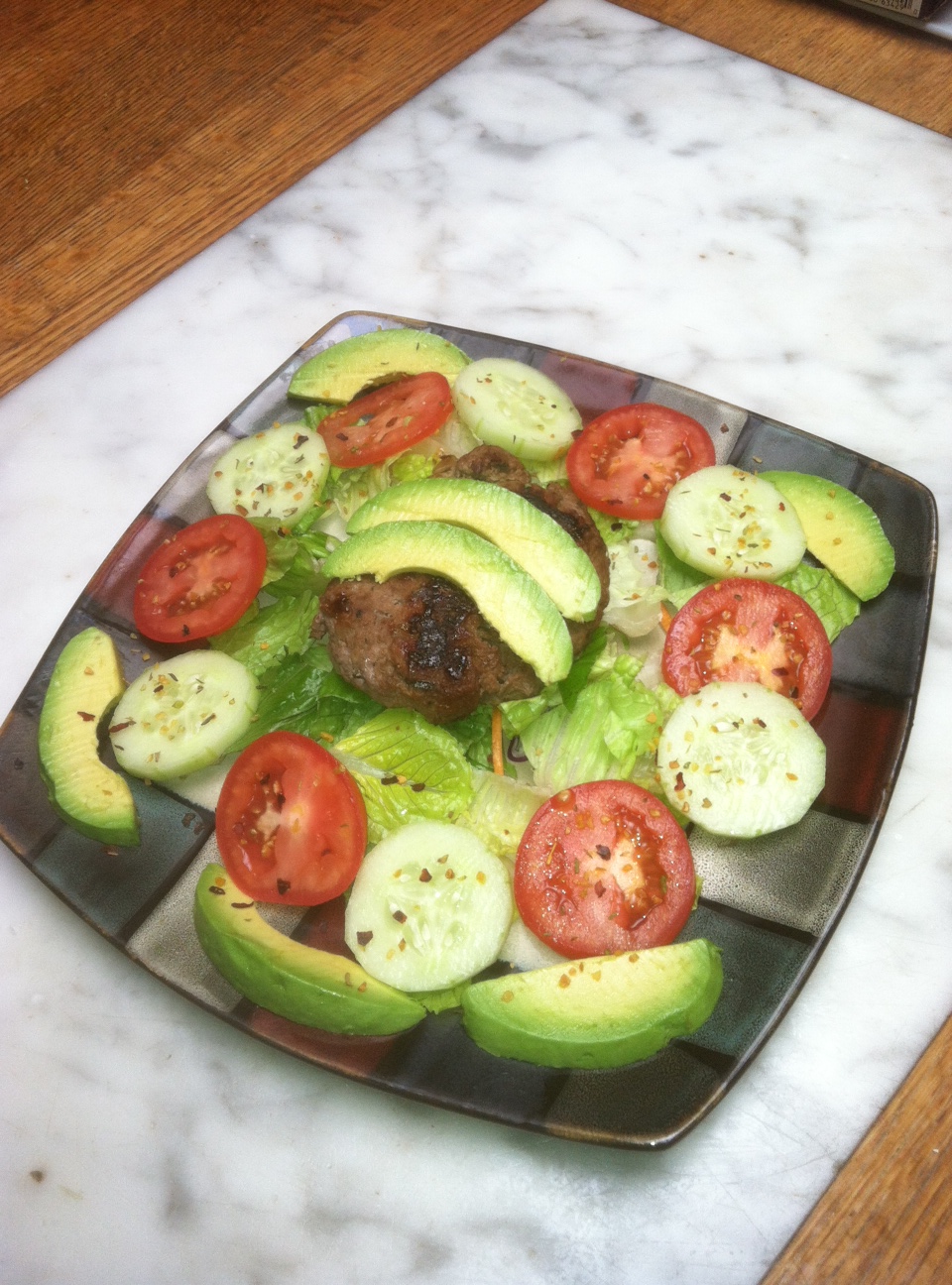
Hamburger-Avocado Salad with tomatoes, cucumbers, lettuce, salt/pepper, and olive oil vinaigrette

This was an OK dinner.  My wife didn’t care for it, which may explain why don’t see anything similar on typical restaurant menus.  You see salads with chicken, salmon, or steak strips, usually.  Hamburger’s just not an ideal pairing with the other flavors, I guess. I dressed it with the left-over olive oil vinaigrette I made yesterday.

-Steve

Sunny’s Super Salad

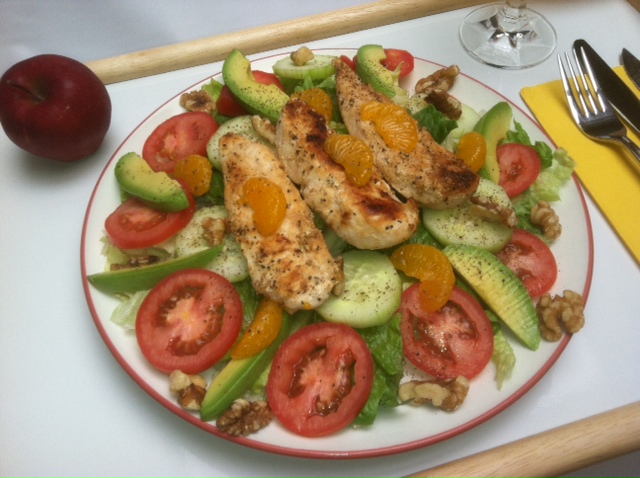
Sunny’s Super Salad

My wife whipped this up for a quick lunch.   The salad has several types of lettuce, walnuts, mandarin oranges, avocado, cucumber, and tomato, topped with pan-fried skinless chicken strips.

I made the vinaigrette with extra virgin olive oil, balsamic vinegar, and salt/pepper in about two minutes.  My oil to vinegar ratio was 3:1.  My wife wants less vinegar next time.

Sprinkle on Weber Roasted Garlic and Herb Seasoning  for extra zing, if desired.  I may add this to my next batch of vinaigrette.

—Steve

Day 1 of My Paleo Diet

Why do it?

  • Direct experience with implementation obstacles
  • Potential health benefits

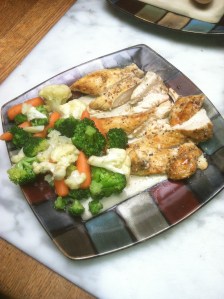
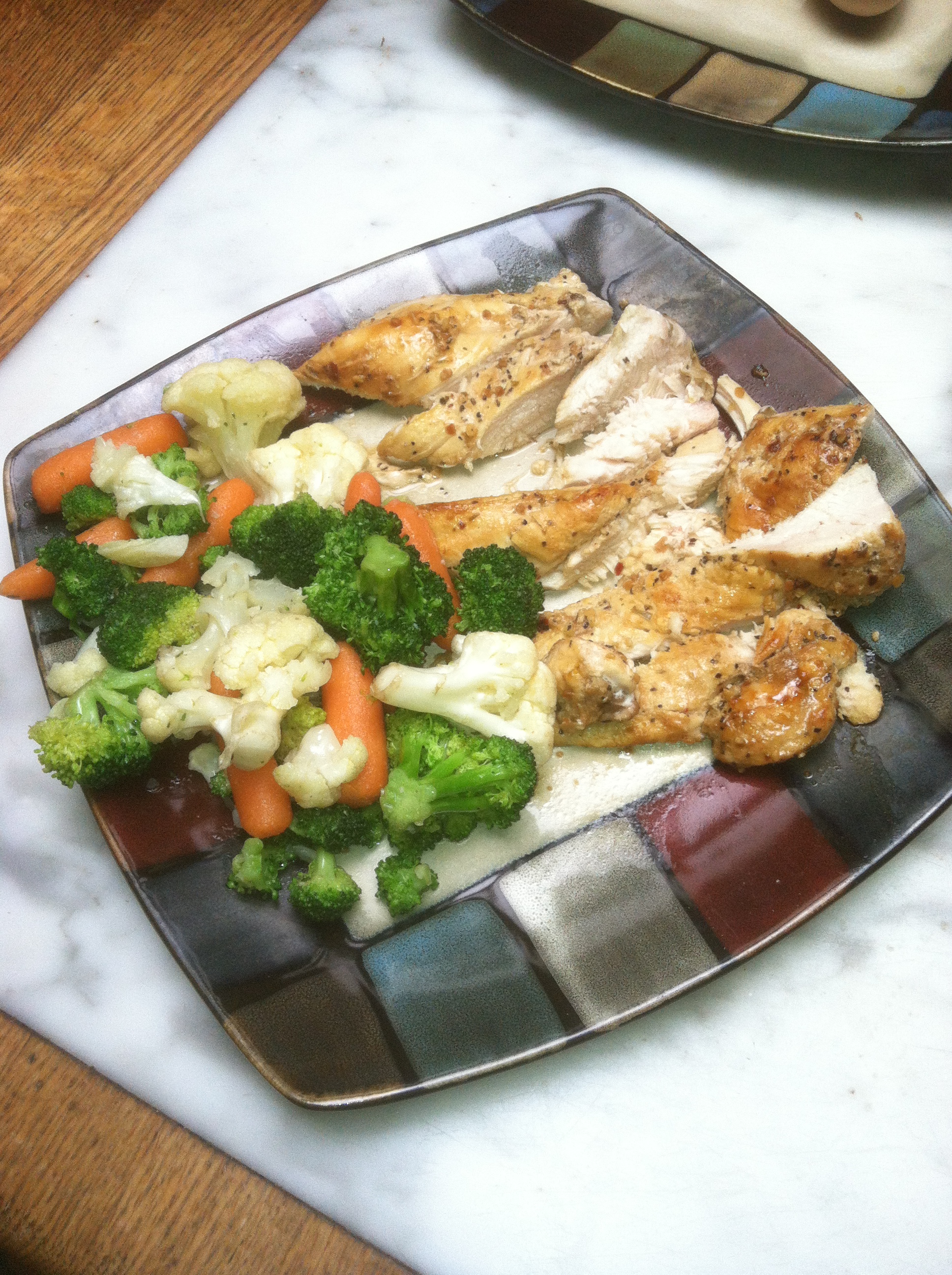
My first Parker Paleo Diet meal: sautéed mixed veggies and pan-fried chicken breast

I’m not doing this to lose weight, although I wouldn’t mind losing 10 lb (4.5 kg).  I weigh 171 lb (77.7 kg, BMI 23.4).  Regarding health benefits, I’m just going to monitor how I feel.  No blood work.  My blood pressure’s normal already.

My current version of paleo is not designed for someone with diabetes or prediabetes.  That may come in the future (Dr. Frassetto, when can we see your latest research results?).  By “current version,” I mean I’ll quite likely tweak it over the coming months.  One of my major issues is whether to keep or delete potatoes.

Here’s what I’ll eat (or not) on the Parker Paleo Diet:

FORBIDDEN FOODS: Grains (e.g., corn, wheat, rice), Dairy, Legumes (peanuts, beans, peas, green beans), Industrial Vegetable Oils (soybean, corn, safflower, etc.), Alcohol, Refined Sugars.

PROTEINS: Meat, fish/seafood, eggs, poultry, and wild game.  Bacon OK; minimize other processed meats.

NUTS & SEEDS: Especially walnuts, macadamia, cachews, almonds.  Limit to 1-2 oz/day.

FRUITS: Limit 2 pieces/day?

VEGETABLES:

Lower-Carb: Greens (lettuce, spinach, chard, collard, mustard geen, kale), radicchio, endive, bok choy, herbs, celery, radishes, mushrooms, cabbage, jicama, avocado, asparagus, okra, cucumbers, cauliflower, broccoli, peppers, summer squash, zucchini, Brussels sprouts, green onions, tomatoes, eggplant, tomatillos, eggplant, artichokes, turnips, rutabagas, spaghetti squash, carrots, onions, leeks, water chestnuts (small serving).  This list generally starts with the lower carb items and gradually increases to higher carb grams.  All these have 5 or fewer carbs per serving; most are  much less.

Starchy, Higher-Carb: Beets (6 g, GI 64), winter squashes (acorn, butternut), water chestnuts, parsnips (9 g, GI 97), potatoes (35 g, GI 87), sweet potatoes, (20 g, GI 61), cassava (37 g), taro (21 g), plantains.  Some categorize carrots as starchy.

HERBS & SPICES: Cilantro, parsley, basil, rosemary, thyme, etc.  Salt (minimal), pepper, vinegar.

OILS: Extra virgin olive, canola, flax, avocado.

CONDIMENTS: Olive oil vinaigrettes, mayonnaise from olive oil & egg yolk, and ?

LIQUIDS: H2O, coffee, tea

I’m not counting calories, fat grams, or carb grams.  I’ll eat until full or satisfied, not stuffed.  This is a two-month trial, excluding 24 hours around Thanksgiving.

Steve Parker, M.D.

Which Vegetables Are Low in Carbohydrate Content?

Laura Dolson over at About.com has a helpful list of low-carb veggies.  Helpful if you experience excessive

blood sugar spikes from high-carb items, or if you’re restricting carbs for weight management.

-Steve

What Exactly Is the Paleo Diet?

Pure paleo

Let’s be realistic: There’s no way to eat a Stone Age diet these days unless you live off the land, hunting, fishing, and gathering from what’s naturally available in the wild.  Few can do that, although it’s not impossible.  I’m going to specify my version of the paleo diet because I’m starting a paleo diet trial soon—a first for me.

How long has man had fire?  Biological anthropologist Richard Wrangham estimates hominins tamed fire and started cooking with it 1.8 million years ago.  So I’m cooking my paleo foods if I wish.

As with my beloved Mediterranean diet, definitions of the paleo diet vary.  The following guidelines are influenced by my review of blogs or websites by Loren Cordain, Julianne Taylor, Robb Wolf, and Kurt Harris.  The first three are closely affiliated with each other, so expect lots of overlap.  It’s simplest to define paleo by what’s not allowed.

What’s NOT Paleo?

Industrial vegetable oils (e.g., soybean, corn,safflower), legumes, dairy, refined sugars, grains, alcohol, and high salt consumption.

What Is Paleo? 

The focus is on minimally processed, in-season, locally available foods.  Many favor pastured, grass-fed beef, free-range chickens, “organic,” and the like.  I guess that’s fine if you can afford it; I choose to spend my money elsewhere.

Proteins

Meat, fish/seafood, eggs, poultry, and wild game.  Most paleo proponents favor lean meats over fatty ones; it’s debatable. Undoubtedly, our domesticated feedlot animals are fattier than wild game, generally.  Processed meats such as bacon would not be pure paleo, but many paleo advocates allow it.

Nuts and Seeds

Favor those with the best omega-6/omega-3 ratio (2 or 3:1), such as walnuts, almonds, macadamia, and cashews.  Modern humans eat way more omega-6 fatty acids compared to ancient hunter-gatherers.

Fruits and Vegetables

It’s probably best to favor those with lower glycemic index.  Examples are berries, melons, cauliflower, tomatoes, onions, and broccoli.  Most modern fruits and veggies  have been bred for large size and good looks.  Ancient fruits and veggies were smaller and had much more fiber per serving.

Tubers, Roots, Bulbs

These are OK per Cordain, and I agree.  Examples include potatoes, cassava, taro root, onions.  Some paleo proponents exclude potatoes.

Oils

Cordain favors oils such as canola, flax, olive. Others mention avocado oil.  Aim for a good omega-6/omega-3 ratio.  Lard is probably OK although obviously processed.

Herbs and Spices

Many of our favorites should be OK.  Wolf says balsamic vinegar is allowed, although processed, like all vinegars.  Vinegar is “natural,” as you might have noticed if you ever walked through an apple orchard with rotting fruit on the ground; you can smell the vinegar.

Condiments

Undecided.  Note that you can make mayonnaise from olive oil and egg yolk.

Miscellaneous

Olives?  They’re processed, but I’m inclined to keep them in the mix.  Coffee?  Not paleo, but I ain’t givin’ it up.  Consider limiting nuts to one ounce daily since most of them are high in omega-6 fatty acids.  Fresh foods are more purely paleo than canned or frozen, but I’ll not exclude canned and frozen.  Limit fruit?  Probably: in most environments, they’re available only seasonally.  Diet sodas?  Clearly not paleo, but I enjoy one now and then and don’t see any drawbacks to low consumption.

Steve Parker, M.D.

Update October 8, 2012

I learned today that my version of paleo, by coincidence, is similar to the Hartwigs’s Whole30 plan.  But they allow clarified butter or ghee, green beans, and snow peas.  I include potatoes, but Whole30 doesn’t.

Are We Fat Because We’re Less Active?

Less active

Much of the world has seen a significant decline in populaton-wide physical activity over the last few decades, according to Nike-sponsored research reported in Obesity Reviews.

Countries involved with the study are the U.S., U.K., Brazil, China, and India.  How did they measure activity levels?

Using detailed historical data on time allocation, occupational distributions, energy expenditures data by activity, and time-varying measures of metabolic equivalents of task (MET) for activities when available, we measure historical and current MET by four major PA domains (occupation, home production, travel and active leisure) and sedentary time among adults (>18 years).

The authors note the work of Church, et al, who found decreased work-related activity in the U.S. over the last half of the 20th century.

Inexplicably, they don’t mention the work of Westerterp and colleagues who found no decrease in energy expenditure in North American and European populations since the 1980s.

More active

My gut feeling is that advanced populations around the globe probably are burning fewer calories by physical activity over the last 50 years, if not longer, thanks to technologic advances.  We in the U.S. are also eating more calories lately.  Since the 1970s, average daily consumption by women is up by 150 calories, and up 300 by men.  I’m surprised we’re not fatter than we are.

Steve Parker, M.D. 

Quote of the Day

Frederick Douglass taught that literacy is the path from slavery to freedom. There are many kinds of slavery and many kinds of freedom, but reading is still the path.”

Carl Sagan

Aggressive Blood Sugar Control Prevents or Delays Neuropathy in Type 1 Diabetes

I couldn’t find a “neuropathy” picture so enjoy this

Aggressive efforts to control blood sugar either prevent or delay clinical neuropathy in patients with type 1 diabetes, according to the Cochrane Collaboraton as reported in MedPage Today.  Type 2 diabetics showed a strong trend in the same direction, but did not quite reach statistical significance (p=0.06, which is darn close to significant).  Be aware, however, that tight control of diabetes is often at the cost of more frequent episodes of hypoglycemia.

Intensive blood sugar control is also a treatment for established neuropathy.

One in ten diabetics has neuropathy at the time of diagnosis.  After 10 years, four or five of every 10 have it.  The pain of neuropathy is worse than the numbness.

The medical community is still debating how aggressively blood sugars should be managed.

Steve Parker, M.D.

PS: I don’t know what the Cochrane reviewers consider “tight control” because the article is behind a paywall, and the MedPage Today article didn’t address that either.

Reference: Callaghan BC, et al “Enhanced glucose control for preventing and treating diabetic neuropathy” Cochrane Database Syst Rev 2012; DOI:10.1002/14651858.CD007543.pub2.