Category Archives: Uncategorized

U.S. Diabetes Prevalence: 1935 to 2011

From 1935 to 1996, the prevalence of diagnosed type 2 diabetes [in the U.S.] climbed nearly 765%.

765%—Wow!  This statistic is from the Centers for Disease Control and Prevention as cited in Increased Consumption of Refined Carbohydrates and the Epidemic of Type 2 Diabetes in the United States: an Ecologic Assessment, American Journal of Clinical Nutrition, 2004, vol. 79, no.5, pp: 774-779.

I thought 765% might be a misprint, so I did some digging.  A similar figure is in DHHS Publication No. (PHS) 82-1232 published in 1981:

  • Diabetes prevalence rose from 0.4% of the population in 1935,  to 2.4% in 1979.

This is a six-fold increase.  The major part of the upward trend started in 1960.  Interestingly, that’s when corn syrup started working its way into our food supply.  Coincidence?  The authors of the Department of Human Services paper write:

Preliminary evaluation of these trends suggests that the change in the prevalence of known diabetes has resulted from improvements both in detection of diabetes among high-risk groups and in survivorship among persons with diabetes.

To me, it sounds like they weren’t considering an true increase in the number of new diabetes cases (i.e., incidence), but better detection of existing cases and improved longevity of existing patients (prevalence).  Incidence and prevalence are often confusing.  Wikipedia has a clarifying article.  These days, both incidence and prevalence of diabetes are greatly increased over 1935 levels.

In January, 2011, the U.S. Centers for Disease Control and Prevention released the latest estimates for prevalence of diabetes and prediabetes.

  • 8.3% of the total U.S. population has either diagnosed or undiagnosed diabetes (earlier percentages in this post were for diagnosed cases only)
  • Nearly 27% of American adults age 65 or older have diabetes (overwhelmingly type 2)
  • 6% of the U.S. adult population has diagnosed diabetes (My calculation: Population in 2011 was 311 million; with 18.8 million diagnosed cases of diabetes, 7 million undiagnosed)
  • Half of Americans 65 and older have prediabetes
  • 11% of U.S. adults (nearly 26 million) have diabetes (overwhelmingly type 2)
  • 35% of adults (79 million) have prediabetes, and most of those affected don’t know it

Here’s a post about prevention of type 2 diabetes.

I suspect that overconsumption of concentrated sugars and refined starches (e.g., grains) has contributed to the prevalence of type 2 diabetes and overweight lately.  A paleo-style diet restricts those quite a bit, and therefore, could prevent some cases of diabetes.

Steve Parker, M.D.

PS: The paleo diet is also referred to as the Old Stone Age, Stone Age, hunter-gatherer, caveman, and ancestral diet.

Exercise Motivation

No crowds and no roads: You have to be in good shape to get up here

This last winter I slacked off on my physical activity.  But in April I started Chris Highcock’s Hillfit program.  It’s based on resistance exercise, and I supplemented with high-intensity interval training on a treadmill.  All in less than an hour a week.

To help me judge effectiveness of the new plan, I measured and recorded my baseline fitness.

Exercise isn’t fun.  You need good reasons to do it.  Here are mine:

  • it keeps you young (fountain of youth)
  • longevity
  • less low back aching
  • injury resistance
  • dementia prevention
  • lowered risk of heart disease and cancer
  • I’m a sheepdog, not a sheep
  • weight management
  • emergency preparedness
  • more energy to enjoy life (hiking, camping, horseback riding, long walks with others, etc.)

If you hope to exercise regularly, you’ll need your own list of reasons.  You’ll have days, weeks, or months when you just don’t want to exercise.  Review your list then.

Steve Parker, M.D.

PS: Here’s my report after six weeks of Hillfit.

Does Eating Fish, Meat, and Poultry Ruin Your Mood?

Cow’s in a good mood. What a great place to live!

Your mood might improve if you restrict meat, poultry, and fish, according to a pilot study in Nutrition Journal. I don’t have time to read it anytime soon. Why don’t you, and comment below?

My gut tells me these researchers are wrong.  At least for me.  To each his own.

-Steve

Reference: Beezhold, Bonnie and Johnston, Carol. Restriction of meat, fish, and poultry in omnivores improves mood: a pilot randomized controlled trial. Nutrition Journal 2012, 11:9 doi:10.1186/1475-2891-11-9. Published: 14 February 2012

Institute for Justice Takes Steve Cooksey’s Case Involving North Carolina Dietitians

The Institute for Justice will be helping paleo diet blogger Steve Cooksey defend his right to free speech.  That’s an expensive battle so I’m glad Steve is not alone in the fight.

I’m sure that the Institute for Justice accepts donations.  I’ve been familiar with their great work for years.

-Steve

Brenna Reviews Sugar Substitutes

Too late now!

Paleo diet purists don’t eat artificial sweeteners.  Yet many adherents eat paleo-style only 80 or 90% of the time, partly because they miss their sweets.  Fruits and honey don’t always hit that sweet spot.

Dietitian Brenna at Eating Simple has a post on sugar substitutes, which I sometimes refer to as non-caloric sweeteners (not entirely accurate). She reviewed sucralose, saccharine, aspartame, and acesulfame potassium.

A few days later, she reviewed sugar alcohols.

Many who have a sweet tooth, including myself, use sugar substitutes such as sugar alcohols. Sometimes they affect blood sugar levels, although not as much as table sugar (sucrose).

Brenna links to a Mayo Clinic article on artificial sweeteners.  Also at the Mayo Clinic website is an article by Dr. Maria Collazo-Clavell on use of artificial sweeteners specifically by people with diabetes.  Like Brenna, she notes that sugar alcohols can raise blood sugar levels in people with diabetes.

Dr. Richard K. Bernstein says acceptable sugar substitutes for PWDs (people with diabetes) are:

  • saccharin tablets or liquid
  • aspartame tablets
  • acesulfame-K
  • stevia
  • sucralose tablets and liquid Splenda

He says to be wary of any of these in powdered form because they are usually then mixed with dextrose (glucose) or maltodextrin or other type of sugar to increase bulk. So blood sugars go up.

I never got excited enough to cover this topic in detail myself. Thanks, Brenna!

Steve Parker, M.D.

FDA Approves Exenatide for Once Weekly Injection

Once-weekly injection of exenatide, sold in the U.S. as Bydureon, has been approved for use by the U.S. Food and Drug Administration.  It’s the first-ever once-weekly drug for type 2 diabetes.  Bydureon’s main competitors are Byetta (exenatide  injected twice daily) and Victoza  (liraglutide).  Byetta and Bydureon are made by the same company, Amylin Pharmaceuticals.  Bydureon is a slow-release formulation of exenatide.

Victoza is the one that celebrity chef Paula Deen endorsed about a month ago, around the same time she revealed she’s had type 2 diabetes for three years.  Victoza’s injected once daily.

The New York Times has a January 27, 2012, article on Bydureon, focusing on business and investing.  The new drug is expected to retail for $4,200 (USD) a year.

Click for complete prescribing information.

Click for a press release approved by Amylin.

David Mendosa is excited about Bydureon.

These drugs are in a class called GLP-1 receptor agonists, which mimic the effect of glucagonlike peptide-1, a hormone that increases insulin secretion by the pancreas when blood sugar levels are high.  They are prescribed as adjuncts to diet and exercise in adults with type 2 diabetes.

Steve Parker, M.D.

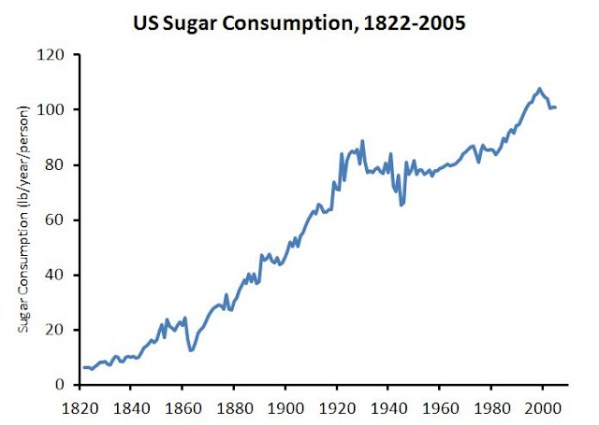
173 Years of U.S. Sugar Consumption

Thanks to Dr. Stephan Guyenet and Jeremy Landen for this sugar consumption graph.  I’d never seen one going this far back in time. 

 Dr. Guyenet writes:
It’s a remarkably straight line, increasing steadily from 6.3 pounds per person per year in 1822 to a maximum of 107.7 lb/person/year in 1999.  Wrap your brain around this: in 1822, we ate the amount of added sugar in one 12 ounce can of soda every five days, while today we eat that much sugar every seven hours.
The U.S. Department of Agriculture estimates that added sugars provide 17% of the total calories in the average American diet.  A typical carbonated soda contain the equivalent of 10 tsp (50 ml) of sugar.  The average U.S. adult eats 30 tsp  (150 ml) daily of added sweeteners and sugars.
 
Note that added sugars overwhelmingly supply only one nutrient: pure carbohdyrate without vitamins, minerals, protein, fat, antioxidants, etc.
 
Do you think sugar consumption has anything to do with diseases of affluence, also known as diseases of modern civilization?  I do.
 
Was our pancreas designed to handle this much sugar?  Apparently not, judging from skyrocketing rates of diabetes and prediabetes.
 

Famous People With Diabetes

dLife maintains a list of famous, prominent, or noteworthy folks who have or had diabetes.  I mention it here in case you have diabetes and sometimes feel like it’s got you by the throat and is ruining your life.  Be inspired.

Steve Parker, M.D.

B.B. King is No.3 on Rolling Stone’s list of 100 Best Guitarists of All Time.  King has diabetes.

PS: Who has a list of infamous diabetics?

Classic Australian Aborigine Study on Return to Ancestral Diet and Lifestyle

Did you know kangaroo is edible?

The scientific article I review today is often cited by those who favor a Paleolithic diet for diabetics.  Cordain and Stefanson have written about it, for example.

Background

Urbanized Australian Aboriginal communities have a high prevalence of type 2 diabetes.   Kerin O’Dea writes:

The change from an urban to a traditional lifestyle involves several factors that directly affect insulin sensitivity: increased physical activity, reduced energy intake and weight loss, and changes in the overall dietary composition.  All of these factors improve insulin sensitivity and should, therefore, be of benefit to the insulin-resistant diabetic.

Methods

Ten urban type 2 diabetic and four nondiabetic full-blood Aborigines agreed to revert to their traditional lifestyle as hunter-gatherers in an isolated region of Australia for seven weeks.  Average age was 53.  Half of them were moderate to heavy alcohol drinkers.  Average diabetic weight was 82 kg (180 lb); nondiabetics averaged 77 kg (169 lb).  There were equal numbers of men and omen.  None of the diabetics was on insulin, and only one was on an oral diabetic drug (a sulfonylurea). 

Ayers Rock, Uluru National Park, Australia

The study was carried out at Pantijan, the traditional land of these Aborigines.  It’s a day-and-a-half drive in a four-wheel vehicle from Derby.  At least it was in 1984.

For seven weeks, the participants ate only what they hunted or collected.  Diet composition was dependent on whether they were travelling to the homeland (1.5 weeks), at the coastal location (2 weeks), or inland on the river (3.5 weeks). Protein sources were mainly beef, kangaroo, fish, birds, crocodiles, and turtles.  Carboydrate content ranged from under 5% to 33%.  Protein content varied from 50 to 80%.  Fat was 13 to 40%.  So, very high protein and low-carb.  Carb sources were yams, honey, and figs.  Yams were the predominant carb source.  They also eat yabbies (shrimp or crayfish (“crawdads” in Oklahoma)).  Average energy intake was a very low 1,200 calories a day. 

The author implies this was the traditional Aboriginal diet.

What did they eat back home in the city? 

The main dietary components were flour, sugar, rice, carbonated drinks, alcoholic drinks (beer and port), powdered milk, cheap fatty meat, potatoes, onions, and variable contributions of other fresh fruit and vegetables. 

O’Dea estimates a macronutrient breakdown of 50% carb, 40% fat, and 10% protein (similar to the Standard American Diet, then).

What Did O’Dea Find Out?

Everyone lost weight, a group average of 8 kg (18 lb) over the seven weeks.

Fasting blood sugars fell in the diabetics from 11.6 mmol/l to 6.6 mmol/l (209 to 119 mg/dl).  After-meal blood sugars also fell dramatically.

Fasting insulin levels fell from 23 to 12 mU/l.

Fasting triglycerides fell drastically. 

HDL cholesterol fell significantly, whereas LDL cholesterol tended to rise.

So What?

How often do you see a scientific article with just one author?  Rarely, these days.

The investigator wrote that, “Under the conditions of the study it is difficult to separate out effects of dietary composition, low energy intake, and weight loss.”

O’Dea estimates that experimental activity levels were probably higher than in the urban setting, but not dramatically more so.  (He was with the participants throughout the experiment.)

The main carbohydrate sources in this ancestral diet were yams, honey, and figs.  Modern Australian honey is probably similar to the honey of 100,000 years ago.  But what about yams and figs? 

These folks had to have been eating twice as many calories, at least, back in their urban environment.  O’Dea didn’t comment on how well the participants tolerated calorie restriction.  Did they complain?  Did they eat to satiety?  They had no access to food other than what they could hunt and gather.  Was food in short supply?  It’s not documented.  You’d think O’Dea would mention these issues if they were a problem. 

This particular ancestral diet was extremely high in protein: 50–80% of calories.  (Eaton and Konner suggest that an average ancestral diet provides only 25–30% of total calories from protein.  A typical modern high-protein diet derives about 30% of calories from protein, compared with 15–18% in the standard American diet.)  Protein helps combat hunger.  But halving caloric intake for seven weeks is extreme.  Don’t believe me?  Just try it.  This degree of caloric restriction by itself would tend to lower blood sugar levels and body weight in most humans, regardless of macronutrient ratios and ethnicity.

I know nothing about Australian Aborigines as an ethnic and genetic group.  Is their diabetes similar to European diabetes?  Pima Indian diabetes?   

O’Dea never called the study diet Paleolithic, because it wasn’t. It was a modern hunter-gatherer diet eaten by rural, isolated Australian Aboriginal communities.

This calorie-restricted, very-high-protein, natural diet was very effective for weight loss and blood sugar control in this tiny, seven-week study on a specific ethnic population.  I bet the caloric restriction was the most effective component of the lifestyle change.  Restriction of refined sugars and starches also helped. 

This ancestral diet was beneficial for a few Australian Aborigines.  Are the lessons widely applicable?  Not yet.  As they say, “further studies are needed.”  You can’t just cite this study to say that paleo diets are healthy for diabetics.

It does jibe with plenty of other research that shows severe calorie restriction leads to weight loss and lower blood sugar levels.

Steve Parker, M.D.

Reference: O’Dea, Kerin.  Marked improvement in carbohydrate and lipid metabolism in diabetic Australian Aborigines after temporary reversion to traditional lifestyle.  Diabetes, 33 (1984): 596-603.

Link to Evidence in Favor of High-Intensity Interval Training

Tabata's team used stationary bicycles

I ran across this recent scientific review article on HIIT (high-intensity interval training) and thought you might be interested.  Looks like it’s slated for publication in The Journal of Physiology.

I’m interested in HIIT as a means to achieve fitness in much less time than the 150 minutes a week of exercise recommended by various public health authorities.

Why didn’t the authors at least mention the oft-cited and apparently pioneering work of Izumi Tabata et al from 1996?

Steve Parker, M.D.

References:

Gibala et al.  Adaptations to low-volume, high-intensity interval training (preliminary draft).  Journal of Physiology, doi: 10.1113/jphysiol.2011.224725

Tabata, I., et al.  Effects of moderate-intensity endurance and high-intensity intermittent training on anaerobic capacity and VO2max.  Medicine and Science in Sports and Medicine, 1996 Oct;28(10):1327-30.