Jamie Scott Reflects On His Boulder, CO, Trip

Living in the U.S. and not being an international traveler, I’m interested in how foreigners perceive the U.S.  Jamie Scott (from New Zealand) was recently in Boulder, CO, for the Ancestral Health Symposium. Parts of this trip he loved, but others, not so much:

“Let’s put this bluntly – we HATE travelling inside America.  The best way to describe it is dehumanising.  From the time you set foot on American soil, you never feel welcome. You are herded, yelled at, scolded, and glared at.  San Francisco is generally a much better entry point than LAX, but it is still terrible.

I always arrive with the intention of treating everyone doing their job like a human being, but by the time I was through immigration and heading toward the TSA screening for our connecting flight to Denver, I was seriously needing to bite my tongue.  It didn’t matter whether it was the person checking our baggage through, the person checking our passports at TSA, or the cabin crew on our flight – not a single one had the ability to acknowledge you as a human being in front of them.  Even the armed guard checking tickets on our train ride from downtown Denver to the airport left us feeling barked at and interrogated.”

Source: In Thin Air | re|evolutionary

In case you don’t know it, Boulder has little resemblance to the rest of the U.S.

Tom Naughton Eviscerates S. Andrikopoulos

Sof Andrikopoulos recently criticized the paleo diet as being unfit for folks with diabetes. Tom disagrees. For example:

“Andrikopoulos isn’t exactly a common name, yet it sounded familiar.  So I searched the blog.  Sure enough, I wrote a post about the Aussie perfesser back in February after he produced a study purporting to demonstrate that a paleo diet will makes us fat and sick.  I say purporting because the (ahem) “study” was on mice … and the “paleo” diet tripled the furry little subjects’ sugar intake, provided all their protein in the form of casein (just like yer average paleo diet, eh?) and increased their normal fat intake by 2567 percent – with much of the fat coming from canola oil.  Yup, sounds exactly like my paleo diet.”

Source: Fat Head » This Is Why So Many Australians Have Diabetes


Dementia risk increased with calcium supplements in women with cerebrovascular disease

He's not worried about adequate dietary calcium

He’s not worried about adequate dietary calcium

The paleo diet is relatively low in calcium content. So is that a reason to take a calcium supplement? Probably not. Calcium supplements are problematic. They may increase the risk of heart attacks. They may raise the odds of premature cardiac death in men. High calcium consumption increased the risk of death in Swedish women.

MedicalNewsToday has a brief report on dementia in women with cerebrovascular disease and calcium supplements:

“Calcium supplements may increase the risk of developing dementia in senior women with cerebrovascular disease, finds a study published in Neurology, the medical journal of the American Academy of Neurology.

Women who took calcium supplements were twice as likely to develop dementia.Cerebrovascular diseases are conditions caused by problems that affect the blood supply to the brain. The four most common types of cerebrovascular disease are stroke, transient ischemic attack (TIA), subarachnoid hemorrhage, and vascular dementia.”

Source: Dementia risk increased with calcium supplements in certain women – Medical News Today

The First Humans In the Americas Arrived By Boat, Not the Bering Land Bridge

An article at ArsTechnica makes the argument:

“The standard story of how humans arrived in the Americas is that they marched 1,500km across the Bering Land Bridge, a now-vanished landmass between Siberia and Northern Canada that emerged roughly 15,000 years ago in the wake of the last ice age. But for the past decade, evidence has been piling up that humans arrived in the Americas by traveling in boats along the Pacific coast. Some 14,000-year-old campsites like Oregon’s Paisley Caves have been found near rivers that meet the Pacific, suggesting that early humans came inland from the coast along these waterways. Now, a new study published in Nature provides more solid evidence the first humans to reach the Americas could not have come via the Bering Land Bridge.”

Source: Time to scrap the idea that humans arrived in the Americas by land bridge | Ars Technica

Official Diabetic Diet Takes a Hit in the U.K.

DailyMail.com has a few of the details. A snippet:

More than 120,000 people signed up to a ‘low-carb’ diet plan launched by the forum diabetes.co.uk in a backlash against official advice.
More than 80,000 of those who ditched a low-fat high-carbohydrate diet found their blood glucose level drop after ten weeks.
By rejecting official guidelines and eating a diet high in protein and low in starchy food – along with ‘good saturated fats like olive and nuts – more than 80 per cent of the patients said they had lost weight.

An article at The Times says, “The results have led doctors to call for an overhaul of official dietary guidelines.”

Regular readers here won’t be surprised by these findings.

The road to this revolution is paved with scientific studies showing that dietary saturated fat has little or nothing to do with causing cardiovascular disease. I crossed that Rubicon in 2009.

If you want the benefits of low-carb eating, check out my free Paleobetic Diet. The book is even better.

Steve Parker, M.D.

PS: If you think carbs are bad, my books have zero digestible carbs. Unless you’re a termite.

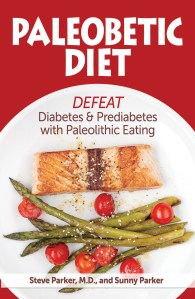
Paleobetic Diet-FrontCover_300dpi_RGB_5.5x8.5

Grant Schofield Defends the Paleo Diet for Diabetes

shutterstock_253272682

Schofield is a Professor of Public Health at Auckland University of Technology and Director of the Human Potential Centre. Prof. Sofianos Andrikopoulos authored an anti-paleo diet editorial in the Medical Journal of Australia.

Schofield penned a rebuttal at Sciblogs. A sample:

“The paleo diet – the idea that we should be guided in human nutrition/public health nutrition by evolutionary history is steeped with controversy. Health experts and authorities are seemingly going well out of their way to make sure people are warned off such ways of eating.

Proponents are often mystified by this, because the idea of using human evolutionary history to understand human function is common in human biology. In fact its a guiding principle. As well, in the midst of a chronic disease epidemic, including diabetes and obesity which are potentially improved by this approach, you’d think approaches which are based on whole food eating, and appeal to at least some of the population would be welcomed.

I find it curious that other approaches such as vegetarianism, which are often based not around science, but religion and other beliefs are welcome in public health nutrition advice. Yet the paleo approach is not.

Yes, people who are follow this way of eating are restricted to eating much less processed food and often lower carbohydrate diets. Neither of these approaches are known to be anything but beneficial for human health, especially in the context of diabetes.”

Source: Sciblogs | Anti-paleo diet attacks miss the point Read the whole thing.

Steve Parker, M.D.

No degludec up in here!

Available worldwide

President of Australian Diabetes Society On Paleo Diet for Diabetics: Don’t Do It

Really?

Really?

From SBS.com:

“People with type 2 diabetes should ditch the paleo diet until there’s substantial clinical evidence supporting its health benefits, warns the head of the Australian Diabetes Society.

It may be popular among celebrities but there’s little evidence to support the dozens of claims it can help manage the disease, says Associate Professor Sof Andrikopoulos.

“There have been only two trials worldwide of people with type 2 diabetes on what looks to be a paleo diet,” he said.

“Both studies had fewer than 20 participants, one had no control diet, and at 12 weeks or less, neither study lasted long enough for us to draw solid conclusions about the impact on weight or glycemic control.”

In a paper for the latest issue of the Australian Medical Journal, Andrikopoulos recommends people with type 2 diabetes seek advice from their GPs [general practitioners], registered dietitians and diabetes organizations.”

Source: Diabetics should put paleo on hold: expert | SBS News

I disagree with Prof. Andrikopoulos. We have adequate evidence to support a paleo-style diet for people with diabetes. I review it in 32 pages of my book. If you want to see the evidence right now, search this site for key words: O’Dea, Lindeberg, Jonsson, Frasetto, Ryberg, Mellberg, Boers, and Masharani.

If you seek diet advice from your general practitioner, endocrinologist, registered dietitian, and diabetes organizations, you’ll likely be told to eat too many carbohydrates, including processed man-made foods, which will wreck your glycemic control. The drug companies and medical-industrial complex will benefit at your expense.

Steve Parker, M.D.

No degludec up in here!

Front cover

Don’t Do It: Exercise Promotes Cancer

Needs a bit more hormetic stress

“Would you spot me, bro?”

I’ve always assumed that exercise reduces the risk of cancer, contributing to the well-established fact that folks who exercise live longer than others.

But a recent study found a positive association between exercise and two cancers: melanoma and prostate.

The good news is that exercise was linked to lower risk of 13 other cancers.

Here’s a quote for the New York Times Well blog:

The researchers found a reduced risk of breast, lung and colon cancers, which had been reported in earlier research. But they also found a lower risk of tumors in the liver, esophagus, kidney, stomach, endometrium, blood, bone marrow, head and neck, rectum and bladder.

And the reductions in risk for any of these 13 cancers rose steeply as people exercised more. When the researchers compared the top 10 percent of exercisers, meaning those who spent the most time each week engaging in moderate or vigorous workouts, to the 10 percent who were the least active, the exercisers were as much as 20 percent less likely to develop most of the cancers in the study.

I’m surprised the protective effect of exercise against cancer wasn’t stronger.

Action Plan

So how much physical activity does it take to prevent cancer? And what type of exercise? We await further studies for specific answers.

I’m hedging my bets with a combination of aerobic and strength training two or three times a week.

Steve Parker, M.D.

PS: If you think cancer’s bad, read one of my books. Wait, that didn’t come out right.

PPS: Men with diabetes seem to be less likely than average to get prostate cancer.

Olive Oil Helps Control After-Meal Blood Blood Sugars

Steve Parker MD, Advanced Mediterranean DIet

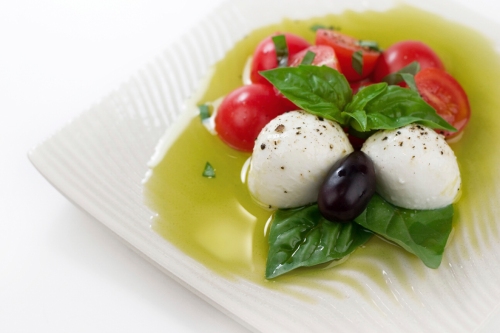
Naturally low-carb Caprese salad: non-paleo mozzarella cheese, tomatoes, basil, extra virgin olive oil

Italian researchers found that extra-virgin olive oil taken with meals helps to reduce blood sugar elevations after meals in type 1 diabetics. This may help explain the lower observed incidence of diabetes seen in those eating a traditional Mediterranean diet, which is rich in olive oil.

Before going further into the weeds, remember that glycemic index refers to how high and quickly a particular food elevates blood sugar. High-glycemic index foods raise blood sugar quicker and higher compared to low-glycemic index foods.

The study at hand is a small one: 18 patients. They were given both high- and low-glycemic meals with varying amounts and types of fat. Meals were either low-fat, high in saturated fat (from butter), or high in monounsaturated fat from olive oil. Meals that were high-glycemic index resulted in lower after-meal glucose levels if the meal had high olive oil content, compared to low-fat and butter-rich meals.

If meals were low in glycemic index, blood sugar levels were about the same whether the diet was low-fat, high in saturated fat, or rich in olive oil.

I don’t know if results of this study apply to those with type 2 diabetes. Probably, but uncertain. (google it!)

Action Plan

If you have type 1 diabetes and plan on eating high on the glycemic index scale, reduce your blood sugar excursions by incorporating extra-virgin olive oil into your meals.

Steve Parker, M.D.

PS: No olive trees were killed to produce my book.

Reference: Bozzetto, Luigarda, et al. Extra-virgin olive oil reduces glycemic response to a high-glycemic index meal in patients with type 1 diabetes: a randomized controlled trial. Diabetes Care, online before print, February 9, 2016. doi: 10.2337/dc15-2189


Fire and Human Evolution

Richard Wrangham figures our hominin ancestors tamed fire and started cooking with it 1.8 million years ago. Other authorities date our mastery of fire from 12,000 to 400,000 years ago.

From the New York Times:

“When early humans discovered how to build fires, life became much easier in many regards. They huddled around fire for warmth, light and protection. They used it to cook, which afforded them more calories than eating raw foods that were hard to chew and digest. They could socialize into the night, which possibly gave rise to storytelling and other cultural traditions.

But there were downsides, too. Occasionally, the smoke burned their eyes and seared their lungs. Their food was likely coated with char, which might have increased their risk for certain cancers. With everyone congregated in one place, diseases could have been transmitted more easily.”

Source: Smoke, Fire and Human Evolution – The New York Times