What’s the Paleobetic Diet?

Two years ago, a few of my patients with diabetes asked me whether the paleo diet would help with management of their diabetes. After much deliberation, I can definitely say, “Yeah, maybe.”

We still don’t have much scientific data to back it up, but I’ve seen enough to convince me it would be adequately safe to try a paleo-style diet under medical supervision. The greatest immediate risk is hypoglycemia in those taking certain drugs.

Regardless of diet, diabetics are at risk for hypoglycemia if they use any of the following drug classes. Also listed are a few of the individual drugs in some classes:

  • insulins
  • sulfonylureas: glipizide, glyburide, glimiperide, chlorpropamide, acetohexamide, tolbutamide
  • meglitinides: repaglinide, nateglinide
  • pramlintide plus insulin
  • exenatide plus sulfonylurea
  • possibly thiazolidinediones: pioglitazone, rosiglitazone
  • possibly bromocriptine

I’ve just finished a handout for my patients interested in a paleo diabetic diet. If interested, click for details.

Steve Parker, M.D.

PS: The paleo diet is also referred to as the Paleolithic, Stone Age, Old Stone Age, cavemen, ancestral, and hunter-gatherer diet.
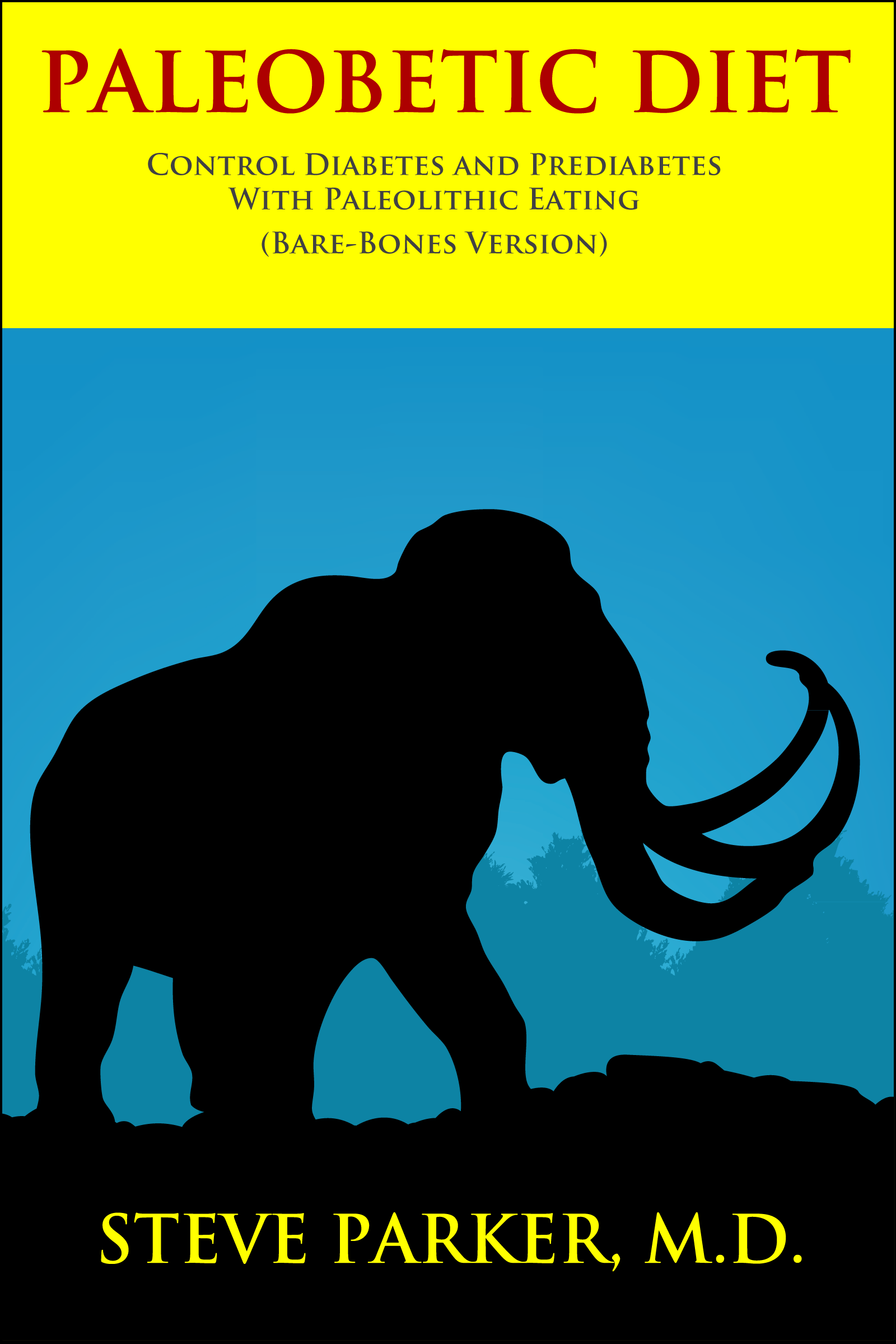
Paleobetic diet, Steve Parker MD,paleo diet, diabetic diet, diabetes

Cover of the fleshed-out ebook at Smashwords

Who Invented Clothes?

Archeologist Suzi Gage suggests the answer in an article at The Guardian:

Quite astonishingly, there is physical evidence that Neanderthals more than 100,000 years ago were tanning animal skins – a stone tool from the site of Neumark-Nord in Germany has preserved scraps of organic material stuck to it that were soaked in tannin, the substance in oak bark used to make leather. It was probably part of the tool handle that got wet while the hides were being worked.

DNA from lice indicate that our ancestors wore clothes as long as 170,000 years ago.

Read the rest.

Meet The Paleo Hygienist

I just discovered Debbie the Paleo Hygienist and thought you might be interested. Debbie had left a comment at Dr. Cate’s blog post on flossing (Dr. Cate’s NOT a flosser). From Debbie’s “About” page:

I created this website, for both dental professionals and patients, to discuss oral health issues from a holistic health/nutrition/Paleo perspective.  After discovering and converting to a Paleo diet, I believe it is the optimal diet for oral and systemic health.  My overall goal is to bring fresh ideas to the table to spur new ways of thinking when it comes to the dental-systemic health connection, which I feel is much needed in our industry.

After obtaining my dental hygiene degree from Clark College in Vancouver, WA I started out in general dentistry, but soon moved to a periodontal practice where I have been a periodontal hygienist since early 2008.  Prior to dental hygiene, I obtained my BS degree in Community Health Education with a minor in Anthropology from Western Washington University.  I have always been passionate about health and nutrition and this site is the perfect opportunity for me to combine my knowledge of oral health with my passion for nutrition in order to help others achieve not only optimal oral health, but overall health as well!

Debbie is one of the most intellectual and science-oriented dental hygienists I’ve ever run across. I hope you benefit from her expertise.

-Steve

PS: I still floss. My wife doesn’t, but uses a water-jet device that may be just as good, assuming flossing’s good. She had a close friend die of endocarditis, and one of the doctors on the case speculated suggested that flossing was the cause.

Eva Twardokens on Teeth Whitening, Amalgam Fillings, Wisdom Tooth Extractions, and More

See her Part 3 article at Whole9Life.com. For example:

The priority with whitening should come after health is established. Then, whitening is appropriate, kinda. Zoom whitening is for instant-gratification folks with money to burn. If you are going to whiten your teeth, first just buy some Crest White Strips (around $40) and see how you like the result. If they work, you’re done. If not, you may invest in professional trays and bleach (around $400). The chemicals in these products are mostly the same, and the Zoom (not so magical) light simply adds the factor of heat, which we all know quickens chemical reactions.

There are really not many long term studies on what bleach does to your teeth, and the industry assumes it is pretty safe. Just know that if you are in the process of whitening your teeth, stay away from chromogenic foods like blueberries, red wine, and coffee. You can really embed that stain into your teeth if you do it along with a series of whitening.

Australian Aboriginal Lifestyle Soon To Disappear

Australian Aborigine in Swamp Darwin

Australian Aborigine in Swamp Darwin

I wrote previously about O’dea’s study on Australian Aboriginals and their improvement in diabetes following a return to their ancestral lifestyle and diet.

National Geographic has an article on the vanishing Aboriginal lifestyle. Among other things, you’ll learn how to catch and cook a sea turtle.

The Aboriginals had Australia to themselves before Captain James Cook landed on the continent in 1770. Now they’re less than three percent of the population.

Read the rest.

Type 1 Diabetic Notes Improvement On Paleo Diet

Type 1 PWD (person with diabetes) AllisonN wrote about her one-month paleo diet trial at DiabetesMine. The paleo diet version she followed was the Whole30 program, with which I’m not terribly familiar. Some quotes:

3. I have the best control in recent memory, but it’s not perfect. Like anything that involves tweaking and adjustments, the Paleo diet is hardly a cure. Now that I’m taking less insulin, there are fewer chances for me to go low, and more chances for me to go high. You can never expect anything — not a diet, not a medication, not an insulin pump — to run the show for you.

4. If you eat low-carb, you have to bolus for protein. This was the biggest shock for me. After querying my friends, I discovered that bolusing for approximately half the protein is what I need to do to prevent a post-meal spike. Gary Scheiner, author and CDE at Integrated Diabetes Services, explained, “Since your Central Nervous System needs glucose to function, if your diet is lacking in carbs, the liver will convert some dietary protein into glucose.  So it is usually necessary to bolus for some of your protein whenever you have a meal that is very low in carbs.” For me, a low-carb meal is anything under 30 grams of carbs.

***

One thing that I kept thinking about during my month-long Paleo experiment was how much of diabetes really is an experiment anyway. Think about how often we have to try out different things to see what works: Changing up bolus ratios and basal rates. Fiddling with different temp basals or snack choices before working out. Alternating what we eat for breakfast. While the Paleo diet may not be for everyone, I wholeheartedly believe that if what you’re doing currently isn’t giving you the results you want, maybe you should consider starting another experiment!

AllisonN wrote that the paleo diet hasn’t been studied scientifically in people. That’s not accurate. A handful of studies have been done, even involving people with diabetes. Search this site and you’ll find them. In addition, Lynda Frassetto’s study at University of California-San Francisco should be published later this year.

Read AllisonN’s post.

Shouldn’t We Be Vegans or Vegetarians?

I ran across some nutrition-advice videos of Dr Michael Greger six months ago and started following him at Twitter.  It soon became clear he favors a vegan or vegetarian diet.  Dr. Harriet Hall at Science-Based Medicine has Dr. Greger in her crosshairs, challenging many of his claims.  Well worth a read.  An excerpt:

Vegans tell us the Inuit, who lived almost exclusively on food of animal origin, had a short life span. That’s not true. Statistics on the Inuit between 1822 and 1836 showed that their average life expectancy was about the same as that of European peasants of the time who ate a diet overwhelmingly based on bread. 25% of Inuit lived past 60, and some lived into their 80s and 90s.

Anastasia on Resistant Starch

Primalmeded physician Anastasia has started a series on resistant starch. I’m still trying to get the definition into my thick skull. Anastasia offers this one:

The official website named Resistantstarch.com – An Information Portal for Health Professionals (don’t you wish that broccoli had an official website?), gives us this definition:

”Resistant starch is the sum of starch and products of starch digestion not absorbed in the small intestine of healthy individuals”

It is also classified as the third type of fibre (together with soluble and insoluble) by several health agencies, including Food Standards Australia and New Zealand, and its MO [modus operandi] is to bypass the normal absorption process in the small intestine straight to the colon where it is fermented by colonic bacteria (which also makes it a “prebiotic”).

Read the whole enchilada.


Exercise Frequency: Are Two Sessions a Week as Good as Six?

exercise for weight loss and management, dumbbells

If you’re not familiar with weight training, a personal trainer is an great idea

Weight Maven Beth Mazur  found evidence in favor of the fewer days, at least in post-menopausal women.

I don’t like to exercise.  Too often I find excuses to avoid even my twice weekly 40-minute workouts.

You may well have good reasons to exercise every day.  Maybe you’re a competitive athlete or enjoy exercise.  If you just want the health benefits of exercise, I’m increasingly convinced that twice a week is enough.

The Road to Dental Health

Whole9 is publishing a two-part series on dental health written by Eva Twardokens.  Part 1 covers:

  • finding a dentist
  • scheduled professional teeth cleaning
  • baseline x-rays
  • night guards
  • flossing

Click for Part 1.

Stay tuned for Part 2 covering periodontal disease, fluoride, dental materials, mouthwash, insurance, and ZOOM whitening.